His Daughter Told Him to “Hold On a Few More Years” So She Could Inherit the House — Then 23 Bikers Changed His Will Forever
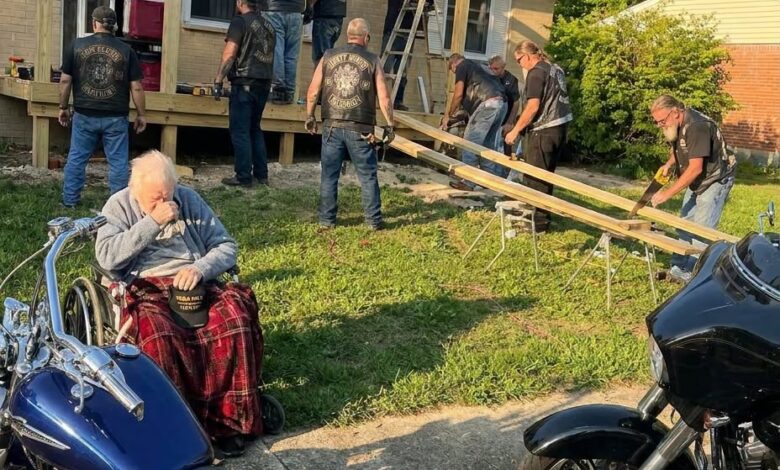
Jennifer stood in her father’s yard screaming into her phone that gang members were modifying her property while twenty-three bikers rebuilt the porch her ninety-one-year-old father had been falling through for three years. I watched from my kitchen window as the officer arrived, looked at the scene, and told Jennifer to leave before he arrested her for elder neglect. My name is Margaret, and I have lived next door to Harold Peterson for thirty-two years. I watched his children grow up in that house, watched his wife Martha die of cancer, and watched three successful adults refuse to spend a single dollar on the father who raised them. Harold’s pension was $1,100 a month. His savings held $837. The porch repair estimate was $15,000. His son drove a Tesla. His daughter sold million-dollar homes. His youngest couldn’t be bothered to return a phone call. And not one of them lifted a finger while their father cried on a collapsing porch holding his dead wife’s photograph.
Harold spent forty years as a carpenter who never overcharged and never turned away someone who needed help. He built handicap ramps for disabled veterans, repaired porches for single mothers, and once drove four hours to fix a church roof because the congregation couldn’t afford a contractor. When the city sent condemnation notices about his collapsing porch, Harold called each of his three children. Michael, a banker, told him to check into a nursing home. Jennifer, a real estate agent, told him the house was worth more as a teardown and suggested he “hold on a few more years” so they could handle everything after he was gone. She said that to her father’s face — a ninety-one-year-old Navy veteran in a wheelchair. David, the youngest, sent a text saying he was busy and never followed up. Three children within fifty miles. Combined net worth over $3 million. Total contribution to their father’s survival: zero.
I walked to the Wheelers MC clubhouse on a Saturday morning because Harold was going to die from either falling through his porch or from the heartbreak of being abandoned. A man named Tom answered, and when I said Harold’s name, his entire body changed. Tom’s father was Roger Williams, a disabled Korean War veteran who Harold had built a handicap ramp for in 1987 at half price. Within two hours, twenty-three bikers arrived with donated lumber, tools, and decades of skill. They rebuilt everything — wheelchair ramp, railings, lighting, new door, roof leak, fresh paint. When Jennifer called police and Michael threatened lawsuits, a biker named James calmly identified himself as an attorney specializing in elder law and asked Michael whether he’d like to discuss criminal neglect charges on the record. Michael got back in his Tesla and drove away without another word. But the real devastation came three weeks later when Harold called his own attorney — and what he put in his new will made everything his children had been waiting for completely worthless.
Harold changed his will and left everything — the house, the property, his pension survivor benefits, and the life insurance policy his children had been quietly counting on — to the Wheelers MC Veterans Fund. His attorney confirmed the document was properly witnessed, notarized, and structured to withstand any challenge. When Michael discovered the change through a legal inquiry he had filed about the property’s future value, his own lawyer advised him that contesting the will would fail and would expose years of documented neglect in open court. Jennifer hired an attorney to pursue a conservatorship, arguing Harold was mentally unfit to manage his finances, but Harold’s physician provided a letter confirming full cognitive competency, and James filed a counter-motion documenting three years of the children refusing to maintain safe living conditions for a disabled veteran. The conservatorship attempt was dismissed in two weeks. Harold sat on his new porch that evening in the leather jacket the bikers had given him and told me quietly, “My children decided I was already dead. These bikers reminded me I’m still alive. So I gave my future to the people who earned it.”
Two weeks after the will was changed, a car pulled into Harold’s driveway and a young woman stepped out with two small children. It was Sarah — Michael’s daughter — who had seen a local news story about the porch rebuild. She stood in the yard crying and said her father had told her Harold was in a nursing home and didn’t want visitors. Harold held his great-grandchildren for the first time on a porch built by strangers who remembered his kindness better than his own family did. Sarah visits every Sunday now. Her children call the bikers “the leather grandpas.” The Wheelers set up a daily schedule — someone checks on Harold every morning, brings groceries, mows the lawn, and fixes whatever needs fixing. On his ninety-second birthday, three hundred people came, and Harold gave a speech that silenced the entire room: “These men, who society tells us to fear, showed me more love than my own blood. They fixed my porch but saved my soul.” Jennifer still drives by sometimes but never stops — she just slows down long enough to look at what strangers built for the father she told to hurry up and die. Harold wheels onto that porch every morning, waves at the neighborhood, and smiles. Because twenty-three men in leather vests proved what his own children never understood: family is not who inherits your house. Family is who fixes it while you’re still alive.