My Son Left Me at the ER and Flew to Cancún During My Heart Attack — Then a Nurse Handed Me a Phone
The emergency room doors opened at 7:15 on a Tuesday morning and I walked through them alone, because my son had a flight to catch. Danny didn’t park. He didn’t turn off the engine. He leaned across the passenger seat of the SUV I helped him buy and said, “Text me when they discharge you, Pop — Uber home, there’s forty bucks on the counter,” and then he drove to the airport and flew to Cancún while a triage nurse looked at my blood pressure, went pale, and called a code that put five people around my chair. I remember the ceiling tiles moving past. I remember a doctor saying “cath lab” and “right now.” I remember thinking, absurdly, that I should text Danny like he asked, so he wouldn’t worry. Two stents went into my heart that afternoon. The hospital called my son eleven times over three days. He answered none of them. And on the third night, a nurse named Priya came into my room pushing a phone cart, with a look on her face I hadn’t seen since my wife was alive — the look of a woman who has made a decision — and said, “Mr. Alvarez, there’s someone you need to talk to. And I need you to stay calm.”
I raised Danny alone from the time he was nine, after his mother passed, and I did it the only way I knew: thirty-eight years driving a delivery truck, a second job at a warehouse on weekends, lunches packed at 4:40 every morning. When he and Brianna wanted a house in 2019, I gave them $61,000 from my retirement for the down payment, and I’d do it again — that part I don’t regret. What I regret is 2024, when they sat me at their kitchen table and convinced me to sell my little two-bedroom on Curtis Street, the house where Danny grew up, because “you shouldn’t be alone at your age, Pop.” The sale brought $214,000. Danny said he’d “invest it” for me and handle the paperwork, and I signed what he put in front of me, because he’s my son. The in-law suite turned out to be a basement room next to the water heater. My Social Security started going to “household expenses.” My truck got sold. The warning signs were a staircase I walked down one step at a time, telling myself each step was normal, until the morning my chest turned to concrete and my own son sighed at me over his coffee because I was inconveniencing his vacation.
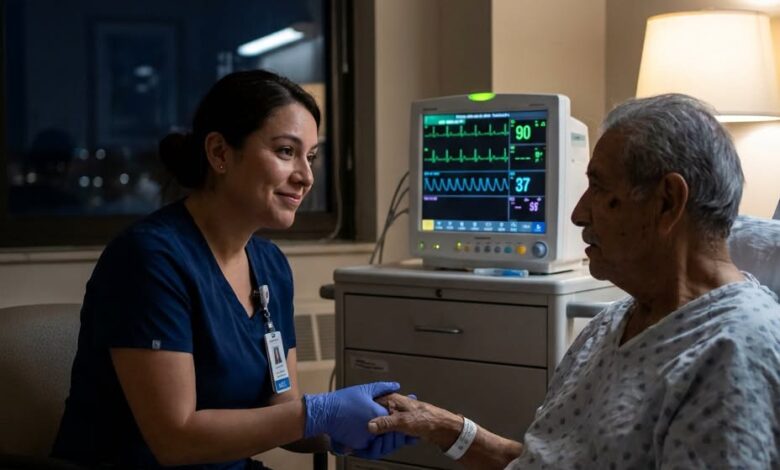
Priya was the night nurse on the cardiac floor, and by day two she had stopped pretending she wasn’t angry on my behalf — she’d seen the call log, eleven unanswered attempts, and she’d seen me lie about it, telling day staff my son was “traveling for work.” On the third night she wheeled in the phone cart, and the voice on the other end belonged to a woman named Carol from the county recorder’s office — Priya’s own mother, as it turned out, thirty-one years in that office — because when Priya heard me mention the house sale and the “investing,” something in her gut had itched, and she’d asked her mother to look up one public record as a favor. Carol’s four words came through the receiver very gently: “Sir, who is Brianna?” Because the deed history showed my $214,000 hadn’t been invested anywhere. Eight days after my closing, the full amount had gone into the purchase of a rental property on the east side of town — a duplex, bought in cash — and the name on that deed wasn’t mine, and it wasn’t even Danny’s. It was Brianna’s, alone. My monitor started beeping fast enough that Priya took the phone from my hand, and while she talked me back down to a safe rhythm, breathing with me the way she had at 3 a.m. the night before, she said the sentence that started everything that came after: “Mr. Alvarez, my mother says you need an attorney. And my brother-in-law happens to be one who takes cases like yours for free.”
The attorney’s name was Sam, and he sat by my hospital bed on the morning of my discharge — Danny still hadn’t called — with a legal pad and a level voice, explaining words I’d never had reason to learn: fiduciary duty, financial exploitation of an elder, constructive trust, conversion of assets. The paperwork I’d signed at their kitchen table had given Danny a limited power of attorney “for the house sale,” and he had used it to sign my proceeds check over in a way no court would ever bless. Sam filed within two weeks. The court froze the duplex with a lis pendens so it couldn’t be sold or borrowed against, subpoenaed the closing records, and traced every dollar of my $214,000 from my sale into Brianna’s cash purchase — a paper trail so clean Sam called it “a gift.” Danny came home from Cancún to a certified letter and, for the first time in three years, called me nine times in one day. His attorney initially claimed the money had been “a gift from a loving father.” Then Sam produced the escrow instructions where Danny had described the funds, in writing, as “held for my father’s care.” The case never saw a trial. Facing a judge, a forensic accountant’s report, and the very real possibility of a criminal referral for elder financial abuse, they settled: the duplex signed over to me in full, my Social Security payments returned, and their attorney’s careful language about how everyone “regretted the misunderstanding.” A misunderstanding. Eleven phone calls, and two stents.
I live in the duplex now — upstairs unit, big windows, morning sun — and my downstairs tenant is a young nursing student who reminds me of someone, and pays her rent in casseroles half the time, which suits me fine. Danny and I speak, a little, carefully, the way you walk on a leg that was broken and set crooked; Brianna and I do not, and I’ve made peace with that. Every few weeks Priya comes by on her day off with her kids, and we sit on the porch and I tell them stories about driving trucks through blizzards while she rolls her eyes and checks my pulse without asking, because that’s who she is. People keep telling me I got justice, and I suppose the deed in my drawer says I did. But justice isn’t what I think about at night. What I think about is that at the lowest hour of my life, at 3 a.m. with a jumping heart monitor and no family in the waiting room, a stranger held my hand and said “you’re not alone, not on my floor” — and meant it. Blood makes you related. Showing up is what makes you family.