Heartless Daughter Told Her 91-Year-Old Father to “Hurry Up and Die” So She Could Inherit the House—Then 23 Bikers Delivered Brutal Justice
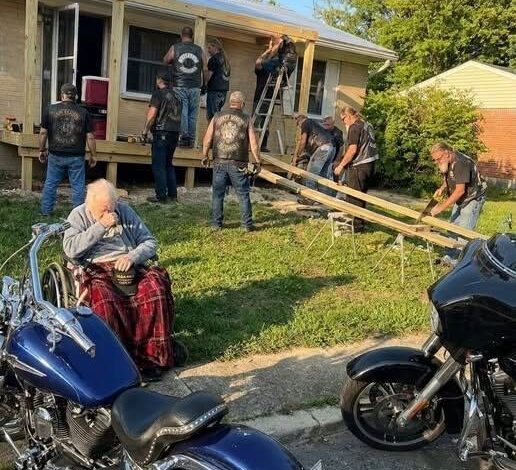
Jennifer stood in her elderly father’s front yard, shrieking into her phone about “gang members” defacing her future property, all while twenty-three burly bikers diligently rebuilt the crumbling porch that her ninety-one-year-old father had been dangerously falling through for three years. I watched from my kitchen window as a police officer arrived, took one look at the scene, and immediately ordered Jennifer to leave the premises before he arrested her for elder neglect. My name is Margaret, and I have lived next door to Harold Peterson for thirty-two years. I have watched his children grow into successful adults, yet I have also watched them refuse to spend a single dime on the man who raised them.
Harold spent forty years as a master carpenter. He was a man who never overcharged, never turned away a neighbor in need, and lived a life of quiet service. He built handicap ramps for disabled veterans, repaired porches for struggling single mothers, and once drove four hours just to fix a church roof for free because the congregation couldn’t afford a contractor. Now, in his twilight years, his pension was a modest $1,100 a month, and his savings had dwindled to $837. When the city finally issued condemnation notices regarding his unsafe, collapsing porch, Harold turned to his three children for help.
The response was a masterclass in cruelty. Michael, a wealthy banker who drives a high-end Tesla, told his father to just check into a state nursing home. Jennifer, a real estate agent who makes her living selling million-dollar homes, told him the house was worth more as a vacant teardown and suggested he “hold on a few more years” so they could handle the estate after he was gone. She said that directly to her father’s face—a decorated Navy veteran sitting helplessly in a wheelchair. David, the youngest, couldn’t even be bothered to call, merely sending a dismissive text that he was “too busy” to deal with it. Between the three of them, they boasted a combined net worth of over $3 million, yet their total contribution to their father’s safety and survival was exactly zero.
I knew Harold was reaching a breaking point; he was going to die either from a catastrophic fall through his own rotting floorboards or from the sheer, crushing heartbreak of being abandoned by his own blood. On a Saturday morning, I walked to the local Wheelers MC clubhouse. I simply mentioned Harold’s name to a man named Tom, and his entire demeanor shifted. It turned out Tom’s father was Roger Williams, a disabled Korean War veteran whom Harold had helped decades prior by building him a custom handicap ramp for half price. The debt of gratitude was paid back in full within two hours.
Twenty-three bikers descended on Harold’s home with donated lumber, high-end tools, and decades of professional craftsmanship. They didn’t just fix the porch; they built a new wheelchair ramp, installed sturdy railings, improved the lighting, replaced the rotted front door, fixed a persistent roof leak, and gave the entire house a fresh coat of paint. When Jennifer tried to involve the police and Michael threatened us with frivolous lawsuits, a biker named James—who happened to be a high-powered attorney specializing in elder law—calmly asked Michael if he would like to discuss criminal elder neglect charges on the public record. Michael didn’t say another word; he simply climbed into his Tesla and sped away.
The real devastation for the greedy children came three weeks later. Harold called his attorney and fundamentally changed his will, disinheriting his children entirely. He left his house, his property, his pension survivor benefits, and the life insurance policy his children had been counting on to the Wheelers MC Veterans Fund. His lawyer ensured the document was bulletproof, notarized, and structured to withstand any legal challenge. When Michael tried to file a legal inquiry regarding the property’s future value, his own legal counsel advised him that contesting the will would be disastrous. It would expose years of documented neglect and abuse in an open court, effectively destroying their reputations and careers.
Jennifer even attempted to file for a conservatorship, baselessly claiming Harold was mentally unfit to manage his affairs. That effort was dismissed in less than two weeks when Harold’s physician provided documentation of his full cognitive competency, and James filed a devastating counter-motion detailing the children’s history of abandonment. That evening, Harold sat on his beautiful, safe new porch wearing a leather jacket the club had gifted him. He looked at me and said quietly, “My children decided I was already dead. These bikers reminded me I’m still alive. So, I gave my future to the people who earned it.”
A glimmer of redemption arrived shortly after when Sarah, Michael’s daughter, saw a local news report about the project. She drove to the house with her two small children, sobbing as she realized her father had lied to her for years, telling her that Harold was in a nursing home and didn’t want visitors. Harold held his great-grandchildren for the first time on the porch his own son had refused to fix. Sarah now visits every Sunday, and her children affectionately call the bikers “the leather grandpas.”
The Wheelers have established a daily support rotation, ensuring Harold has groceries, a mowed lawn, and constant companionship. On his ninety-second birthday, three hundred people crowded into his yard to celebrate a man who had finally found the family he always deserved. Jennifer still drives by the house sometimes, but she never stops. She just slows down long enough to gape at what strangers built for the father she told to hurry up and die. Harold just waves, smiles, and wheels onto his porch, finally understanding that family isn’t determined by blood or inheritance—family is found in the people who show up to fix your life while you’re still alive to appreciate it.