How FIFA’s Folarin Balogun Decision Sparked Debate as Donald Trump Praised the Outcome
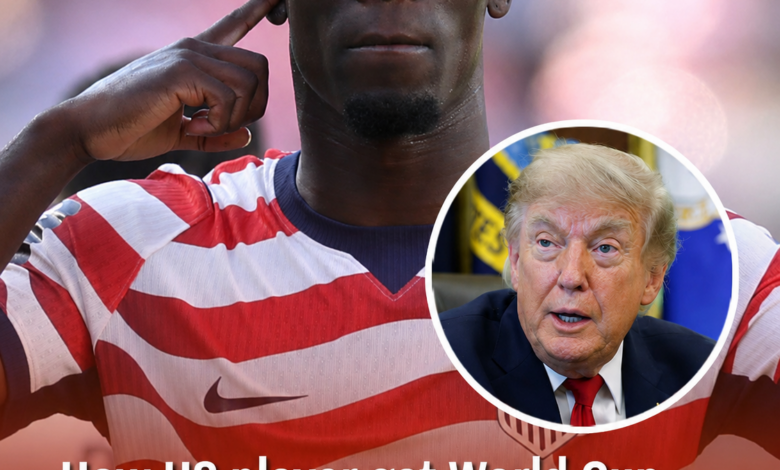
The FIFA World Cup has delivered unforgettable football, dramatic finishes, and no shortage of controversy. While fans around the globe have celebrated thrilling matches, several off-the-pitch decisions have generated intense discussion among players, coaches, and supporters. One of the biggest talking points involves the decision surrounding United States striker Folarin Balogun and his eligibility for a crucial knockout match.
Balogun has been one of the standout performers for the United States throughout the tournament. His pace, movement, and finishing ability have helped the American side reach the knockout rounds, making him one of the team’s most important attacking players. Losing him for any match would have been a significant setback.
During the Round of 32 victory over Bosnia and Herzegovina, Balogun was shown a red card following a challenge that was reviewed by the Video Assistant Referee. Initially, the on-field referee allowed play to continue before changing the decision after reviewing the incident on the pitch-side monitor.
As is normally the case in international football, a straight red card carries an automatic suspension for the following match. Many fans expected Balogun to miss the United States’ upcoming Round of 16 showdown against Belgium, believing the disciplinary process would follow its standard course.
Instead, FIFA announced that the implementation of Balogun’s suspension would be suspended under provisions within its disciplinary regulations. The decision immediately became one of the tournament’s biggest controversies, with supporters, analysts, and former officials debating whether the ruling was justified.
According to multiple reports, U.S. Soccer questioned the VAR process that led to the dismissal. Their reported argument centered on how video replays were used during the referee’s review and whether the protocol had been applied correctly under FIFA’s own guidelines.
Several football analysts also weighed in on the incident. Some argued that slow-motion footage can sometimes exaggerate the appearance of contact and should only be used to identify the point of impact rather than determine intent or the severity of a challenge.
Others maintained that once the referee viewed the available footage, issuing a red card became the expected outcome. The differing opinions only fueled further debate across television broadcasts, social media, and football discussion forums around the world.
The controversy quickly expanded beyond football circles after reports claimed the issue had attracted attention from political figures in the United States. Those reports suggested senior officials were aware of the situation as discussions over the disciplinary decision continued.
Former U.S. President Donald Trump later publicly welcomed FIFA’s decision after Balogun became eligible to play. Posting on his social media platform, Trump described the outcome as correcting what he believed was an unfair decision, drawing even more attention to the story.
His comments spread rapidly online, with supporters and critics sharing their own opinions. While some praised his reaction, others questioned whether politics should become involved in football matters, especially during the world’s biggest sporting event.
Belgium’s football federation reacted strongly after learning Balogun would be available for the knockout fixture. Officials expressed surprise over the ruling and questioned how it aligned with the competition’s disciplinary regulations regarding automatic suspensions.
The federation argued that consistency is essential in tournaments where every team is expected to compete under the same rules. They also indicated they were reviewing their available options following FIFA’s announcement.
Football fans were equally divided. Some believed FIFA had acted appropriately by reviewing a potentially flawed disciplinary process, while others argued that changing the punishment created confusion and raised questions about fairness.
The situation highlighted how influential VAR has become in modern football. Designed to reduce clear and obvious errors, the technology continues to divide opinion whenever controversial decisions affect major matches.
Many former referees pointed out that VAR remains one of the sport’s most challenging topics. While technology can improve accuracy, the interpretation of incidents still depends on human judgment, meaning disagreements are almost inevitable.
The debate also brought renewed attention to FIFA’s disciplinary code. Although automatic suspensions are standard following direct red cards, the organization maintains certain powers under its regulations regarding disciplinary enforcement.
Beyond the Balogun case, this year’s tournament has featured several rule adjustments designed to improve the pace of matches. Changes involving substitutions, time management, and expanded VAR responsibilities have all generated discussion among players and supporters.
Some football experts believe the modern game is entering a new era where technology and regulations will continue evolving together. As football grows globally, governing bodies face increasing pressure to ensure decisions remain transparent and consistent.
For the United States, the focus quickly shifted back to preparing for Belgium. With Balogun available once again, the coaching staff regained one of its most dangerous attacking weapons heading into a critical knockout encounter.
Belgium, meanwhile, prepared for a significantly different challenge than originally expected. Facing a full-strength American attack required adjustments in both tactical planning and defensive organization ahead of kickoff.
Regardless of opinions surrounding the decision, the controversy demonstrated how disciplinary rulings can sometimes become almost as significant as the football itself. Major tournaments often produce unforgettable moments both on and off the pitch.
As the World Cup progresses, FIFA will likely continue facing scrutiny over decisions that influence the outcome of important matches. Every ruling is closely examined by fans, players, coaches, and national football associations.
The Balogun decision will almost certainly remain one of the tournament’s defining controversies. Whether viewed as a fair correction or an unusual exception, it has become one of the most widely discussed stories of the competition.
With knockout football becoming increasingly intense, every decision carries enormous importance. Teams understand that a single referee’s call, VAR review, or disciplinary ruling can ultimately shape their World Cup journey.
Whatever the final verdict from football history, the discussion surrounding Balogun’s suspension has shown once again that the World Cup is about far more than goals alone. It is also a stage where rules, technology, and public opinion collide in front of a global audience.