My Twin Sister Vanished During a Church Retreat—Then I Opened My Mother’s Bible and Realized Our Entire Life Was a Lie
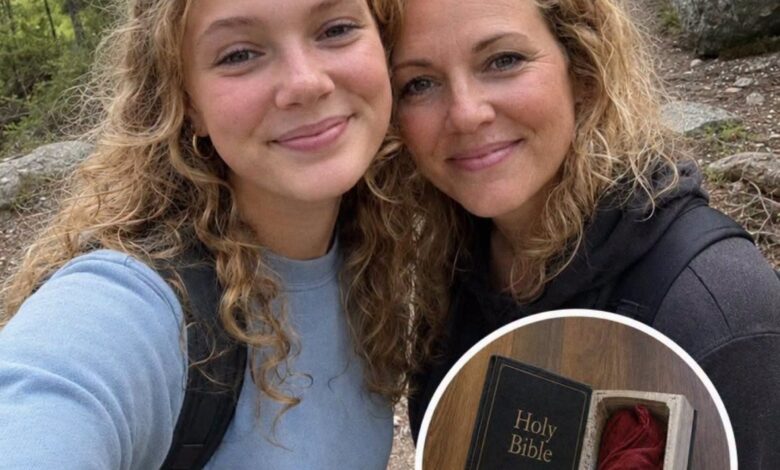
For a year, I lived in the shadow of my twin sister Hannah’s disappearance. She vanished during a church hiking retreat, and the official story was a tragic accident: she twisted her ankle, stepped aside, and was never seen again. I stayed home with a broken arm, left to wallow in the soul-crushing guilt of not being there to protect her. Then, my mother collapsed. While she was hospitalized, I grabbed her constant companion—a worn, heavy Bible she carried everywhere like a holy shield. When it tumbled from my hands, it hit the floor and split open. It wasn’t full of scripture; it was gutted, hiding a secret so explosive it shattered my reality.
The Bible had been meticulously carved out. Tucked inside the hollowed-out pages were stacks of cash, a church donation envelope, and a photo of a boy who looked exactly like me—my eyes, my jaw, my dark hair. Beneath it all was a note in Hannah’s handwriting. My sister wasn’t dead; she had been erased by the people who were supposed to love us most. As the pieces clicked into place, the grief I’d carried for twelve months transformed into a cold, blinding rage. My parents hadn’t lost a daughter; they had hidden one.
The retreat had been a curated stage for my father’s ministry, a routine event at a familiar lakeside lodge. When Hannah went missing, my father took to the pulpit with performative grace, turning our family’s nightmare into a sermon on “trusting the Lord in seasons of brokenness.” He whispered to everyone that Hannah was emotional and had run away, effectively silencing any real investigation. My mother became a hollowed-out ghost, clutching that Bible as if it held the only truth left in the world. I was the grieving brother, the one who should have been on that trail, never realizing that my mother wasn’t protecting Hannah’s memory—she was protecting a dark, institutionalized conspiracy.
The truth crawled out when I confronted my mother in her hospital bed. I threw the gutted Bible onto her lap, the photograph of the strange boy—Eli—sliding out. “Tell me she’s dead,” I demanded, my voice trembling. When she couldn’t, the dam broke. Eli was my father’s son from an affair, a secret he had been funding through the church benevolence committee—a committee my mother managed. Hannah had stumbled upon Eli at the retreat and overheard my father arguing with a church elder about the payments. She hadn’t been kidnapped by a stranger; she had been sacrificed to preserve my father’s reputation and the church’s financial image.
My mother confessed that she had been terrified. When Hannah threatened to tell the truth, my father panicked, and my mother, complicit and cowardly, orchestrated Hannah’s “disappearance” with the help of my aunt. They didn’t save her to protect her; they sent her away to ensure their own status remained untarnished. They let me suffer for a year, watching me waste away with self-blame, treating my grief like a convenient babysitter to keep me from asking the wrong questions.
I didn’t wait for permission. I sent the address found in the Bible to the local authorities and demanded a ride from a family friend who had been deeply suspicious of my father’s piety all along. The address led to a quiet house where I finally saw her. Hannah was alive, her hair shorter, her eyes older, living in the shadow of the secret she had discovered. When she opened the door, the year of silence evaporated in a single, gut-wrenching embrace. We were both sixteen when this happened—children who had been discarded by the adults we were taught to revere.
We didn’t just walk away; we chose to finish the sermon my father had started. That evening, I walked into the sanctuary during his Sunday service. The congregation was hushed, waiting for the usual hollow platitudes, but they didn’t get them. I took Hannah’s hand and led her down the center aisle. My father’s face went white, his performative mask slipping to reveal the sweating, desperate coward beneath.
“I didn’t disappear in the woods,” Hannah told the silent crowd, her voice steady and echoing against the vaulted ceiling. “I found out my father had another child and that church money was being used to keep it quiet.” I held up the bank envelopes and the records I had pulled from my mother’s Bible. The silence in the room was absolute, a heavy, suffocating weight that finally crushed the lies my father had built his life upon.
My mother sat in the back, trembling, finally forced to choose between her loyalty to a monster and the children she had failed. She confessed it all—every check signed, every lie whispered to the police, every night she looked at me and knew she was starving my heart to save her own skin. My father was stripped of his position before the service even ended, the elder was suspended, and the truth flowed out like poison from a wound.
In the aftermath, Hannah and I sat on a porch, miles away from the home that had become a prison. The relief wasn’t immediate; it was a slow, painful process of reconstructing identities that had been stolen. We had both been children, victims of a profound betrayal, but we were finally free of the narrative they had written for us. We decided that family wasn’t defined by the people who had orchestrated our isolation, but by the truth we had finally clawed back from the hollowed-out pages of a book that was never meant to be opened. The adults had tried to bury us in their secrets, but they forgot that the truth has a way of rising to the surface, especially when you stop asking permission to speak it.