The Meaning Behind A Boot On A Fence Post
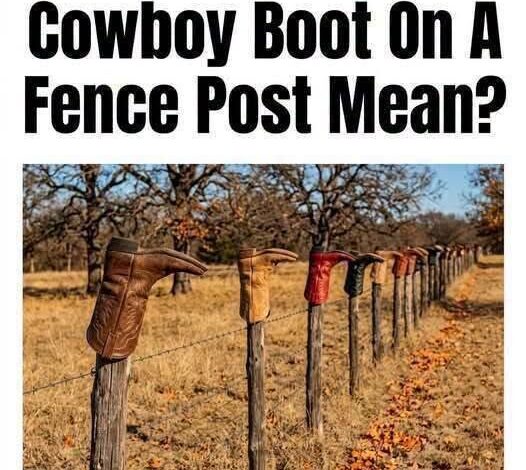
You’re driving along a quiet country road, the kind that stretches endlessly between open fields and weathered fences. There are no busy intersections, no towering buildings, only rolling farmland disappearing into the horizon beneath an enormous sky. The steady hum of your tires is the only sound breaking the silence. Then, almost without warning, something catches your eye. Perched carefully on the top of an old wooden fence post sits a single worn-out boot. It stands there alone, facing the road as though it has been waiting for you to notice it.
At first, you barely give it a second glance. Maybe someone lost it. Maybe it was tossed from the back of a passing truck. Perhaps it simply ended up there by accident. Yet as the miles pass, your mind refuses to let it go. Why only one boot? Why place it so carefully on the fence instead of leaving it on the ground? Why does it almost feel as if it’s trying to say something? It begins to resemble a message written in a language you don’t understand. Is it a warning? A memorial? A practical signal? Or simply an old joke meant to puzzle strangers forever?
The truth is that in many rural communities, a boot resting on a fence post is rarely just a random piece of trash. To people unfamiliar with country life, it may seem insignificant. But for those who have spent their lives working the land, every object often carries a story, and boots are no exception. They are more than footwear—they are faithful companions that endure years of long days, muddy fields, scorching summers, freezing mornings, and endless miles walked across pastures and dirt roads.
For many ranchers and farmers, an old pair of boots represents decades of hard work. Those boots have stepped through freshly plowed fields before sunrise, crossed streams during heavy rains, stood beside newborn calves, repaired broken fences, and endured seasons that changed both the land and the people caring for it. When the leather finally wears thin and the soles can no longer survive another day’s work, simply throwing them into the trash can feel almost disrespectful. Instead, some choose to place one or both boots on a fence post, giving them a quiet and dignified retirement overlooking the land they faithfully helped care for.
Sometimes that solitary boot becomes something even more meaningful. It may serve as a silent memorial for a rancher who spent a lifetime working those fields before passing away. Family members leave the boot standing proudly where everyone can see it, not because it replaces the person they lost, but because it reminds them that a part of that life still remains on the land. Every passing neighbor understands the message without a single word being spoken. The boot quietly says that someone lived here, worked here, and left behind memories that deserve to be remembered.
In other cases, the tribute is not for a person at all but for a trusted horse. Anyone who has spent years riding the same horse understands that the bond extends far beyond usefulness. Horses become partners, companions, and loyal friends through countless seasons of work. When one finally passes away, placing a boot on a nearby fence can honor the years they spent together. Every time the ranch gate swings open and someone notices that weathered boot, they remember the familiar sound of hooves that no longer echo across the pasture.
Not every fence-post boot carries sorrow, however. Country communities have always appreciated a good sense of humor. Some boots appear simply because someone wanted to make travelers smile or scratch their heads in confusion. A bright red cowboy boot, a glitter-covered high heel, or an old work boot painted in outrageous colors can transform an ordinary roadside fence into an unforgettable local curiosity. Visitors often slow down, wondering what unusual story might be hiding behind such an unexpected sight.
Over the years, some of these boots become local landmarks more reliable than modern navigation systems. Long before GPS guided every journey, directions were often based on memorable objects scattered throughout the countryside. Instead of street names and numbered exits, locals would simply say, “Drive until you see the old boot on the fence, then turn left at the next gravel road.” Generations of families followed those directions successfully because everyone knew exactly which boot they meant. While technology has advanced, many rural communities still use these familiar landmarks today because they are often easier to recognize than digital maps.
There are also practical reasons behind the tradition. On working farms and ranches, subtle signals often communicate information without requiring phone calls or lengthy conversations. A boot displayed on a fence post may quietly tell neighbors that the owner is home, that someone is out working nearby, or that visitors are welcome to stop in for coffee. In some places, it can indicate that equipment is already in use or that someone is tending livestock in distant fields. To outsiders it appears mysterious, but to locals the meaning may be perfectly obvious.
Because these traditions vary from one region to another, the exact meaning of a boot on a fence post is rarely universal. Its significance often depends on the family, the community, or even the individual who placed it there. That uncertainty is part of what makes the sight so fascinating. Every lonely boot invites questions, encouraging passing travelers to imagine the life behind it rather than simply driving past without noticing.
Perhaps that’s why the image stays with you long after you’ve continued down the road. The fields disappear behind you, new towns come and go, and countless other sights fade from memory. Yet that single boot remains vivid in your thoughts. It transforms from an ordinary object into a quiet reminder that every landscape holds stories invisible to those rushing through it.
So the next time you’re traveling along a lonely country road and spot a weathered boot standing proudly atop a fence post, don’t dismiss it as roadside litter or a random accident. Pause for a moment and appreciate that it may represent decades of honest work, a beloved friend remembered, a family’s private tradition, a local joke shared across generations, or simply a landmark guiding neighbors home. Whatever its purpose, that solitary boot is standing watch over someone’s history, whispering to every passerby, “I was here, and this place has a story worth remembering.”