The Day the Uniform Cracked Open: How My Son’s Homecoming Unburied Our Family’s Silent, Shattering Secret
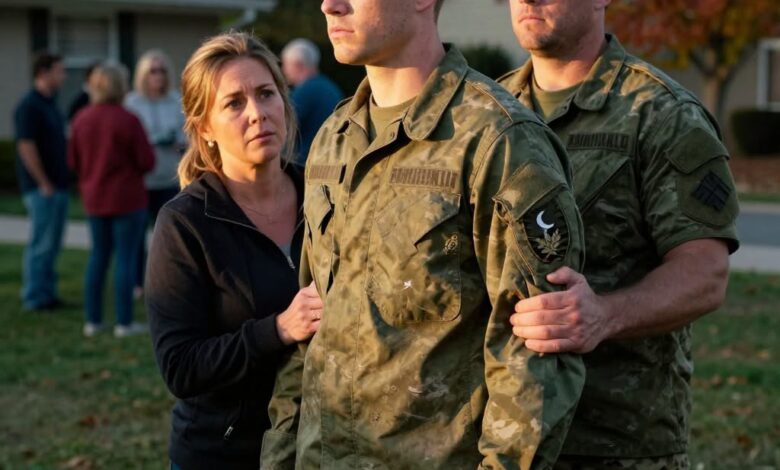
The smell hits you first. It’s an indescribable blend—stale diesel mixed with freshly laundered wool, a faint metallic tang of sweat, and something inherently *him*. Ethan. My boy. After three years away at Fort Bragg, after endless video calls filled with clipped updates about training schedules and mundane dorm life, that scent was the herald of everything: peace, pride, exhaustion, and the terrifying potential for revelation.
It was a Tuesday in late October, the kind of autumn afternoon where the sun slants low enough to cast long, buttery shadows across the manicured lawn of our suburban home. The driveway was already crowded with neighbors who had come out armed with casseroles and questionable advice. My husband, David, stood by the mailbox, his usual stoic composure stretched thin, a rare tremor visible in his jawline. He looked like a man bracing for a storm he secretly hoped would pass harmlessly over their perfectly curated existence.
Me? I was hovering near the porch swing, hands clasped so tightly my knuckles were white islands against sun-warmed skin. For three years, we had built our life around Ethan’s absences—planning his return dinners, dusting off the old family photos where he grinned awkwardly in a slightly too-tight polo shirt, and conducting elaborate internal debates over which oversized hoodie would best suit his rugged new aesthetic.
“He’s here,” David finally murmured, his voice cracking just enough to betray the dam holding back years of contained emotion.
The crowd surged forward as Ethan stepped out of the olive-drab Humvee, helmet tucked under one arm, rifle slung across his chest like a second skin. He was taller than I remembered, broader in the shoulders, etched with the kind of hard-won maturity that only deployments to high-stakes theaters can bestow. The tan seemed deeper, burnished by harsh suns and relentless training. But it wasn’t just his appearance; it was the way he moved—with a deliberate, grounded confidence that felt utterly foreign yet profoundly right.
“Mom!”
The roar of my name broke through the chatter of well-meaning relatives. I didn’t walk; I launched myself across the lawn in a clumsy burst of maternal instinct, wrapping my arms around his chest, burying my face into the familiar scent of him. He dropped the heavy rifle slightly, one large hand coming up to grip the back of my neck, anchoring me against the overwhelming rush of feeling.
“Oh, Ethan. You’re home,” I choked out, inhaling deeply, trying to map every contour of his being—the subtle shift in his scent profile, the slight roughness of his jawline from shaving during deployment, the reassuring weight of him against my frail frame.
David joined us, enveloping both of us in a massive hug that felt less like affection and more like annexation. He squeezed tighter than usual, burying his face into Ethan’s hair, murmuring incoherent reassurances into his son’s ear. This was perfect. This was the homecoming fantasy we had meticulously constructed over three grueling years.
But then, it happened. The tiny hitch in the narrative thread.
As David pulled back slightly, his gaze—usually so steady and impenetrable—flicked past my shoulder to Ethan’s face. It wasn’t a glance of pride or relief; it was a flicker of acute, almost paralyzing recognition. His eyes locked onto something just over Ethan’s left shoulder—a detail only visible because Ethan had instinctively turned slightly toward his father during the embrace.
Ethan, sensing the shift in atmospheric pressure, straightened up fully, resting one hand on my back and letting David cradle him securely. And that’s when we saw it. Or rather, *him* saw it.
Tucked discreetly into the fold of Ethan’s combat T-shirt, right where the fabric gathered at his hip bone, was a small, faded patch. It wasn’t the official unit insignia—that was proudly displayed on the sleeve. This patch was older, embroidered with slightly fraying thread, and depicted a stylized silver crescent moon cradling a single, defiant oak leaf.
It was *our* patch. Or rather, it was *my* secret patch, the one I thought had been relegated to the bottom of my own cedar chest after my sister’s disastrous college farewell party fifteen years ago.
David’s breath hitched audibly. His grip on Ethan tightened until his knuckles bleached white against the tan fabric of the soldier’s uniform shirt. He didn’t say a word, but the change in him was seismic. The relaxed posture vanished; it snapped back into the rigid formality of a man guarding a closely guarded treasury.
My own heart began to perform an anxious drum solo against my ribs. *The moon and leaf.* That symbol belonged exclusively to the clandestine ‘Garden Collective’—a small, fiercely protective circle of women from our family’s history whom David had sworn secrecy with after a particularly messy summer in college when their bohemian ideals clashed violently with their impending commitment to traditional life.
The Garden Collective represented more than shared herbal teas and meaningful glances over brunch. It symbolized the truth about Amelia, my younger sister—the beautiful, vibrant, intensely private soul who was supposed to be thriving at her Master’s program twenty states away.
David had spent years subtly steering conversations around Amelia. He praised her resilience; he admired her dedication to environmentalism; but underneath the compliments lay a carefully constructed edifice of normalcy. A narrative that suggested Amelia was *stable*, *committed*, and fundamentally, *fine*.
But the crescent moon and oak leaf meant something darker: it meant Amelia had been involved in the Garden Collective’s most secretive project—a commitment so intense, so consuming, that David had convinced himself she must have dropped her life entirely for it. He’d chalked up her sporadic check-ins to ‘deep research phases.’