My Family Mocked Me at Graduation — Then the Dean Announced Harvard
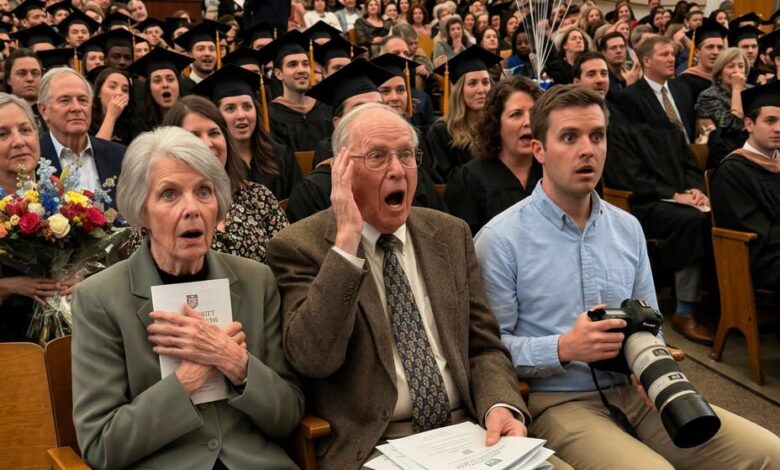
At 10:42 on graduation morning, Sarah Thompson sat beneath the bright auditorium lights while her father leaned toward her mother and whispered that he was finally finished wasting money on “this loser.” The polished floor reflected rows of black gowns, programs rustled like dry leaves, and somewhere behind her, her brother Marcus laughed under his breath. Sarah kept her eyes fixed on the stage, refusing to give their cruelty the satisfaction of a reaction. Only hours earlier, she had overheard her mother complain that Sarah’s tuition should have been spent on Marcus’s unfinished law-school plans. None of them knew that she had earned the highest GPA in her department, completed three years of Alzheimer’s-related research, and supported herself through campus jobs and private tutoring. They believed she was receiving an ordinary biology degree with few practical prospects. Sarah had learned to keep her best news protected until it became too real for anyone to ridicule.
For four years, Sarah had lived in a cramped apartment with a cracked ceiling, unreliable heat, and a kitchen table that doubled as her desk. She worked late shifts at the campus coffee shop, tutored chemistry students, and spent unpaid hours studying protein folding under the supervision of Dr. Patricia Hendricks. Her family rarely asked about the research, and when Sarah tried to explain it, her father called it “that biology thing.” Marcus received praise for ambitions he had not yet fulfilled, while Sarah’s completed work passed through family conversations unnoticed. Dr. Hendricks became the person who recognized what Sarah’s relatives refused to see, guiding her through failed presentations, recommendation letters, publication reviews, and confidential meetings with Harvard. On Sarah’s refrigerator hung a handwritten note from her mentor: “You belong in every room your work opens.” Sarah carried those words with her as the dean stepped toward the microphone.
Before the diplomas were presented, Dean Morrison announced that the university’s Undergraduate Research Award was going to a student whose work on protein folding could contribute to a better understanding of Alzheimer’s progression. Sarah’s hands tightened around the folded program as he revealed that the research had been accepted by the Journal of Molecular Biology and selected for presentation at an international conference. When he called Sarah Elizabeth Thompson to the stage, the auditorium erupted in applause. Her mother stared blankly, Marcus lowered his expensive camera, and her father appeared unable to move. Then the dean announced that Sarah had also received full scholarship admission to Harvard Medical School. As people rose for a standing ovation, he opened another letter and revealed that Harvard had awarded her a four-year physician-scientist fellowship with tuition, housing assistance, a living stipend, and direct placement into a combined M.D.-Ph.D. research track—and Sarah realized the announcement was not finished yet.
The dean explained that Harvard’s decision recognized not only Sarah’s scientific promise but also the discipline required to maintain the university’s highest graduating GPA while financing her own living expenses. Faculty members, students, and guests turned toward the family who had treated her education as a financial burden instead of an investment in extraordinary ability. After the ceremony, Sarah’s mother demanded to know why she had kept the scholarship secret, while Marcus offered sudden praise and her father admitted that he might have underestimated her. Sarah answered that he had not underestimated her; he had simply never cared enough to see her clearly. When a university photographer suggested including the family in an official press photograph, Sarah asked instead to stand beside Dr. Hendricks and Dean Morrison—the people who had provided the mentorship, academic advocacy, and institutional support that helped her reach the stage. The camera captured Sarah between them, holding the glass research award while her family stood outside the frame they had never helped her build.
Weeks later, Sarah accepted the fellowship and moved to Boston with two suitcases, research notes, and the quiet confidence of someone no longer asking permission to believe in herself. Her family continued reaching out through careful messages, awkward congratulations, and an eventual email from her father admitting that he had been wrong. Sarah did not confuse those apologies with immediate repair, nor did she feel obligated to erase years of contempt simply because her success had become public. On the day she received her first white coat, she remembered the graduation auditorium and the moment the world applauded loudly enough to silence the people who had mocked her. Harvard changed the direction of her career, but it was not the deepest turning point in her life. That had happened earlier, in the private hours when Sarah stopped measuring her worth by whether her family recognized it and began trusting the work that had already carried her farther than their approval ever could.