My Son Took the Italian Villa — Then I Opened the Cabin My Wife Left Me
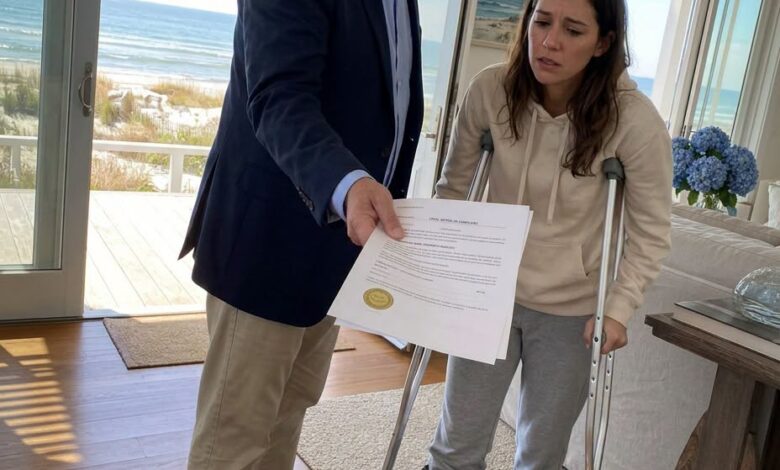
Bradley laughed when the attorney announced that he would inherit the Italian villa while his father received an aging beach cabin on Driftwood Lane. Eight days after Helen’s funeral, he treated the will like a victory list, then told Eugene to leave the family home so it could be sold. The cabin’s paint was peeling, the porch sagged, and one window had been boarded against years of coastal weather. Yet when Eugene unlocked the door, he smelled lavender instead of mold and found flowers on the table, clean dishes by the sink, and medicine on the counter. A photo album showed Helen laughing beside a younger woman Eugene had never seen. Moments later, that woman entered on forearm crutches, looked directly at him, and said she already knew his name. Then she revealed that Helen had been her birth mother.
Carol Martinez had been born before Helen met Eugene and was placed for adoption when Helen was nineteen. Four years earlier, Carol found her, and the two quietly rebuilt their relationship inside the cabin because Carol feared disrupting Helen’s marriage and family. When multiple sclerosis began limiting her mobility, Helen purchased the property in her own name and used it as a safe, accessible home where she could help with groceries, appointments, and daily care. Eugene’s son Bradley knew nothing about his half sister, and Helen intended to keep it that way while she was alive. She understood that Bradley valued visible wealth, status, and property, which was why the villa and much of the obvious estate went to him. The neglected-looking cabin concealed the one inheritance he would never consider valuable enough to investigate.
Inside the bedroom, Eugene found a letter, a clear deed, and Helen’s final explanation. She apologized for hiding Carol but wrote that her silence had grown from fear rather than shame, and that finding her daughter had been the great grace of her later years. Helen believed Bradley would challenge Carol, exploit her vulnerability, or search for any financial interest attached to her if he learned the truth. By giving him the villa, she satisfied his expectations and directed his attention away from Driftwood Lane. The cabin was left solely to Eugene because she trusted the retired bridge engineer to protect Carol after her death. Her final request was simple: he had built bridges his entire life, and she needed him to build one more between the family he knew and the daughter he did not.
Eugene allowed Bradley to keep the villa and sell the former family home rather than risk drawing him toward Carol. He moved his tools to the coast, rebuilt the porch, installed ramps and grab bars, replaced the boarded window, and made the property fully accessible. The deed contained no mortgage, liens, or competing estate claims, leaving Eugene with complete legal authority to preserve the home for Carol’s safety. Eighteen months later, Bradley arrived after hearing that his father lived with a younger woman and immediately recognized Helen’s eyes and mannerisms in Carol. Eugene explained the adoption, the secret reunion, and the structure of the will. Bradley left angry after realizing that his mother had trusted him with expensive property but not with a vulnerable sister—and that no attorney, inheritance challenge, or financial demand could give him access to what she had deliberately hidden.
Carol continued calling him Eugene rather than Dad, but eventually listed him as her emergency contact, a gesture that affected him more deeply than any title could have. They built a quiet family through medical appointments, difficult seasons, shared meals, and mornings watching the ocean from the repaired porch. A handwritten note clipped to the deed explained that the cabin was not forgotten but hidden, because the structures carrying the greatest weight are often placed where no one thinks to look. Bradley inherited the villa and the money he valued. Eugene inherited a daughter, a purpose, and the final unseen part of the woman he had loved for thirty-eight years. Helen had designed one last bridge before she died, and Eugene completed it gradually—one board, one appointment, and one quiet morning at a time.