After My Father’s Funeral, a Plastic Grocery Bag Revealed the Life My Mother Chose Without Me
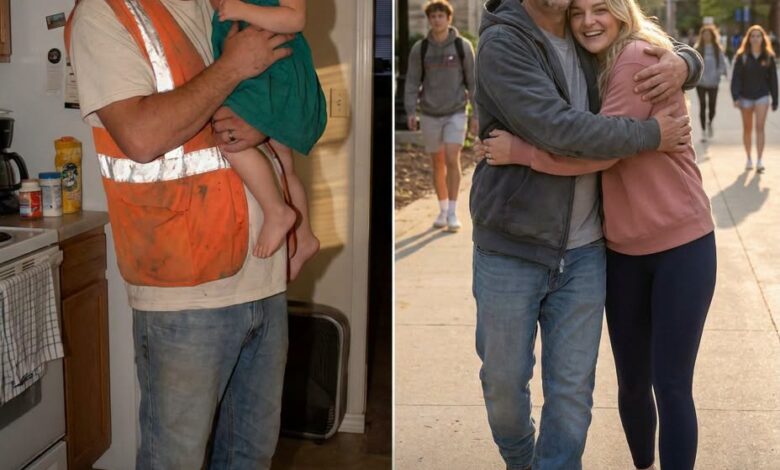
“Daddy’s Bug, I hope you’ll forgive me after you see what’s inside,” the note read as I stood in the empty funeral home wearing my father’s construction jacket over my black dress. Three hours earlier, I had buried the man who raised me alone after my mother supposedly left to buy milk and never returned. Inside the wrinkled grocery bag was a recent photograph of her smiling beside a husband and two grown children. Her eyes were mine, and the date on the back proved she had been alive, nearby, and building another family while Dad worked construction until illness broke his body. Beneath the photograph were birthday cards addressed to him, tuition checks he had paid after she left, custody documents, and a calendar recording every rare contact she made. My father had known where she was. The life I had understood since childhood began coming apart on the kitchen table.
Dad had been studying engineering when I was born, but after Mom disappeared he withdrew from college and raised me in the same small apartment for more than twenty years. He repaired his boots with glue, stretched meals across several days, and turned power outages into indoor camping nights so I would never understand how little money we had. The documents revealed that Mom contacted him six months after leaving and asked for help completing school. Believing stability might bring her back, he paid nearly two years of tuition while supporting me on construction wages. She later remarried, rejected the visitation schedule he proposed, and signed a court order granting him sole custody. Her occasional cards never asked to speak with me and referred to me as though I belonged entirely to someone else. Dad preserved them but hid the truth because he could not bear the thought of watching me ask a mother to choose me and hearing her refuse.
I contacted Hannah, the daughter in the photograph, and learned that Mom had told her second family she had never had children before them. We met in a café, where Hannah showed me albums filled with school concerts, birthdays, vacations, and the college move-in for which Mom stayed three days. My father had slept in his truck when he moved me into college because he could not afford a motel. The next afternoon, Hannah brought me to a family gathering where Mom planned to speak about building her life independently. She recognized me the instant I entered and dropped the serving bowl she was carrying. In front of her husband and children, I produced the custody papers, birthday cards, and canceled tuition checks. When she blamed Dad for hiding the truth, I agreed that he had been wrong—but reminded her that his mistake was staying silent, while hers was continuing to leave.
The custody order, payment records, correspondence, and dated calendar established a clear documentary history that neither parent had ever fully disclosed to me. Dad’s final letter admitted that I had the right to know and that he had delayed because he feared losing my forgiveness. I required Mom to correct the false story she had told her husband, children, and friends before I would consider any future relationship. Hannah and I began communicating slowly, without pretending that shared biology could erase years of deception. Mom sent letters, but I left the first ones unanswered because reconciliation was not a legal or emotional entitlement created by confession. I later used part of Dad’s remaining estate to establish an educational fund through a community organization for single parents returning to engineering, construction, and skilled-trade programs. The first recipient was a mother who had left school after her son was born.
I kept one of Mom’s birthday cards, not for the few careful words she had written, but for the date Dad had recorded on the envelope and the fact that he preserved it all those years. I remain angry that he decided what I was strong enough to know, yet I understand the fear beneath his silence. He had watched one parent abandon me and spent the rest of his life making certain I never felt abandoned again. Mom occasionally wrote about love from a distance; Dad demonstrated it in lunches, patched coats, night shifts, and every ordinary day he stayed. The grocery bag did not leave me with a perfect father and a heartless mother. It left me with two flawed choices and the right to decide what they meant. Dad had hidden the letters, but he had never hidden me.