How this little boy turned a violent childhood into TV stardom and millions
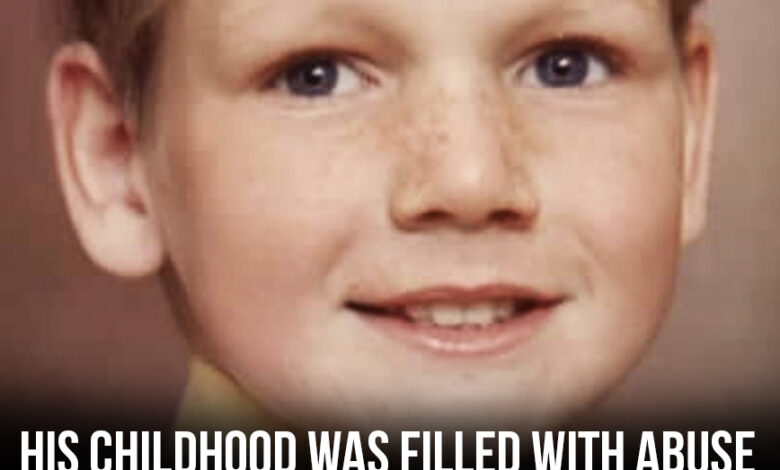
In the high-octane world of global celebrity, we are accustomed to the finished product: the crisp white chef’s whites, the multi-million dollar television syndication deals, and a personal net worth hovering around $220 million. We know Gordon Ramsay as the fire-breathing sovereign of the kitchen, a man whose verbal eviscerations of undercooked scallops have become the stuff of digital legend.
But behind the Michelin stars and the “Governor” persona lies a narrative etched in the grim reality of 1960s and 70s council housing—a story of a boy who didn’t just learn to cook, but cooked to survive a “sh*t mess” of domestic horror.
A Childhood in Motion: The Shadow of the Bottle
Born in Johnstone, Scotland, on November 8, 1966, Ramsay’s early years were defined by a “hopelessly itinerant” existence. While his mother, Helen, labored as a nurse to provide a semblance of stability, his father—a man of fleeting ambitions and deep-seated demons—drifted through roles as a swimming pool manager, welder, and shopkeeper.
The geography changed constantly, but the atmosphere remained suffocatingly the same. Ramsay’s father was a “hard-drinking womanizer” whose alcoholism dictated the family’s emotional weather.
“It’s hard, isn’t it, when someone’s an alcoholic?” Ramsay once reflected, his usual bravado giving way to the raw vulnerability of a haunted child. “You’re nervous. You’re worried about hitting the end of the bottle and seeing that bottle of Bacardi disappear, because you know what happens at the end of that.”
What happened at the end of the bottle was often explosive. Sudden job losses, fueled by confrontations with neighbors and colleagues, forced the family into a cycle of packing up and starting over. For the young Ramsay, stability wasn’t a right; it was a luxury he couldn’t afford.
Twenty Years of Bruises
The reality inside those cramped council flats was darker than a simple lack of funds. Helen Ramsay would later reveal a staggering truth: she endured physical abuse at the hands of her husband for 20 years.
The violence was triggered by the mundane—an unironed shirt, a plate of food not perfectly set. “I would be frightened, checking everything and seeing if everything’s been done properly,” Helen recalled. The abuse was so severe that police intervention and hospital visits became semi-regular occurrences. There were nights spent hiding on street corners, Helen shielding her four children while her husband hunted for them in a drunken rage.
The trauma reached a breaking point when the state intervened. Social services removed the children, placing Gordon and his siblings in care—a “torrid” chapter that left indelible scars. It was during this period of upheaval that a young Gordon looked at the wreckage of his heritage and made a silent vow. When his father later dismissed him as a “snob,” Ramsay’s retort was a manifesto: “No, definitely not a snob. I just want to get out of the sh*t mess I was born in.”
The Culinary Lifeboat
Ramsay’s escape route was originally paved in grass, not linoleum. A promising football career was cut short by a devastating knee injury, leaving him at 19 with no clear path. He turned to the kitchen not out of a lofty passion for haute cuisine, but out of a desperate need for a trade.
He started at the bottom, scrubbing pots as a dishwasher. By 19, he moved to London, entering the brutal, high-pressure orbit of Marco Pierre White at Harveys. While he was mastering the French mother sauces, his home life remained a battlefield; his younger brother was spiraling into heroin addiction.
“If I didn’t cook my way out of that mess, then I could have gone down with the rest of them,” Ramsay told People. The kitchen became his sanctuary—the one place where chaos could be organized, where heat could be controlled, and where perfection was the only defense against a world that had tried to break him.
Building the Legacy: 1998 to Today
The gamble paid off with historic velocity. By 1998, Ramsay opened his eponymous restaurant; within three years, it held three Michelin stars. He was the first Scot to reach that pinnacle of culinary achievement.
Today, his business empire, Gordon Ramsay Holdings Limited, is a juggernaut. With a 69% stake in the company (valued at approximately $67 million) and a massive media footprint spanning Hell’s Kitchen, Kitchen Nightmares, and The F-Word, he has leveraged his “explosive” personality into a brand worth nearly a quarter of a billion dollars.
However, the most significant “win” for Ramsay isn’t on a balance sheet. Married to Tana Hutcheson since 1996, he has consciously constructed the antithesis of his own upbringing. Raising six children between London and Los Angeles, he has swapped the fear of his father’s house for a home defined by support and presence.
The Survivor’s Drive
In his recent Netflix documentary, Being Gordon Ramsay, the 59-year-old chef peels back the layers of his aggressive TV persona. He traces his relentless, “thousand miles an hour” work ethic directly back to his mother, who often worked three jobs—cook, night nurse, and cleaner—even on Christmas Day.
“You never take things for granted,” he explains. “There’s this relentless drive for whatever you’ve got—you never want to lose it.”
Ramsay has turned his personal history into a catalyst for change, serving as an ambassador for Women’s Aid alongside Tana, helping to raise over $600,000 for domestic abuse victims. He remains a man of contradictions: a chef who demands perfection because he knows how easily a life can fall apart, and a father who provides the security he was once denied.
Gordon Ramsay’s journey is a testament to the fact that while you cannot choose the kitchen you are born in, you can certainly choose what you cook.