A Simple Family Photograph from 1872 Hid a Detail No One Noticed for Generations
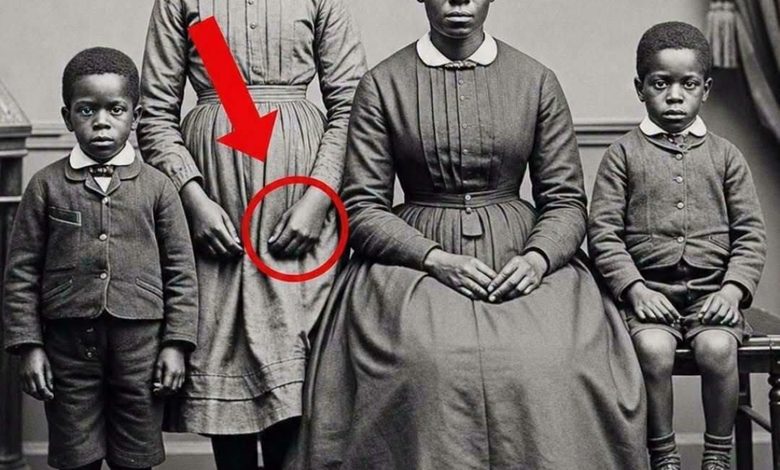
A single photograph shattered their ordinary lives. At first glance, it’s just a stiff Victorian family portrait. Then someone notices it—the extra hand. No body. No arm. Just a pale, impossible hand resting where nothing should be. Experts argue, skeptics scoff, believers whisper about ghosts. Every explanation fails, and the mystery tightens around that tiny, chilling detail. The longer you stare at the image, the stranger it becomes, because the hand appears so ordinary and yet so completely out of place.
The photograph comes from an era when taking a portrait was nothing like taking a picture today. Victorian photography required patience, careful positioning, and long exposure times. People had to remain remarkably still while the camera captured the image. Even the smallest movement could create unexpected visual effects. Shadows could overlap. Bodies could blur. Clothing could merge together. A person standing just outside the obvious composition could leave behind an optical illusion that looked impossible to modern eyes.
That history makes the mysterious hand even more fascinating. What appears supernatural at first could have a surprisingly ordinary explanation. Perhaps another person was positioned behind the family. Maybe a sleeve blended into the background. Perhaps a posing aid or hidden support created an unusual shape. Long exposure may have allowed one figure to move partially out of the frame while leaving a faint impression behind. Early photographic techniques were capable of producing results that viewers today might interpret as something far more mysterious.
What lingers in that 1872 portrait is not just a strange shape, but the unsettling feeling that the past is refusing to sit still. Whether the “extra hand” is a quirk of long exposure, a hidden posing stand, overlapping sleeves, or an early double-exposure accident, the photograph quietly exposes how fragile our trust in images really is. We like to believe a camera simply records the truth; this small anomaly reminds us it can also manufacture ghosts.
That is perhaps the most unsettling part of the story. We have been trained to treat photographs as evidence. If something appears in a photograph, our instinct is to assume that it must have existed exactly as shown. But photography has never been a perfect window into reality. Cameras capture light, movement, timing, perspective, and whatever happens to be positioned within the lens. The resulting image can be technically authentic while still creating an illusion.
Imagine standing in that studio in 1872. The room would have been quiet. The family would have carefully arranged themselves, perhaps wearing their finest clothing and attempting to maintain serious expressions. Nobody would have been thinking about ghosts or mysterious photographs. They were simply creating a permanent record of their family at a particular moment.
The family who posed that day likely never imagined their picture would be pored over, enlarged, argued about more than a century later. To them it was proof of presence, of love, of time briefly held in place. To us, it has become a riddle made of light and chemistry. The mystery endures not because we lack answers, but because we secretly prefer the shiver of not knowing.
There is also something deeply human about our attraction to unexplained photographs. A strange sound can be dismissed. A strange story can be forgotten. But an image feels different. We can see the mystery with our own eyes. We can zoom in, inspect the details, compare shadows, and search for clues. The photograph becomes a puzzle, and every attempt to solve it seems to make the unexplained detail even more compelling.
Skeptics naturally search for physical explanations. They examine the shape of the hand, the direction of the light, the clothing, the positioning of the people, and the limitations of the photographic equipment available at the time. Believers may see something else—a moment when the boundary between the living and the dead supposedly became visible. Neither interpretation changes the fact that the image is extraordinarily effective at creating unease.
And perhaps that is why the debate has survived for so long.
A photograph does not tell us what to believe. It only shows us what was captured. Everything else comes from interpretation.
The extra hand could be a photographic artifact. It could be an overlapping part of another person’s body. It could be an unusual arrangement of fabric and shadow. It could even be the result of a technique that photographers of the era understood better than modern viewers do. But without complete knowledge of how the original portrait was created, certainty becomes difficult.
The mystery is amplified by the age of the image itself. A photograph from 1872 feels distant and almost inaccessible. The people are gone. The photographer is gone. The room is gone. The original circumstances surrounding the portrait have disappeared into history. What remains is a single frozen frame, separated from us by generations.
That distance gives the image its power.
We cannot simply ask the family what happened. We cannot recreate the exact room, the exact lighting, the exact positions, or the exact photographic process with absolute certainty. We are left with the picture and our own assumptions.
And assumptions are powerful.
Once someone points out the hand, it becomes almost impossible not to see it. Before that moment, the portrait may have looked completely ordinary. Afterward, every eye goes directly toward the strange detail. The mind begins searching for explanations, but at the same time it becomes increasingly attached to the mystery itself.
That may be the real lesson hidden inside the photograph. Seeing something is not always the same as understanding it. A camera can preserve an image, but it cannot explain what happened outside the frame. Context matters. Technique matters. Perspective matters. And sometimes the most convincing mysteries are created by ordinary things interacting in unusual ways.
Still, there is no denying the chill that comes from staring at a century-old family portrait and seeing something that appears impossible. The expressions are frozen. The clothing belongs to another world. The people have been gone for generations. And yet that strange hand seems almost present, as if someone else had quietly joined them for the photograph.
Maybe it was nothing more than an accident of photography.
Maybe it was a hidden person, a strange shadow, or a movement captured at exactly the wrong moment.
Or maybe the mystery survives because some part of us does not really want a definitive answer.
The family who posed that day wanted to preserve a moment. More than a century later, they accidentally created something else: a question. And questions, unlike photographs, do not stay frozen.
They move from one generation to another, gathering new theories, new explanations, and new believers along the way.
The mystery endures not because the past has given us no possible answers, but because that tiny pale hand leaves just enough room for doubt. In the end, the most haunting thing about the photograph may not be the possibility of a ghost at all.
It may be the realization that even when we think we are looking directly at the truth, we are still only seeing one carefully frozen version of it.