The Song Dolly Parton Chose for Her Funeral and What It Reveals – Details & Photos
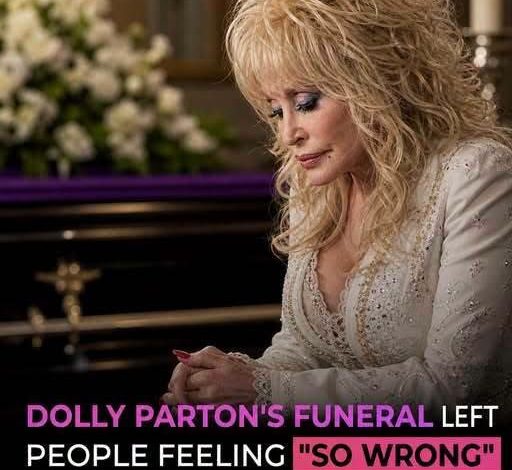
Her last goodbye wasn’t what anyone expected.
No stadium. No star-studded spectacle. No soaring chorus of her biggest hits. No massive television event filled with celebrities, cameras, and carefully planned performances. Instead, Dolly Parton left this world with a quiet service, a hidden plaque, and a single old gospel song that said more than any tribute show ever could. What that song revealed about her marriage, her faith, and the private life she protected for decades made the farewell feel less like the ending of a celebrity career and more like the closing of a deeply personal love story.
In the end, Dolly Parton’s farewell looked less like a global event and more like a family gathering back home. She was laid to rest beside Carl Dean, the man she loved in private for nearly sixty years, under a plaque etched with two small houses, their wedding date, and intertwined rings. It was a final love letter carved in stone, a reminder that behind the rhinestones and spotlights stood a woman whose deepest commitments never changed. While millions knew Dolly as the larger-than-life performer with the unmistakable voice, the private memorial pointed toward another side of her—the wife, daughter, sister, friend, and deeply faithful woman who never needed an audience for the things that mattered most.
The simplicity of the setting was almost striking considering the size of Dolly’s public life. She could have had a farewell worthy of an international icon, with enormous crowds and performances from the biggest names in entertainment. Instead, the emphasis was placed on intimacy. The people closest to her could remember her without the pressure of putting on a show for the rest of the world. In a sense, that restraint felt completely consistent with the way Dolly had always handled the most precious parts of her life.
Her marriage to Carl Dean was perhaps the clearest example. For decades, the world was fascinated by the man who rarely appeared beside her in public. Dolly was constantly surrounded by cameras, while Carl remained almost entirely outside that world. Their relationship endured not because they constantly displayed it, but because they protected it. Their private life belonged to them, and the distance between Carl’s quiet personality and Dolly’s enormous public presence became one of the defining mysteries of their marriage.
The plaque beneath which they were laid to rest seems to capture that contrast perfectly. Two small houses, their wedding date, and intertwined rings say almost everything without saying much at all. There is no need for a lengthy inscription when the symbols already tell the story. Two people built separate worlds around themselves, yet remained connected through a bond that lasted for decades. The final memorial became a quiet reminder that the most important chapter of Dolly’s life was never necessarily the one performed onstage.
The song chosen for her funeral, “If We Never Meet Again (This Side of Heaven),” carried that same quiet devotion. It reached back to the mountain churches and gospel harmonies that shaped her, and forward to all the people she’d already lost. Rather than turning her funeral into one last performance, Dolly chose a hymn about reunion, promising those she loved—and the millions who loved her—that goodbye was not the final word.
There is something especially powerful about that choice because gospel music was woven into the foundation of Dolly’s identity. Long before the fame, the awards, the business empire, and the sold-out stages, there were songs of faith and family. Those melodies were part of the world she came from, and they remained part of the emotional language she carried throughout her life. Ending with an old gospel song brought the story full circle, back to something simpler than fame.
The hymn also transformed the meaning of the farewell. Instead of focusing only on loss, it pointed toward reunion and hope. That distinction matters. A funeral can become a celebration of achievements, but Dolly’s final musical message seemed to focus on relationships—the people who had gone before her and the belief that separation was temporary. It was less about reminding the world how famous she had become and more about remembering where she came from and what she believed.
For the millions mourning her, that may ultimately be the detail that stays with them. Dolly spent her career making people laugh, cry, sing, and feel less alone. She turned personal experiences into songs that could belong to everyone. Yet in her final goodbye, there was no need to entertain anyone. The silence, the simple symbols, the familiar gospel melody, and the presence of family were enough.
Perhaps that is why her farewell feels so fitting. The woman who lived much of her life under the brightest lights ultimately chose a goodbye defined by what happened away from them. The world may remember the wigs, the rhinestones, the laughter, the songs, and the extraordinary career. But beneath it all was a woman who understood that some things are too meaningful to be turned into spectacle.
Her final farewell did not need a stadium because her legacy already fills one. It did not need another performance because her voice had already traveled across generations. And it did not need a grand declaration about love because the small details—the wedding date, the intertwined rings, the shared resting place, and an old gospel song—said enough.
In the end, Dolly’s goodbye may have been her most Dolly moment of all: quiet, faithful, deeply personal, and centered on the people and beliefs that mattered when nobody was watching. The world may have wanted one last spectacle from an icon, but what it received instead was something far more intimate—a final reminder that beneath every legend is a human life, and sometimes the most powerful goodbye is the one spoken softly.