The Boy With Snow White Hair Who Captivated the World Where Is He Now?
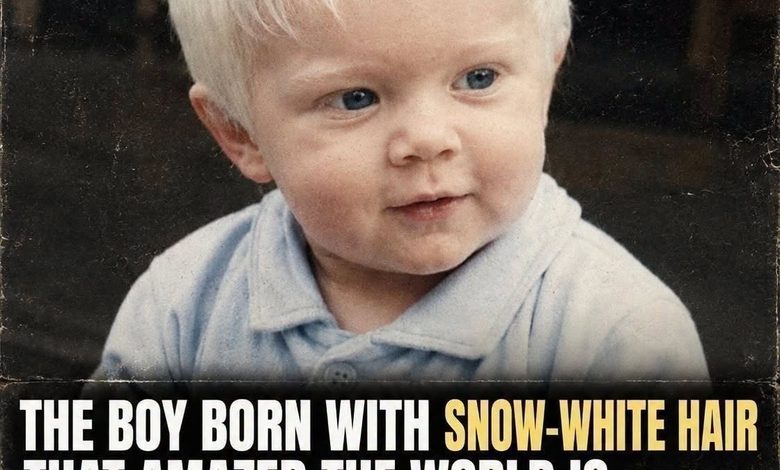
From the moment photographs of him began circulating, the young boy with snow white hair drew extraordinary attention. His pale complexion, light hair, and vivid blue eyes gave him an appearance that millions of viewers found unforgettable. Many people first encountered him as a toddler through social media and news stories, and the images prompted an immediate question. What would life be like for a child whose appearance made him stand out wherever he went?
His distinctive coloring was connected to a rare genetic condition that affects pigmentation. To casual observers, the white hair might have looked like an unusual family trait or even a carefully created style. Specialists, however, explained that genetics had shaped the way pigment appeared in his hair and skin. His look was natural, and it became visible evidence of the enormous range found in human biology.
Public fascination brought admiration, but being noticed so intensely also created challenges. Children who look different can face staring, intrusive questions, careless assumptions, and comments from people who do not understand their condition. Attention that seems flattering to an adult may feel confusing or uncomfortable to a child. His parents therefore had to help him understand both why people were curious and why their reactions did not determine his worth.
Family support became central to his development. Rather than treating his appearance as something that needed to be hidden, his parents encouraged him to accept it as one part of who he was. They worked to build his confidence while allowing him to experience the ordinary parts of childhood. Their approach gave him room to make friends, discover his interests, and grow without feeling that he existed only as the subject of a viral photograph.
As the years passed, people who remembered the toddler continued asking about him. Occasional family updates allowed followers to see him change from a small child into a young man. His recognizable features remained, but his growing maturity increasingly became the more meaningful part of the story. The child once described almost entirely by his hair was developing a personality, ambitions, relationships, and a future of his own.
Those close to him have described him as kind, humble, and grounded. He learned to handle attention without allowing it to define every part of his life. Instead of building his identity around strangers’ fascination, he concentrated on normal routines and personal interests. He spent time with friends and continued moving toward adulthood in much the same way as other young people, even though the public had watched his transformation from afar.
His journey also helped broaden conversations about genetic diversity. Uncommon traits are often treated as curiosities, particularly online, where a striking image can spread before viewers learn anything about the person in it. A more thoughtful response recognizes that visible differences are not defects and that a person should never be reduced to a diagnosis or physical characteristic. Learning why pigmentation varies can replace speculation with understanding.
Experts frequently emphasize how important a supportive environment is for any child who attracts attention because of appearance. Confidence is not produced by pretending that differences do not exist. It develops when children receive honest explanations, consistent affection, and the freedom to value their abilities and character. In this boy’s case, his family’s reassurance helped him meet public curiosity with resilience instead of shame.
Today, viewers who first saw him years ago are surprised by how much he has grown. The snow white hair that made his childhood pictures famous remains part of his identity, yet it no longer tells the whole story. His composure and maturity now leave the stronger impression. He has become a young adult rather than a mysterious face frozen in an old viral image.
What began as fascination with a rare appearance ultimately carries a broader message. Human beings do not need to fit a narrow definition of beauty or normality to live confidently and fully. His features attracted the world’s gaze, but the support surrounding him helped ensure that the gaze did not control his life. His development shows why individuality deserves respect and why character, not appearance, becomes the quality that matters most as a child grows.