Man Loses Pulse for 45 Minutes Wakes Up and Shares a Spine Chilling Vision of the Afterlife
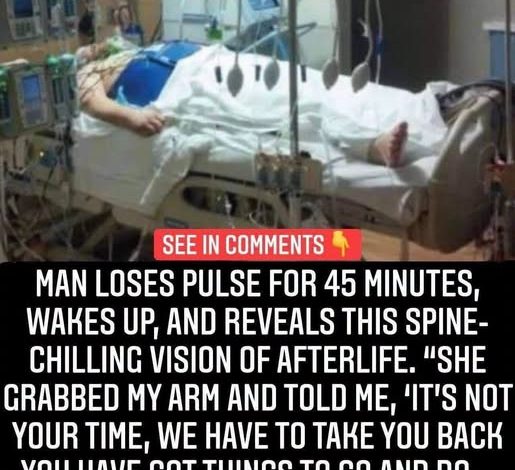
Ohio resident Brian Miller was opening the lid of a container when he suddenly felt pressure in his chest. Recognizing that something was seriously wrong, the 41-year-old called for an ambulance. At the hospital, doctors discovered a blockage in one of his arteries and worked to restore blood flow.
The immediate procedure appeared to address the crisis, but Miller’s condition soon changed dramatically. He developed ventricular fibrillation, a dangerous rhythm in which the heart’s lower chambers quiver instead of pumping blood effectively. Medical staff began emergency treatment as his heart stopped producing a pulse.
ICU nurse Emily Bishop later described the severity of the moment. Miller had no heart rate, no blood pressure and no pulse. The team performed cardiopulmonary resuscitation and shocked his heart four times. Nothing seemed to work. After prolonged efforts, he was pronounced dead.
Then, after roughly 45 minutes without a detectable pulse, Miller’s heart began beating again. The return stunned those around him. Surviving such a long cardiac arrest is highly unusual, particularly because the brain and other organs depend on continuous circulation and oxygen.
When Miller regained consciousness, he described an experience that stayed with him. He remembered moving along a path surrounded by flowers and seeing a bright light. In that place, he encountered his late stepmother. According to Miller, she told him that it was not his time and that he needed to return.
His account became compelling not only because of what he said he saw, but because of the circumstances surrounding it. The clinical team had documented a period in which they could not find a pulse despite sustained resuscitation. Miller later awakened with a clear memory of what felt to him like a journey beyond ordinary consciousness.
People interpret near-death experiences in different ways. Some understand them spiritually, while researchers have explored how the brain may respond under extreme physiological stress. Miller spoke about his experience as something deeply real and transformative. For him, the flower-lined path, the light and his stepmother’s instruction were not abstract ideas. They became part of how he understood his survival.
The story also highlights the intensity of the medical response. The nurses and doctors continued working through a crisis that appeared irreversible. Their actions kept open the possibility of recovery even after repeated shocks failed to restart an effective rhythm.
After awakening, Miller had to process both a serious heart emergency and the knowledge that he had been considered clinically dead for an extraordinary length of time. The experience changed the way he viewed life, time and the people closest to him.
Whether his vision is understood through faith, biology or a combination of both, the central fact remains remarkable. A man who had no measurable pulse for approximately 45 minutes returned, remembered a vivid encounter and lived to describe the moment he was told to go back.
Miller’s survival left his family and caregivers with a story few people ever expect to witness. What began with pressure in his chest became an extended fight for his life, followed by a recovery and an account that continues to provoke questions about consciousness at the boundary between life and death.