Passerby Who Killed Man Attacking Cop Learns His Fate
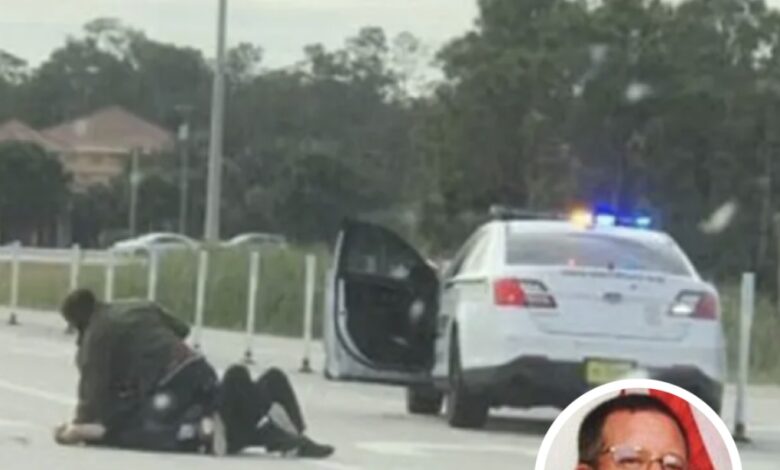
FORT MYERS, FL — The State Attorney’s Office has formally closed its investigation into a fatal Interstate 75 shooting, concluding that a passerby who intervened to save a law enforcement officer from a violent roadside assault will not face criminal charges.
The shooter, identified as 35-year-old Ashad Russell, has been officially cleared of any wrongdoing in the death of Edward Strother, 53. The decision marks the end of a high-stakes legal review that pitted the “Good Samaritan” narrative against the somber reality of a life lost during a routine traffic stop gone wrong.
The Conflict on I-75
The incident began when Lee County Sheriff’s Deputy First Class Dean Bardes initiated a stop for a speeding violation on the busy interstate. According to investigators, the interaction escalated rapidly when Strother allegedly attacked the deputy. Bardes was reportedly pinned to the asphalt, enduring a barrage of punches while trapped in a vulnerable position.
As the struggle intensified, Russell—a licensed concealed carry holder—stopped his vehicle and emerged to assist the deputy. Reports indicate that Bardes, recognizing that the intervening citizen was armed, explicitly instructed Russell to shoot his attacker. Before discharging his weapon, Russell reportedly issued multiple verbal warnings to Strother to cease the assault and move away from the officer. When Strother failed to comply, Russell fired three shots into the man’s neck, resulting in his death.
A “Justified” Verdict
Following an exhaustive review of the evidence, the State Attorney’s Office (SAO) determined that Russell’s actions met the legal threshold for the use of deadly force.
In its formal statement, the SAO noted that Russell was “justified in using deadly force when he reasonably believed that the use of such force was necessary to prevent imminent death or great bodily harm to Deputy Dean Bardes or to prevent the imminent commission of a forcible felony upon Deputy Bardes.” The office confirmed the investigation is now closed, with no further legal action anticipated.
The Sheriff’s Response and Social Context
Lee County Sheriff Mike Scott was vocal in his support of Russell, taking to Facebook to offer a public tribute that addressed the complex racial optics of the era.
“I thank the hero that recognized the imminent threat, rushed to Deputy Bardes’ aid, and ultimately stopped that threat,” Scott wrote. He pointedly noted that in an age of heightened racial tension, the incident served as a unifying moment: “The fact is that this hero happens to be a man of color who stopped another man of color from further harming or killing a white cop; thereby reminding us that black lives matter, blue lives matter, and indeed all life matters.”
A Dissenting Voice
However, the narrative of heroism is not shared by everyone. The family of the deceased, represented by brother Louis Strother, expressed deep skepticism regarding the lethal response. In a perspective highlighted by The Washington Post, Louis Strother challenged the “Good Samaritan” label being applied to the man who killed his brother.
“They are calling him a good Samaritan?” he asked. “Was my brother armed?”
The question underscores the enduring debate over the proportionality of force used by armed citizens in defense of others—a debate that the State Attorney’s Office has now settled in the eyes of the law, even if it remains unresolved for those grieving on the sidelines of this tragedy.