Hidden Words on a Grave
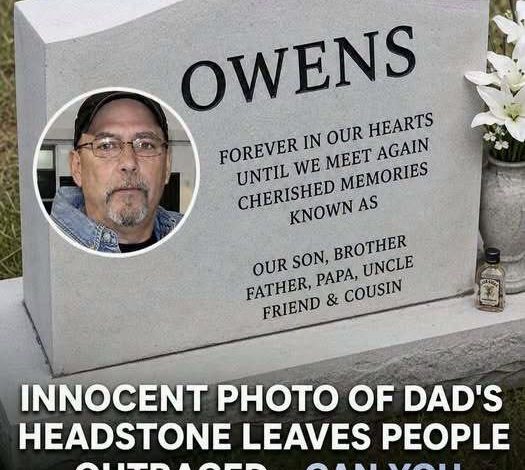
A gravestone was never meant to start a war.
But this one did.
What should have been a quiet memorial to a father became the center of a furious dispute after someone discovered a hidden message carved into the stone. It wasn’t immediately obvious. It wasn’t written in large letters or displayed like a declaration. Instead, a carefully constructed acrostic concealed a single profanity—a private joke transformed into a permanent part of the monument.
And suddenly, a cemetery became the unlikely center of a battle over grief, humor, decency, and ownership.
Officials objected.
Trustees threatened removal.
Lawyers became involved.
The family refused to back down.
And the internet, predictably, had plenty to say.
Some people laughed at the cleverness of the message. Others called it disrespectful. Some argued that a dead man should be allowed to have the final word, especially when the words reflected the personality he had shown throughout his life. Others insisted that a cemetery is a shared public space, and that individual families cannot simply redefine the standards everyone else is expected to follow.
What began as a private joke between a father and his children had suddenly become a public referendum on grief, taste, and who gets to control the final memory of a person.
To his family, the acrostic wasn’t vandalism.
It wasn’t an attempt to insult anyone.
It was him.
They knew the man behind the stone. They knew his sense of humor, his personality, and the kinds of jokes that made his children laugh. The hidden message was their way of preserving a tiny piece of that personality after everything else had been taken away by death.
The stone wasn’t meant to speak to strangers.
It was meant to speak to the people who knew him.
And that distinction became the heart of the family’s argument.
They believed that removing the message would do more than clean up a piece of stone. It would erase something personal—a final spark of the man they remembered. His voice was gone. His jokes were gone. His presence was gone.
But this tiny act of mischief remained.
For them, preserving it was part of preserving him.
Their grief therefore became intertwined with defiance.
They weren’t simply fighting over a few words.
They were fighting over whether a family should be allowed to decide how someone they loved is remembered.
Across the cemetery boardroom table, however, the trustees saw something entirely different.
To them, the issue wasn’t really about one father or one family.
It was about precedent.
If one profanity could be carved into a memorial and accepted, what would happen next?
What if another family wanted something offensive?
What if someone demanded a political statement?
What if another gravestone contained language that neighboring mourners found disturbing or inappropriate?
The trustees feared that allowing one exception could gradually weaken the standards that helped define the cemetery as a solemn shared space.
A cemetery isn’t experienced by only one family.
People walk through its rows while grieving parents, spouses, siblings, friends, and children are saying goodbye to their own loved ones. The environment matters. The atmosphere matters. And for the trustees, maintaining a sense of dignity was part of their responsibility to everyone who entered the grounds.
That is what makes the dispute so difficult.
Neither side is arguing from a completely incomprehensible position.
The family sees a personal memorial.
The cemetery sees a shared public environment.
The family sees humor.
The trustees see a rule that must apply consistently.
The family sees a final expression of personality.
The cemetery sees a precedent that could change what others are permitted to place on memorials.
And somewhere between those competing definitions of respect is the uncomfortable question of who truly owns a legacy after death.
Does the person belong to the family who knew them best?
Or does the memorial become part of a larger community the moment it is placed in a public cemetery?
Can grief justify breaking a rule?
Can a rule designed to protect everyone override the wishes of the people who are grieving?
And perhaps most importantly, does honoring the dead mean preserving everything that made them human—including their flaws, their humor, their irreverence, and the jokes that would have made them laugh?
There is no simple answer.
Death often encourages us to sanitize people’s stories. We turn complicated human beings into polished memories, carefully choosing the photographs, words, and stories we believe are appropriate to preserve.
But real people aren’t always polished.
They can be funny and difficult.
Tender and inappropriate.
Generous and stubborn.
They can leave behind memories that would make one person smile and another person shake their head.
Perhaps the family was trying to preserve exactly that humanity.
The gravestone wasn’t supposed to be a statement about everyone else.
It was supposed to be a statement about one man.
But the moment that message became visible, it stopped being entirely private.
Now strangers could see it.
Now cemetery officials had to respond.
Now lawyers could debate it.
And now thousands of people who had never met the man could decide whether the joke was funny, offensive, clever, or completely inappropriate.
That may be the strangest part of the entire story.
A man who can no longer speak has somehow managed to start an argument among people who never knew him.
His final monument became a battleground because the people left behind couldn’t agree on what remembrance should look like.
Maybe that’s why the controversy has lasted.
It isn’t really about one word.
It’s about control.
It’s about grief.
It’s about personality.
It’s about whether a memorial should reflect the person as the world wants to remember them—or the person their loved ones actually knew.
The trustees want dignity.
The family wants authenticity.
Both believe they are protecting something important.
And between them stands a single piece of stone, carrying a message that was never intended to become famous.
In the end, perhaps the gravestone raises a question no lawyer, trustee, or internet commentator can completely settle:
**When someone dies, who owns the final word—the community that sees the monument, or the loved ones who remember the person behind it?**