Pai Lin Spent 25 Years Carrying Tourists — Her Story Changed the Way Many People Think About Elephant Rides
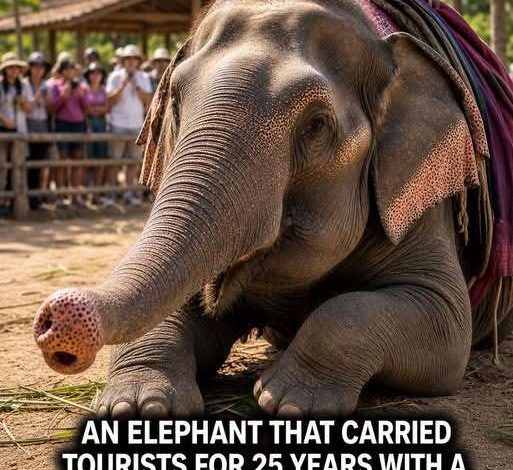
Pai Lin’s spine did not simply bend.
It collapsed.
For nearly 60 years, she carried the weight of human profit on her back—logs, heavy chains, equipment, and tourists who climbed onto her without ever seeing the damage accumulating beneath the saddle. To the people around her, she was often treated as a means of transportation, a working animal expected to keep moving regardless of exhaustion, pain, or age.
But an elephant’s body can remember everything.
Every load.
Every journey.
Every hour spent carrying something it was never meant to carry.
For decades, Pai Lin was treated as a tool rather than a living being. She was forced to haul timber, perform labor, beg on streets, and carry tourists in heavy howdahs. What may have looked like an innocent ride to a visitor could represent something very different for the animal underneath.
Over time, the repeated weight and strain took an irreversible toll.
Her spine became visibly sunken, her back developing a dramatic deformation that revealed the years of physical hardship she had endured. By the time Pai Lin eventually reached the Wildlife Friends Foundation Thailand, the damage was already permanent.
No gentle hand could completely undo it.
No open field could straighten it.
No peaceful morning could give her back the body she should have had.
But something else could finally be given to her.
Choice.
At the sanctuary, Pai Lin no longer had to carry tourists simply because someone wanted a photograph or an experience. She had space to move at her own pace. She could rest. She could spend time around other elephants. For perhaps the first time in a very long time, her existence did not have to revolve around what humans wanted from her.
And sometimes, freedom does not look dramatic.
It looks like an elephant being allowed to walk without a saddle.
It looks like lying down without being ordered back to work.
It looks like choosing where to stand, where to rest, and who to spend time with.
It looks like simply being allowed to exist.
Pai Lin’s body, however, remained a permanent record of what had happened before she reached safety. Her sunken spine could not be hidden behind a beautiful landscape or a carefully framed photograph.
Visitors who encountered her could see the consequences immediately.
One glance was enough.
Her back told a story that words sometimes struggle to communicate: behind a seemingly harmless tourist attraction can be a long history of labor, restraint, exhaustion, and suffering that visitors never see.
A short elephant ride might last only a few minutes for a traveler.
But for an animal, the consequences can last a lifetime.
That is what made Pai Lin’s story so powerful.
She became more than a rescued elephant.
She became a living warning.
Her body showed the hidden cost behind an industry that can sometimes turn an intelligent, social animal into an attraction. What one person sees as a memorable vacation photograph can exist alongside years of hardship that remain invisible in the final picture.
Yet her story is not only about suffering.
It is also about what happened when the suffering stopped.
In sanctuary, Pai Lin was finally surrounded by space rather than confinement, companionship rather than exploitation, and care rather than demands.
Her damaged body remained, but her life no longer had to be defined by the work that damaged it.
That distinction matters.
Rescue cannot always erase the past.
Sometimes it can only make sure the past is no longer repeated.
Pai Lin’s story reminds us that rehabilitation is not always about restoring an animal to the body it had before. Sometimes the greatest gift is allowing that animal to live the rest of its life with dignity, safety, and freedom from further harm.
She had spent decades carrying the weight of people.
At the sanctuary, people finally carried some of the weight for her.
And that is why her legacy did not disappear when her life ended.
Her story continues through every visitor who sees an elephant differently because of her.
It continues through every person who questions what happens behind the scenes of an attraction.
It continues whenever someone chooses a sanctuary that prioritizes animal welfare over entertainment.
And it leaves every traveler with an uncomfortable but important question.
When you see an elephant ride advertised as an unforgettable experience, what are you really supporting?
When you take a photograph, what happened before the camera appeared?
And when you spend your money, where does that money ultimately go?
Because tourism is not neutral.
Every ticket is a choice.
Every attraction receives support from someone.
And every traveler has the power to decide which kind of animal tourism deserves to survive.
Pai Lin could not choose the industry that shaped her early life.
She could not choose the loads placed on her back.
She could not choose the years of labor that left her permanently injured.
But the people who come after her can choose differently.
They can choose experiences that allow animals to remain animals.
They can choose places where elephants are observed rather than ridden, respected rather than exploited, and given room to live according to their natural needs.
Pai Lin’s back became a map of everything humans had asked her to endure.
But her final years also became proof that compassion can still change what comes next.
Her long-delayed peace cannot erase what happened.
But it can teach us.
And perhaps that is the question her story leaves behind—not only about elephants, but about all the animals whose suffering remains hidden behind entertainment.
**Will you reward the places that break animals slowly, or the ones that finally let them simply live?**