SPECIAL MIRACLE: 3 Missing Texas Girls Found Alive in a Hollow Tree 1 Mile From Camp — They Survived Nearly 10 Days Thanks to These 2 Things…\
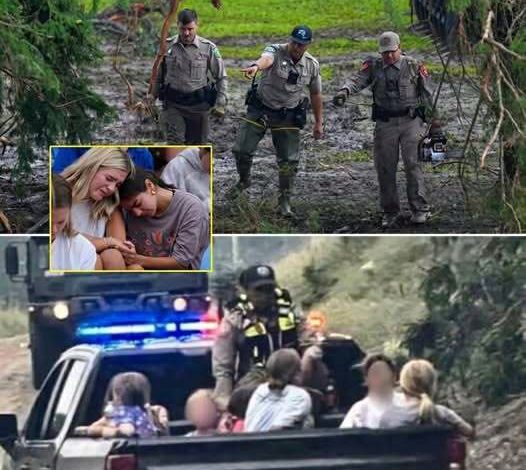
The first girl stumbled out of the darkness, barefoot and shaking.
She could barely stand.
Her clothes were torn and covered in dirt, her face exhausted, and her eyes carried the kind of fear that made the people who found her immediately realize that whatever had happened was far worse than they had imagined.
Minutes later, two more girls followed.
Three survivors.
Three trembling figures emerging from the darkness.
And the story they carried back with them has already shaken even seasoned investigators.
Twenty-seven girls had vanished after the Texas disaster.
Twenty-seven young lives suddenly unaccounted for.
Families had spent hours waiting for answers that never came.
Now three of those girls had returned.
Alive.
Dehydrated.
Terrified.
And carrying memories of those missing hours that were almost impossible for anyone outside the ravine to comprehend.
Their parents say the nightmare isn’t over.
Because while three families have finally been able to hold their daughters again, dozens of other families are still waiting for the same miracle.
They were supposed to be just another group of students on a routine trip.
The kind of trip children remember years later for ordinary reasons.
They were laughing on the bus.
Scrolling through their phones.
Sharing snacks.
Talking about weekend plans.
Complaining about the heat.
Making jokes that seemed meaningless at the time but would later become precious memories.
Nobody expected the day to become a nightmare.
Then the Texas sky turned against them.
Sirens.
Screaming.
Confusion.
Metal tearing like paper.
A violent sequence of events that transformed an ordinary trip into chaos within moments.
People ran.
Others searched desperately for friends.
Parents began calling.
Phones rang unanswered.
And somewhere in the confusion, twenty-seven girls simply disappeared.
There was no explanation that made sense.
No immediate way to know where they had gone.
No simple list that could tell frightened parents who was safe and who was missing.
The hours that followed seemed to stretch endlessly.
For the families, time stopped behaving normally.
Minutes felt like hours.
Hours felt like days.
Parents clung to photographs of their daughters, staring at familiar smiles on phone screens while waiting for a message that might never come.
They refreshed news feeds again and again.
They called friends.
They called schools.
They called anyone who might know something.
Some prayed.
Some cried.
Some simply sat in silence because there was nothing else left to do.
And beneath all of it was the same unbearable question:
*Where are they?*
For a day that felt like a year, families lived inside that uncertainty.
They didn’t know whether their daughters were injured.
They didn’t know whether they were trapped.
They didn’t know whether they could hear the rescue crews searching for them.
And they didn’t know whether anyone would find them in time.
Then something changed.
Three girls emerged from the wreckage-strewn ravine.
They were alive.
But they were not untouched.
They were dehydrated.
Exhausted.
Barefoot.
Shaking.
Their bodies showed signs of what they had endured, but their voices carried something even more powerful.
They had survived.
And as investigators began listening to their accounts, the details revealed something more complicated than a simple rescue.
The girls described darkness.
Confusion.
Cold.
Fear.
They described trying to stay together when everything around them seemed impossible to understand.
They weren’t movie heroes.
There was no dramatic soundtrack.
No perfectly executed plan.
There were simply three frightened young people trying to keep one another alive.
They shared jackets when someone became too cold.
They counted breaths in the darkness.
They whispered each other’s names.
Again and again.
Because they understood something terrifying.
If someone stopped responding, the others needed to know.
So they kept talking.
Even when they were exhausted.
Even when their voices became little more than whispers.
They reminded one another that they were still there.
That they weren’t alone.
That someone would eventually come looking for them.
That hope was still possible.
Their survival wasn’t built on strength in the way movies usually portray it.
It was built on small decisions.
Stay together.
Keep moving when possible.
Save energy.
Share whatever you have.
Don’t let someone disappear into silence.
Those tiny acts became the difference between surrender and survival.
When the girls were finally found, their families experienced a kind of relief that was almost impossible to describe.
A daughter who had been missing was suddenly standing in front of them.
A voice they had feared they might never hear again was speaking.
A face they’d been staring at on a phone screen could finally be touched.
There were tears.
There were embraces.
There were moments when nobody could say anything because words were too small.
But the joy of those reunions also carried another painful reality.
Twenty-four girls were still missing.
Three families had received an answer.
Others were still waiting.
And that made the survivors’ story something more than a rescue.
It became a fragile beacon.
A reason to keep searching.
A reason to keep believing that the darkness might still give someone back.
For the families who remained behind, the three girls’ return was proof that survival was possible.
It didn’t guarantee another rescue.
It didn’t erase the uncertainty.
It didn’t make the waiting easier.
But it changed the question.
Before the girls emerged, families could only wonder whether anyone could survive out there.
Now they knew someone had.
That knowledge mattered.
Investigators continued trying to understand exactly what happened during those missing hours.
Every detail could potentially help locate the others.
Every memory could matter.
Every description of the terrain, the sounds, the direction they traveled, or the conditions they endured could provide another clue.
And for the girls who survived, simply returning home was only the beginning.
The physical injuries may heal.
The dehydration may pass.
The exhaustion may eventually fade.
But memories can be harder to escape.
Darkness can sound different after you’ve spent hours afraid.
Silence can feel different.
A distant siren can bring everything back.
Even ordinary moments can suddenly carry the weight of what happened.
Yet there is something remarkable in the fact that these girls kept each other going.
They couldn’t control the disaster.
They couldn’t make the darkness disappear.
They couldn’t know when help would arrive.
But they could make one decision again and again:
*Don’t leave each other behind.*
And that became their strength.
Their survival has now become a fragile beacon for the families still waiting.
A reminder that even when every hour feels hopeless, a story can still change.
A person can still emerge from the darkness.
A voice can still answer.
A family can still get the call they’ve been praying for.
For the parents who are still waiting, the three girls’ return is not closure.
It is not the ending.
It is a reason to keep going.
A reason to keep searching.
A reason to keep believing that the story has not reached its final page.
Because the most powerful part of these three girls’ story isn’t that they were fearless.
They weren’t.
They were frightened.
They were exhausted.
They didn’t know what would happen next.
They simply refused to let fear completely take over.
They stayed together.
They kept whispering names.
They shared what little they had.
They waited.
And eventually, they found a way back.
Now the rest of the families are waiting for their own daughters to find that same path home.
And until every question has an answer, the three girls who emerged from that ravine remain more than survivors.
They are proof that sometimes, even in the darkest American nightmares, someone finds a way back.