Amazon Air Cargo Plane Overran a Miami Runway — Then a Responder’s Radio Warning Captured the Scale of the Emergency
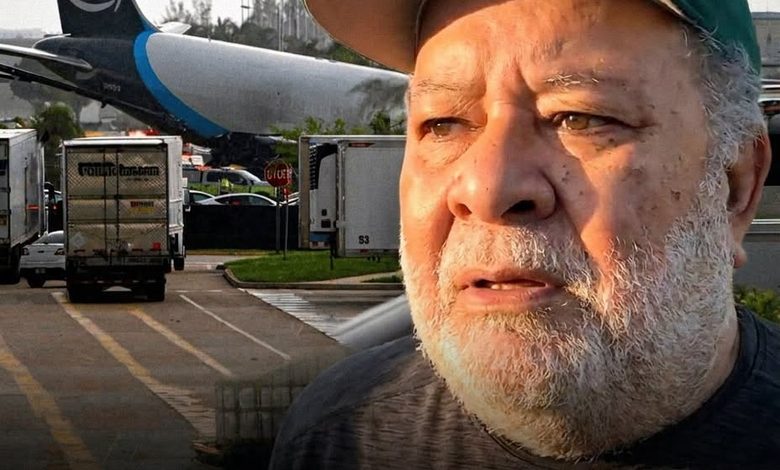
“Guys, the plane’s on fire. Plane’s on fire. Put your game faces on.” The warning crackled over emergency radio traffic as rescue crews rushed toward the wreckage beyond Miami International Airport’s runway on Sunday afternoon. A Boeing 767 cargo aircraft operating for Amazon Air had continued beyond the usable runway after landing, struck several vehicles, and erupted in flames outside the airport’s operational boundary. Five people were reported dead and five others injured, three of them critically. Some victims were trapped inside or beneath damaged vehicles while firefighters confronted burning aircraft components and leaking fuel. More than 60 Miami-Dade Fire Rescue units and roughly 200 personnel converged on the scene. For residents nearby, the first indication that anything had gone wrong was not an airport announcement but a violent impact strong enough to shake houses.
Authorities identified the aircraft as 21 Air Flight 7598, which had arrived from San Juan, Puerto Rico, at approximately 2 p.m. The Boeing 767-300 was being operated on behalf of Amazon Air as part of the company’s cargo network. Miami-Dade Fire Rescue said crews encountered heavy smoke, fire and a complex engine-compartment blaze after reaching the aircraft, while specialized airport units applied firefighting foam and technical-rescue teams searched damaged vehicles for victims. Hazardous-materials personnel worked to secure the aircraft and contain leaking fuel. Nearby resident Jose Sanchez said his house shook hard enough that he initially wondered whether an explosion or truck collision had occurred, and only after stepping outside did he begin smelling smoke. Across the neighborhoods surrounding MIA, the usual rhythm of arriving aircraft suddenly disappeared as emergency vehicles streamed toward the airport and authorities imposed a full ground stop.
What caused Flight 7598 to travel beyond the runway remained unanswered as the emergency response shifted toward investigation. Preliminary information established that the aircraft had landed before overrunning the available pavement, but investigators had not determined why it failed to stop. Flight-tracking data cited in the source indicated the aircraft was moving at nearly 130 mph when it left the usable portion of the runway, while reviewed air-traffic-control audio reportedly contained no emergency declaration from the pilots before landing. Aviation specialists cautioned that neither detail alone explains the accident. Investigators were expected to consider a range of factors, including runway conditions and weather after thunderstorms moved through South Florida, aircraft braking performance, and the condition of the landing gear. Images from the scene also drew attention to the apparent absence or collapse of the nose landing gear, another area likely to receive close examination. Until flight data, cockpit information, mechanical evidence, and runway conditions could be analyzed together, the most important question—why the aircraft could not stop—remained unresolved.
The human consequences were already painfully clear. Rescue crews transported five patients to hospitals while authorities established a hotline for families seeking relatives and temporarily closed runways and taxiways across MIA. Transportation officials warned passengers to expect substantial delays and cancellations as the FAA sent personnel to the scene and the National Transportation Safety Board began gathering information. Amazon confirmed that the aircraft was operating within its air-cargo network and said it was working with local and federal authorities, while expressing condolences to the families and loved ones affected. 21 Air likewise said it was devastated by the accident and would cooperate with the NTSB and FAA. The short radio warning captured before rescuers reached the burning aircraft carried none of the careful language of later corporate and government statements. It was simply the voice of someone looking at an unfolding disaster and preparing colleagues for what they were about to encounter.
By evening, the flames had been controlled and the emergency response had begun yielding the scene to investigators, but the wreckage beyond the runway told its own incomplete story: damaged vehicles, scorched aircraft components, disrupted airport operations, and families waiting for answers that would take far longer than a single afternoon to produce. Aviation investigations are deliberately methodical because catastrophic events rarely reduce to one dramatic explanation. Weather, aircraft systems, crew actions, runway performance, mechanical failure, and dozens of smaller factors must be reconstructed before conclusions can responsibly be drawn. For the people living near Miami International Airport, however, September 6 would be remembered less through technical findings than through the moment ordinary Sunday sounds were replaced by a shaking house, the smell of smoke, and sirens moving toward the airport. And for the responders arriving at the wreckage, the gravity of the afternoon had already been distilled into one brief instruction over the radio: put your game faces on.