The Man in One of 9/11’s Most Haunting Images Was Never Officially Identified — 25 Years Later, His Sister Shares What She Believes
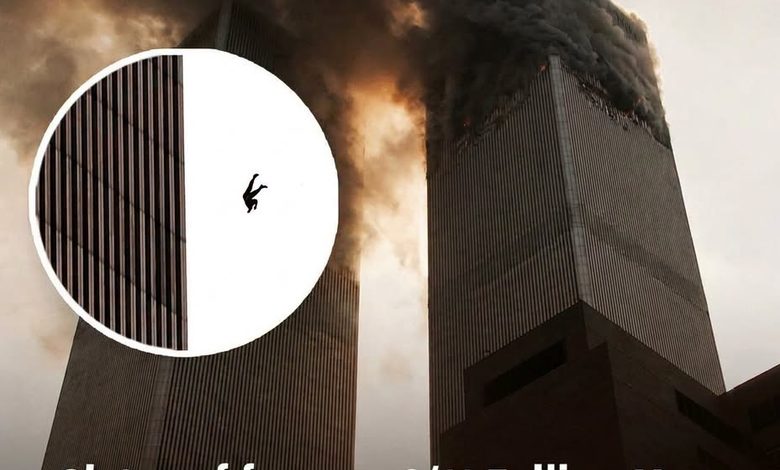
At 9:41 a.m. on September 11, 2001, Associated Press photographer Richard Drew captured an image that would become one of the most difficult photographs of the attacks to look at. A man is seen falling head-first from the World Trade Center, his body appearing almost perfectly vertical against the building behind him. The frame was published widely at first, then quickly withdrawn by many outlets after readers said it was too painful and too intimate. No official list was ever created identifying those who fell or jumped from the towers, and New York’s medical examiner classified the victims of the attacks as homicide deaths. For years, the identity of the man in Drew’s photograph remained uncertain. Yet one name gradually became the most widely discussed possibility: Jonathan Briley, a 43-year-old sound engineer who worked at Windows on the World.
The effort to identify the man was complicated from the beginning. An early theory suggested pastry chef Norberto Hernandez, but later examination of Drew’s sequence of photographs appeared to show an orange shirt beneath the falling man’s outer clothing, a detail that did not match what Hernandez was believed to have worn. Writer Tom Junod later focused on Briley, whose height, black high-top shoes, work clothes, and habit of wearing an orange T-shirt seemed to align more closely with the images. The identification has never been conclusively proven; Briley’s widow had packed away his clothing after his death, leaving no definitive comparison. Briley was the middle of five siblings, a sound engineer, gospel pianist, and recently ordained deacon who had spent the week before the attacks vacationing in Florida with his sister Gwen Briley-Strand and her husband. For Gwen, now in her seventies, the passing decades have not turned September 11 into something distant. She has described the grief as something that comes in waves—some anniversaries feeling twenty-five years removed, others feeling almost immediate.
The most painful part of the photograph has always been the question people attached to it: what does it mean to see someone falling from a burning building, and how should the final moments of that life be understood? Gwen rejects the idea that people who left the towers that way should be morally condemned or reduced to a discussion of suicide. In her view, those trapped above the impact zones were facing circumstances beyond ordinary human choice, and faith does not abandon them because of what happened in their final seconds. She has said she believes those who fell were spiritually “caught,” and she thinks of Jonathan not only as her brother but, in some ways, as representing the thousands of people who died that morning. That belief has allowed her to hold the photograph differently: not as an image of surrender, but as evidence of a human being living through the last moments available to him.
Drew has defended the photograph in similar terms. He has explained that he was shooting sequences of people falling and did not realize at the time that one frame had captured a man in such an eerily symmetrical position. He only recognized the photograph later while reviewing his images. Years afterward, responding to criticism that the picture was exploitative or unbearable, Drew argued that it did not show the man’s death itself; it showed the final portion of his life. That distinction has remained at the center of the photograph’s complicated legacy. News organizations initially recoiled from it, readers protested its publication, and yet the image endured precisely because it stripped away the distance that statistics can create. Nearly 3,000 people died in the attacks, but one anonymous figure against the geometry of the tower forced viewers to confront an individual life inside that number.
Twenty-five years later, the photograph remains unresolved in almost every way that matters. The man has never been officially identified, the exact circumstances of his final moments cannot be known, and no interpretation can make the image easier to absorb. For Gwen Briley-Strand, however, uncertainty has not erased meaning. She remembers a brother who played gospel music, suffered from asthma, became a deacon, and joined a family vacation only days before the attacks. She also refuses to let one frozen frame become the entirety of who he was. Perhaps that is why the photograph has endured despite the discomfort surrounding it: it asks viewers to look beyond the instant itself and remember that before there was a falling figure, there was a person with a family, work, faith, habits, laughter, and a life already in motion. The image is haunting not because it tells us everything about that man, but because it reminds us how much existed before the camera ever found him.