Campers Find A Mystery Baby The Size Of A Fingernail Struggling In The Dirt
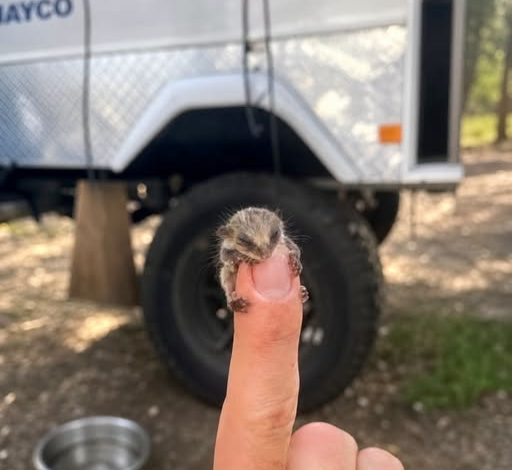
So small he almost disappeared into the dirt, the strange, shivering bundle should never have been able to survive on its own.
A young couple stopped when they noticed something moving near the ground.
At first, they thought it might be a scrap of fur, a fallen leaf, or some tiny creature that had simply wandered too close to their campsite.
Then the bundle moved again.
They froze.
It was alive.
The little animal was barely bigger than their hands, trembling against the cold ground and breathing so faintly that they were afraid to touch him. There was no nest nearby. No mother calling. No siblings. No sound except the tiny breaths coming from his fragile body.
They had no idea what they had found.
They only knew that leaving him there meant leaving him to die.
By the time rescuers from Wildlife Victoria arrived, the couple had already fallen quietly in love with the mysterious stranger they had been protecting between their hands. They had wrapped him carefully, kept him warm, and watched helplessly as his tiny body fought to hold on.
Then came the identification.
He was a feathertail glider—one of Australia’s tiniest marsupials, and a remarkably delicate creature that spends much of its life high among the trees.
Finding one helpless on the ground during daylight was deeply concerning.
Feathertail gliders are nocturnal. They are adapted to life in the canopy, moving between trees and using their remarkable gliding membrane to travel through the forest. A healthy animal should not simply be lying motionless in the dirt, exposed and alone.
And the rescuers quickly discovered just how serious his condition was.
He was desperately dehydrated.
He was cold.
He was weak.
His tiny body had very little reserve left.
That single detail—that such a nocturnal tree-dweller had been found helpless on the ground in broad daylight—told the rescue team everything they needed to know.
There was no time to waste.
The little joey was carefully transported to the rescue center, where the work began with the simplest necessities: warmth, fluids, feeding, and rest.
Nothing about his recovery could be rushed.
When an animal is this small, every decision matters.
A little too much stress can be dangerous. Feeding must be carefully managed. Body temperature has to be monitored. Even something as ordinary as resting can become part of the treatment.
For hours, the tiny survivor seemed almost impossibly fragile.
Then, slowly, something changed.
His grip strengthened.
His eyes became brighter.
His body began to relax.
And eventually, after all the fear and struggle, he fell asleep.
It was a small moment.
But for the rescuers, it was enormous.
Sleep meant his body was finally able to devote some energy to healing instead of simply fighting to survive.
Day by day, the feathertail glider began showing signs that he might actually make it.
The tiny creature who had once been nearly invisible against the dirt was becoming stronger.
His rescuers could begin thinking beyond the next few hours.
Then beyond the next day.
Eventually, he was stable enough to move into a long-term wildlife shelter where his recovery could continue away from the dangers that had nearly claimed him.
But rescue is only the beginning.
Before he can return to the wild, he has to learn the skills that his species depends upon.
He will need to become confident moving through branches.
He will need to learn how to forage.
He will need to develop the strength and coordination required to glide between trees.
Most importantly, he will need to become independent enough that the forest can become his home again.
The goal isn’t to keep him with people.
It is to give him the chance to become wild enough to leave them.
And that is what makes his story so moving.
There was no dramatic discovery deep in a remote rainforest.
No elaborate rescue operation involving helicopters or dozens of people.
It began with two people noticing something almost everyone else could have walked past.
A tiny movement in the dirt.
A faint breath.
A life that was incredibly easy to miss.
Had the couple kept walking, the outcome could have been very different.
Instead, they stopped.
They looked closer.
And because they did, a creature that might otherwise have disappeared without anyone ever knowing he existed was given another chance.
For such a tiny animal, the odds had been enormous.
But so was the determination of the people who refused to leave him behind.
One moment, he was a shivering bundle barely visible against the earth.
The next, he was sleeping safely under human care, his tiny body finally warm.
Someday, if his recovery continues, those same hands that once carried him from the dirt will no longer be needed.
He will climb.
He will glide.
He will disappear into the darkness between the trees.
And that will be the best possible ending.
Because the purpose of a rescue isn’t to make a wild animal belong to us.
It’s to give it back the life it almost lost.
One chance encounter on a campsite floor became his quiet escape from disappearing forever.