At My Mom s Funeral, I Saw My Husband Standing Beside Her Coffin and Heard Him Whisper, I Kept Our Little Thing It ll Stay Hidden Forever Under the Red Maple What I Dug up Made Me Call 911
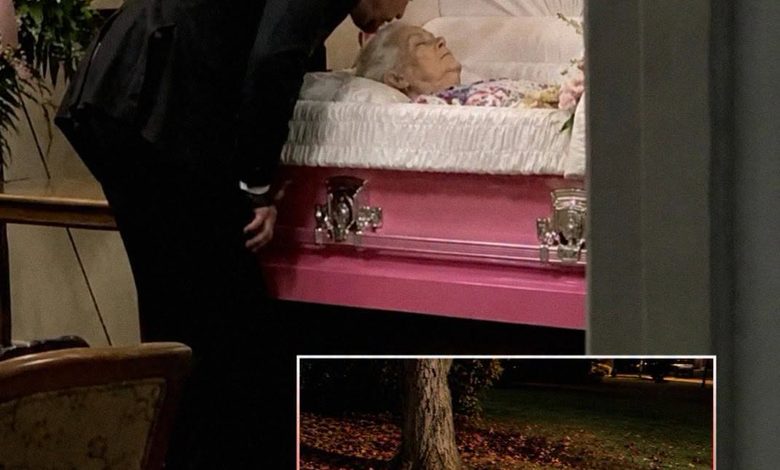
For 27 years, my husband and mom could barely stand each other, but neither would tell me why. At her funeral, I heard him whisper that their secret would stay buried beneath her red maple forever. That night, I took a shovel to her yard—and what I found made me call the police.
My husband and my mother hated each other for twenty-seven years.
I used to say they were like oil and water, but even that sounds too harmless.
Oil and water can sit in the same glass without making Christmas dinner unbearable.
Joe and Mom couldn’t.
I could probably count the number of pleasant conversations the two of them had shared without hands because the answer was zero.
My husband and my mother hated each other
One Thanksgiving, Mom looked across the table at Joe and asked, “Are you still doing contract work?”
Joe put down his fork.
“I own the company, Margaret.”
“I know.” Mom took a slow sip of wine. “I’m making conversation.”
“Could’ve fooled me.”
“I’m making conversation.”
I kicked him under the table.
Our daughter, Emily, who was sixteen at the time, looked between them and muttered, “And people wonder why I like eating in my room.”
***
Later that night, I cornered Joe while he was putting on his coat.
“Why do you let her get to you?”
“And people wonder why I like eating in my room.”
He laughed without humor.
“Because she tries.”
“She does it because you react.”
“No. She does it because she hates me and thinks that gives her permission to treat me like dirt.”
“She doesn’t treat you like dirt.”
She does it because she hates me
He gave me a look.
“Fine. Sometimes she does. But you aren’t exactly warm with her.”
He pulled his jacket on harder than necessary.
“We don’t get along. That’s it.”
That was always the answer.
From both of them.
“We’re from different worlds,” Mom would say.
Joe grew up poor and started construction work at seventeen. Mom built a successful accounting firm from almost nothing.
For years, I assumed that explained it.
Until one afternoon about twelve years into our marriage.
“We’re from different worlds,”
They were arguing in Mom’s kitchen.
I walked in when Mom said, “Don’t stand there and act like you’re some kind of saint.”
Joe’s face went hard.
“I never said I was.”
“You’ve lied to her every day of your marriage.”
“Don’t stand there and act like you’re some kind of saint.”
My stomach dropped.
“Mom?”
Both of them turned.
“What are you talking about?” I asked.
Mom stared at Joe.
“What are you talking about?”
He stared back.
Then she said, very quietly, “You know exactly what you did.”
Joe went silent.
That scared me more than yelling would have.
Joe ALWAYS defended himself.
But not then.
“You know exactly what you did.”
For the first time, I was wondering what my husband had done to make my mother hate him.
I waited until we got home.
“What did she mean?”
Joe was taking off his shoes near the front door.
“Nothing.”
I was wondering what my husband had done to make my mother hate him.
“She said you’ve lied to me every day of our marriage.”
“Your mother says a lot of things.”
“You didn’t deny it.”
He looked up.
“Linda, she hates me.”
“Why?”
He looked away.
“She’s holding onto some old grudge.”
“What grudge?”
“Ask her.”
That ended the conversation. Not because I believed him.
Because I finally understood neither of them intended to tell me the truth.
Then there was Mom’s red maple.
She’d planted it around the time Joe and I married. I never thought much about the timing.
I did think it was strange how fiercely she protected it.
Over the years, the tree became almost ridiculous in its importance to her.
When the roots cracked part of the stone walkway, I told her she might have to remove it.
She looked at me like I’d suggested burning the house.
She’d planted it around the time Joe and I married.
“Absolutely not.”
“It’s damaging the path.”
“Then I’ll replace the path.”
When Emily was maybe five, she once took a little plastic shovel and started digging around the trunk.
Mom saw her through the kitchen window. She dropped her mug and ran outside.
She started digging around the trunk.
“Emily!”
I had never heard her yell at my daughter before.
Emily froze.
Mom grabbed the shovel from her.
“Don’t dig there.”
Emily started crying.
I rushed over.
“Mom, what is wrong with you?”
Mom stared at the disturbed dirt.
Her face was pale.
Then she looked at Emily and softened.
“I’m sorry, sweetheart.”
But she didn’t explain.
She never did.
Years later, I would remember her face more clearly than anything she said that day.
Then she died.
It happened fast.
A stroke, then complications. Three days in the hospital.
She didn’t explain.
By the end, she couldn’t speak.
Joe came with me every day.
The morning she died, he stood beside her bed for almost ten minutes after everyone else had left.
I thought maybe grief had finally erased whatever stood between them.
I was wrong.
At the funeral reception, I noticed Joe was gone.
People were eating sandwiches and drinking coffee in the church hall. Emily was talking to one of my cousins.
I went looking for him.
Mom’s coffin was still in the chapel.
I reached the doorway and heard Joe’s voice.
“I kept our little thing, Margaret.”
I stopped.
Joe stood beside the open coffin with his back partly toward me.
His hand rested on the edge.
“No one ever found out.”
Joe looked down at Mom for a long moment.
Then he let out a breath that sounded almost like relief.
My body went cold.
Then he leaned closer.
“It’ll stay hidden forever under the red maple.”
I stepped backward before he could see me.
I don’t remember walking back to the reception.
He let out a breath that sounded almost like relief.
That night, Joe fell asleep almost immediately.
I lay beside him for twenty minutes.
Then I got up.
I drove to Mom’s house.
The red maple stood behind it, huge now, its branches moving lightly in the wind.
I found a shovel in the garage.
For the first ten minutes of digging, I felt insane.
For the next ten, I felt worse.
Then the blade hit metal.
I stopped breathing.
I dropped to my knees and cleared dirt away with my hands.
There was a container buried about two feet down, wrapped in layers of old plastic.
I carried it to the porch.
My hands were shaking so badly I could barely open it.
Inside were papers.
Hospital papers.
There was a container buried about two feet down
A baby bracelet.
A tiny pink knitted hat.
A card with faded footprints.
I sat down.
The hospital name was the one where Emily was born.
Until that moment, I’d been afraid of what grudge had poisoned Mom and Joe’s relationship. Now I was afraid of what it had to do with me.
I’d been afraid of what grudge had poisoned Mom and Joe’s relationship.
Suddenly I was back there twenty-seven years earlier.
Emily’s delivery had gone badly. There had been emergency surgery, my blood pressure crashing, voices over me—and then nothing.
When I woke hours later, Joe and Mom were beside my bed.
“Is the baby okay?” I’d asked.
Joe squeezed my hand.
“She’s okay.”
That was all I’d ever known.
Now I was looking at the official records, and one shocking detail immediately stood out.
There was my name, and Joes’s.
Then, delivery: emergency cesarean.
Two female infants… TWO.
One shocking detail immediately stood out
It continued.
Twin A: live birth.
Twin B: neonatal death.
I read the line again.
Then again.
I had given birth to twins.
Emily had a sister.
And according to a document buried beneath my mother’s tree for twenty-seven years, that baby had died before I ever knew she existed.
According to a document.
That thought stopped me.
Joe had known.
Mom had known.
They had hidden this from me for twenty-seven years, then buried the proof in the ground.
So why was I trusting anything the box told me?
I grabbed my phone and called the police.
They had hidden this from me for twenty-seven years
While I waited, I kept going through the box.
I found an envelope filled with letters.
The first was in Mom’s handwriting.
Joe,
We need to tell Linda. What we did in those first days may have been understandable because she was critically ill, but every day we continue makes it worse.
Joe’s reply was short.
Not now. She’s barely sleeping. She’s bonding with Emily. Don’t do this to her.
There were more.
Six months later, Mom asked again.
Then after a year.
Then again and again.
There were dozens of letters spanning years.
Mom kept asking.
Joe kept refusing.
Mom had spent years begging Joe to tell me. What I still couldn’t understand was why she’d never simply told me herself.
I sat on the porch floor surrounded by paper when the police arrived.
I still couldn’t understand was why she’d never simply told me herself.
Two officers came around the side of the house.
A woman named Officer Ramirez crouched near me.
“Ma’am, are you Linda?”
“Yes.”
“You said you found something buried?”
I pointed to the box.
She glanced at it.
“What is it?”
I tried to answer.
My voice broke.
“My daughter.”
She stared at me.
I shook my head.
“No. Not a body. Papers. I had another daughter.”
The officers exchanged a look.
I explained everything badly.
The funeral.
Joe’s words.
Officer Ramirez read several pages.
After a while, she sat beside me.
Officer Ramirez read the hospital page twice.
“Do you have any reason to believe this record isn’t real?”
“I have twenty-seven years of reasons not to trust the people who hid it.”
She looked at me.
That was when I finally said what I was afraid to say.
“How do I know my baby really died?”
The question hung between us.
Ramirez’s expression changed.
She asked for the hospital name, the date, and my identification. Then she made several calls while her partner photographed the contents of the box.
I finally said what I was afraid to say.
It took almost an hour.
When she came back onto the porch, she sat beside me.
“The hospital confirmed two deliveries under your name that night. One surviving infant and one neonatal death.”
I closed my eyes.
“So she really died.”
For a moment, I felt hollow.
Then the grief rushed in.
“My little girl… died,” I sobbed. “And I never even knew she existed. How could they do this to me?”
Ramirez glanced toward the box.
The police had answered the question that terrified me most. Their answer made the question waiting for Joe even worse.
“How could they do this to me?”
For twenty-seven years, Joe had known she existed.
And now there was only one person left who could tell me why he’d decided I never should.
I drove home just before dawn.
Joe was in the kitchen.
“Where were you?”
I put the box on the table.
He looked at it.
His face emptied.
“You recognize it.”
He sat down.
“I had twins. One of them died, and you and Mom never told me. Did I miss anything, Joe?”
His eyes closed.
“No.”
I slapped him.
I’ve never hit anyone in my life.
The sound shocked both of us.
Joe touched his cheek but didn’t get angry.
I almost wished he had.
“How could you?” I shouted. “I am her mother! I have a right to mourn her, and you took that from me.”
“You nearly died in surgery. Your blood pressure crashed. You were barely conscious afterward. The doctor said stress could—”
“Why didn’t you tell me six months later? A year?”
“You took that from me.”
He stood.
“There was never a good time.”
I stared at him.
“There was never going to be a good time to tell me that. But in twenty-seven years, you should’ve found one day to be honest with me.”
His eyes filled with tears.
“I was trying to protect you. You were finally happy. You had Emily. What was I supposed to do—walk in one day and tell you there’d been another baby and she was dead?”
“YES!”
He flinched.
“Yes, Joe. You were supposed to tell me my daughter existed.”
“You should’ve found one day to be honest with me.”
“What would knowing have changed?”
Something inside me went still.
“Everything. It would’ve changed everything, you jerk! She was my little girl. You don’t get to decide that I can’t mourn her.”
“Mom wanted to tell me.”
“No, she agreed with me at first.”
“And afterward?”
Joe’s face crumpled.
“But she wasn’t the reason you kept saying no.”
For the first time that night, I wasn’t asking what he’d done. I was asking what he’d been protecting all those years—me, or himself.
He didn’t answer.
“Why, Joe?”
He hit the table with his palm.
“Because I was scared you’d hate me!”
The room went quiet.
That was the first honest thing he’d said.
Joe sat down.
“So your solution was to lie to me long enough to guarantee it.”
His shoulders folded.
For the first time, I understood why Mom hated my husband.
She wasn’t innocent.
She had agreed to the lie when I was sick, then spent years knowing the truth and failing to tell me herself.
But every time she looked at Joe, she saw the man who kept choosing silence.
And every time Joe looked at her, he saw the one person who could expose him.
Twenty-seven years of hatred suddenly made perfect sense.
I told Joe to leave.
He didn’t argue.
Two days later, I told Emily.
She was twenty-seven.
She sat across from me in Mom’s kitchen while I placed the tiny pink hat on the table.
“What is this?” she asked.
“It belonged to your sister.”
Emily stared at me.
“My what? I don’t have a sister.”
“You did.”
I told her everything.
Halfway through, she stood and walked to the window.
When I finished, she stayed there.
Finally she asked, “Dad knew? And Grandma?”
She pressed a hand over her mouth.
“So I was a twin.”
“Dad knew? And Grandma?”
“Did she… were we identical?”
“I don’t know,” I replied, my voice shaking.
She started crying.
We held each other in Mom’s kitchen.
After a while, Emily whispered, “Did she have a name?”
That question destroyed me.
“Did she have a name?”
I had spent days reading everything in the box and hadn’t found one.
“I don’t think they named her.”
Emily pulled back.
“Then we should.”
She took my hand and led me out into the yard.
The red maple was turning orange.
Emily rested her hand against the trunk.
“So this is why Grandma lost her mind when I dug here. She was protecting the box.”
“I think it was more than that. I think this tree was her way of remembering her.”
Emily looked up through the branches.
We chose a name for her sister.
Anna.
It was simply a name we both loved.
I’m separated from Joe now.
Emily still speaks to him, but not the way she used to. Twenty-seven years of silence cost him something neither apology nor good intentions could give back.
Last Sunday, we planted small white flowers beneath the red maple.
This time, when Emily dug into the earth, no one stopped her.