The Meaning Behind Shoes Strung Up On A Power Line
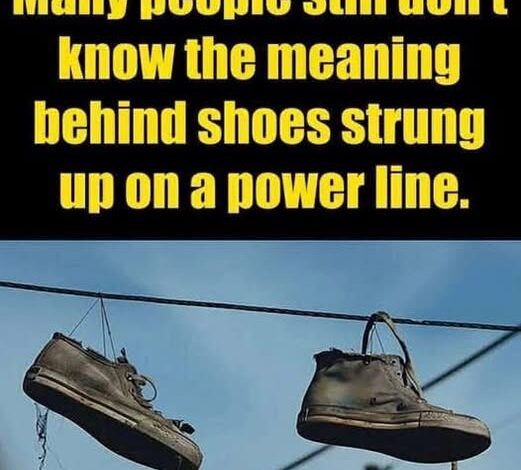
If you have spent any significant amount of time navigating the labyrinthine streets of a modern city or even the quiet, paved cul-de-sacs of the suburbs, you have undoubtedly encountered it: the curious, gravity-defying sight of a pair of sneakers, tied tightly together by their laces, dangling like a strange pendulum from a high-tension power line. It is a visual that is as ubiquitous as it is enigmatic. Against the backdrop of a setting sun or a grey morning sky, these shoes hang high above the asphalt, swaying gently in the wind, seemingly abandoned yet intentionally placed.
For many of us, our first instinct is to dismiss the sight as a relic of a simpler time—perhaps a fleeting moment of teenage mischief or a childish prank born out of boredom and a lack of supervision. I, too, once viewed these hanging shoes as nothing more than the physical remnants of a “dare” gone right. However, as the years have passed and the stories surrounding this phenomenon have multiplied, it has become clear that this is not merely a random act of littering. Instead, it is a complex cultural ritual with multiple layers of meaning, spanning from military traditions to urban legends and the raw dynamics of human psychology.
The Military Origins: A Rite of Passage in Mid-Air
One of the most enduring and widely respected theories regarding the origin of shoe-tossing is rooted in the hallowed traditions of the armed forces. According to historians of military folklore, the practice began as a symbolic rite of passage for soldiers. Imagine a young recruit who has just endured months of grueling physical training, mental exhaustion, and the rigid discipline of a boot camp. Or, perhaps, a seasoned soldier returning from a long, harrowing tour of duty in a foreign land.
For these individuals, the boots on their feet represented the weight of their service—the literal and metaphorical miles they had marched under duress. By tying the laces together and hurling them onto the wires near a base or a hometown street, the soldier was performing an act of “letting go.” It was a declaration that a difficult chapter had closed. In this context, the shoes were not discarded trash; they were a monument to survival, perseverance, and transition. As veterans returned to civilian life, they brought this ritual with them, and slowly, the practice began to bleed into the collective consciousness of the general public, though the original weight of the gesture was often lost in translation.
The Shadow of the Street: Gangs, Territories, and Urban Legends
Perhaps the most famous—and controversial—explanation for sneakers on power lines is their alleged connection to the darker side of urban life. For decades, a persistent theory has claimed that shoes dangling from wires serve as a cryptic language for gangs and organized crime. According to the lore of the streets, these shoes act as “billboards” for illicit activity. Some believe they mark the boundaries of a specific gang’s territory, a warning to rivals that they are stepping onto hostile ground. Others suggest they indicate “crack houses” or locations where drugs are actively being sold, with the style or color of the shoe indicating the type of substance available.
Furthermore, a more somber version of this theory suggests that the shoes serve as a memorial for a fallen gang member who was killed on that very spot. It is a way of keeping their memory “elevated” above the cold pavement where their life ended. While these stories have been immortalized in Hollywood films and sensationalized news reports, law enforcement agencies across the globe have frequently challenged their validity. Many police departments have stated that there is no consistent evidence to link shoe-tossing to crime rates or drug distribution. Despite this, the theory refuses to die. Its persistence speaks to our innate human desire to decode the environment around us—to find a hidden, perhaps dangerous, meaning in something that feels eerie or out of place.
The Playground Power Play: Bullying and Childhood Dominance
Away from the world of soldiers and gangs, there is a much more localized and painful explanation rooted in the rituals of childhood. In countless coming-of-age stories and the lived experiences of many, the image of shoes on a wire represents a moment of acute humiliation. We have all seen the trope in cinema: a group of bullies corners a smaller, more vulnerable child, forcibly removes their sneakers, and tosses them somewhere unreachable—a high tree branch, a rooftop, or the power lines outside the school gates.
In this scenario, the dangling sneakers are a symbol of exclusion and dominance. For the victim, the sight of their own shoes swaying high above is a constant, public reminder of their powerlessness. It is a psychological brand that stays visible to the entire neighborhood until the laces finally rot or the utility company intervenes. In the hierarchy of the playground, the “shoeless” child is the defeated one, and the sneakers become an unspoken billboard of shame.
Celebration, Rebellion, and the Spontaneity of Youth
Of course, not every pair of shoes carries the weight of trauma or tradition. In many instances, the act is born out of pure, unadulterated joy or spontaneous fun. In college towns across the United States and Europe, shoe-tossing has become a hallmark of milestone celebrations. When the final exams are over and the stress of a four-year degree finally evaporates, graduating students have been known to hurl their footwear onto the nearest wire as a final act of collegiate rebellion.
It is a “graduation” from the constraints of the classroom. Similarly, it can be a mark of “firsts”—the first time a teenager gets their driver’s license, the first kiss of a summer romance, or the successful completion of a dare. In these moments, the act is lighthearted, a shared laugh between friends that leaves a permanent mark on the landscape of their youth. It is a way of saying, “We were here, and we were happy.”
The Artistic Perspective: Shoefiti as Urban Expression
In the modern era, the act has even been claimed by the world of art. Dubbed “Shoefiti” (a portmanteau of shoe and graffiti), the practice has been embraced by street artists and photographers who see the dangling footwear as a form of urban sculpture. For an artist, the shoes represent the “ghosts” of the city. They prompt questions about identity: Who wore these? Why did they leave them here? Where are they walking now?
Filmmakers often use the image to evoke a sense of nostalgia or a specific “gritty” atmosphere in their storytelling. To an artist, those sneakers are a canvas for memories. They are a physical manifestation of the layers of human history that exist in a single neighborhood. They represent the foot traffic of a thousand lives, distilled into a single, hanging object.
Conclusion: A Multi-Faceted Monument
Ultimately, the true meaning of sneakers dangling from power lines is as varied as the communities in which they are found. There is no single “key” to unlock the mystery. In one zip code, they may be a somber tribute to a life lost; in another, a joyous shout of a student who has finally finished their studies. They are a military salute, a bully’s trophy, a prankster’s punchline, and a photographer’s inspiration.
What remains fascinating is how such a simple, everyday object—the very thing that connects us to the ground—can be transformed into something that hovers between earth and sky, loaded with so much conflicting significance. Whether born out of tradition, rebellion, grief, or humor, those shoes tell a story. Even if we cannot always be certain what that story is, they stand as a reminder that every street corner has a history, and every pair of shoes has a journey that led them there.