Man cut in half by forklift finally answers the question everyone keeps asking
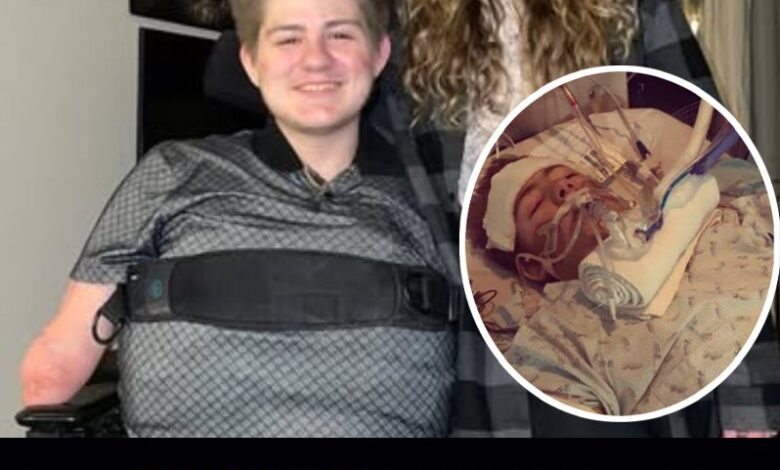
The story of Loren Schauers is one of the most statistically improbable survival tales in modern medical history. In 2019, a routine construction job in Great Falls, Montana, turned into a nightmare that would leave Schauers severed in half. Today, years after the catastrophic event, Loren and his wife, Sabia Reiche, are using their platform to educate the public on the realities of living with a hemicorporectomy—while setting firm boundaries on their privacy.
I. The Accident: A Split-Second Tragedy
In September 2019, while operating a forklift on a bridge, the ground beneath Schauers gave way. He plummeted 50 feet, and the heavy machinery landed directly on his lower body, crushing his hips and right forearm.
Faced with injuries that were almost universally fatal, surgeons presented Loren with a grim ultimatum: undergo a total amputation of the lower half of his body or face certain death. His response has since become a testament to his character. As Sabia recalled, Loren looked the doctors in the eye and told them he didn’t care if he ended up as “just a head on a plate,” as long as they kept him alive.
II. Life After Hemicorporectomy: Navigating a New Anatomy
A hemicorporectomy is one of the rarest and most extreme surgical procedures, involving the removal of the pelvis and everything below it. For Loren, this also included the loss of his right arm. Since launching their YouTube channel, the couple has been flooded with questions about how a human body functions after such a radical change.
Addressing the Biological Questions
Loren has been candid about his daily physical management, explaining the complex systems that have replaced his natural functions:
- The Colostomy: Because his lower digestive tract was removed, his colon has been redirected through his abdominal wall into a colostomy bag.
- Bilateral Nephrostomies: To manage urinary function, tubes are inserted directly into his kidneys, draining urine into external bags.
- Daily Care: This “new normal” requires constant maintenance, much of which is handled by Sabia, who has become his primary caregiver and medical advocate.
III. The Boundary: Intimacy and Respect
Despite their openness about medical procedures, the couple has faced an onslaught of invasive questions regarding their intimate life. Sabia has been vocal about the “disrespectful” nature of these inquiries, pointing out that physical disability does not waive a couple’s right to privacy.
“You wouldn’t ask a random couple on the street how they have sex,” Sabia stated. “Just because our life circumstances are different, it doesn’t give people the right to ask.”
By drawing this firm line, the Schauers are challenging the societal tendency to desexualize or over-fetishize people with extreme physical differences.
IV. A Partnership Forged in Fire
The couple married in 2021, and their relationship has become the cornerstone of Loren’s recovery. On the sixth anniversary of the accident, Loren shared a poignant tribute to his wife, acknowledging the immense burden and emotional strength required to stay by his side.
Loren describes himself as “blessed” to have a partner who sees beyond the physical trauma. For Sabia, the care she provides—from changing colostomy bags to navigating a world not built for Loren’s unique wheelchair—is an act of devotion rather than a chore.
Conclusion: The Human Spirit Unbroken
Loren Schauers remains a medical marvel, but he prefers to be seen as a man who chose life over the alternative. His story serves as a stark reminder that the definition of a “complete life” is not determined by the presence of limbs, but by the presence of love and the will to keep moving forward. As they continue to share their journey, the Schauers are redefining what it means to be a survivor in the 21st century.