My Mother-in-Law Pushed Me Down the Stairs—Then My Husband Finally Told the Truth
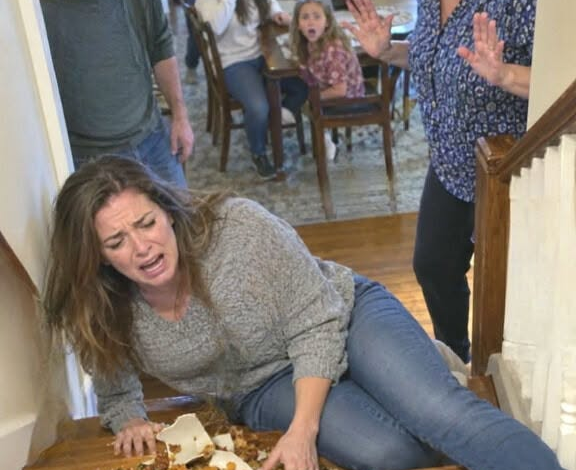
Dr. Mercer waited until the door closed behind Graham.
“You have three fractured ribs,” he told me. “One is displaced, and the scan shows bruising around your lung. You need to stay here for observation.”
For a moment, I couldn’t breathe.
Not because of the pain.
Because someone had finally said out loud what my husband had been trying to minimize.
The doctor carefully documented the injuries and the long pressure mark across my back.
The nurse asked whether I wanted Graham kept outside.
“Yes,” I said.
It was the first decision I had made that night without looking to my husband for permission.
Then I saw the messages on my phone.
While I was inside the scanner, Graham had written in the family group chat:
“Mom didn’t mean to push Nora. Please don’t make this bigger than it is.”
He had admitted the truth to the entire family while trying to make the hospital believe I had simply fallen.
Then Judith arrived.
She was wearing the same cardigan from dinner, with a dark casserole stain still visible near the bottom.
When she saw me in the hospital bed, her face went pale.
“Tell them I never touched you,” she demanded.
I held up my phone.
Graham stared at the message.
Then he looked at his mother.
Judith stepped closer.
“Graham,” she warned.
He finally spoke.
“She pushed you.”
The room went silent.
Judith’s expression changed immediately.
“You were upstairs!”
“I was at the doorway,” Graham said. “I saw your hand on her back.”
My husband had known.
He had watched his mother push me, heard me hit the stairs, and still tried to turn it into an accident.
Judith began calling me dramatic.
She said I was trying to destroy her family.
She insisted the mark on my back could have come from anything.
The nurse stepped between us and told her to leave.
Before the door closed, Judith looked directly at me.
“You will regret this.”
The frightening part was that I believed her.
But I also knew I’d regret myself even more if I lied.
So I gave my statement.
I told them exactly what happened.
The basement door.
Judith’s voice.
The pressure between my shoulders.
The missing step.
The concrete floor.
I showed them Graham’s message.
I didn’t exaggerate anything.
I didn’t need to.
Later that night, Graham was allowed back into my room.
He stayed near the wall.
“I panicked,” he said.
“So you lied.”
“I was trying to keep everyone calm.”
“I was lying at the bottom of a staircase.”
He looked down.
Then he told me about his childhood—how his mother punished him with silence, guilt and emotional pressure whenever he challenged her.
I understood his fear.
But understanding it didn’t make it safe for me.
“You saw her push me,” I said. “Then you told the nurse I slipped.”
He started crying.
I didn’t.
“Will you tell the truth if they ask you again?”
He hesitated.
“Yes.”
“Even if she cuts you off?”
His face tightened.
“Yes.”
I wanted to believe him.
But trust had changed.
For years, Graham had been reliable in ordinary ways.
He remembered my coffee order.
Packed my lunch when I worked late.
Kept jumper cables in my car.
But when everything fell apart, he had chosen the kind of peace that depended on my silence.
The next morning, I told him I wouldn’t be going home with him.
I stayed with a coworker instead.
Over the following weeks, my medical records documented the fractures, bruising and injuries.
Graham eventually gave a formal statement confirming what he had seen.
Then he wrote another message in the family group chat:
“I saw my mother put her hand on Nora’s back. Nora did not slip.”
Judith immediately called him ungrateful.
Then she left the group.
For years, everyone had organized themselves around Judith’s reactions.
For once, the truth remained after she walked away.
My recovery took weeks.
Graham moved into a short-term rental.
He apologized.
He paid the medical expenses insurance didn’t cover.
But I told him I needed distance.
Judith continued trying to contact me through relatives.
First, she called it an accident.
Then a misunderstanding.
Then a private family matter.
Every version required me to protect her from the consequences.
I stopped responding.
Eventually, the case moved forward through medical records, statements and evidence rather than one dramatic confrontation.
Judith accepted a legal resolution that included probation, counseling, restitution toward my medical expenses and an order preventing her from contacting me.
She never apologized directly.
Graham and I separated permanently.
During counseling, he admitted something that hurt almost as much as the lie at the hospital.
He had noticed other warning signs before the staircase.
A hand gripping my wrist too tightly.
A doorway blocked during an argument.
Comments about accidents happening to women who didn’t respect their elders.
He had treated every incident as separate because seeing the pattern would have forced him to choose.
I filed for divorce.
This time, Graham didn’t fight it.
Almost a year after the fall, my ribs had healed.
One Sunday, the coworker who had taken me from the hospital came over with friends.
We ate around my kitchen table.
Nobody monitored what I said.
Nobody questioned my memory.
Nobody asked me to trade the truth for comfort.
Later, I walked past the staircase in my apartment.
For months, stairs had terrified me.
Now they were simply stairs.
I finally understood something.
Family shouldn’t be where harm gets hidden.
It should be where someone tells the truth before you have to beg.