A Waitress Paid a Stranger’s $58 Breakfast Bill With Her Own Card — Nine Days Before Her Power Was Due to Be Cut Off. She Had No Idea Who He Was.
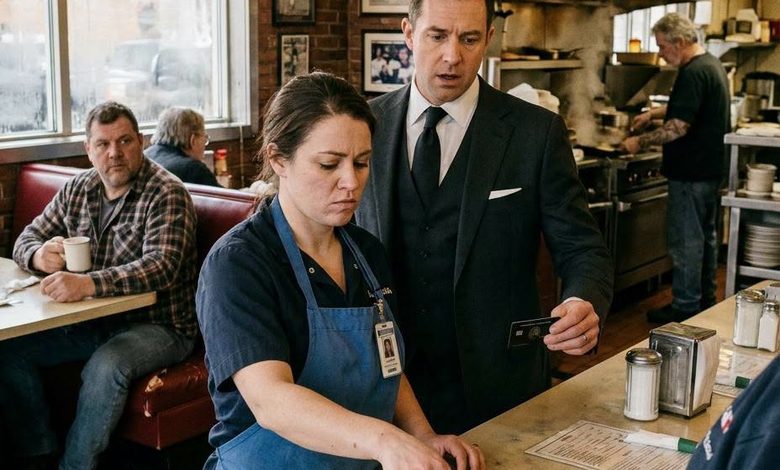
A waitress earning four dollars and fifteen cents an hour plus tips paid a stranger’s fifty-eight dollar breakfast bill with her own debit card, nine days before her electricity was due to be shut off — and the man she paid for had switched his own card off in the car park eleven minutes earlier, on purpose, to see what would happen.
The card is matte black and it weighs about as much as a teaspoon.
It had not been refused in Paris. It had not been refused in Tokyo. On a Tuesday morning in February it got refused at a corner diner on Pernell Street in Pittsburgh, and the whole counter went quiet.
Desmond Ashgrove-Crane looked at the terminal, and then up at the waitress, and said, “Sorry — can you run it again?”
Her name is Hattie Quillane. She is twenty-nine. She has worked at Bellweather’s since she was nineteen.
She blew a bit of hair off her face and looked past him at the queue, because it was twenty to nine and there was a trucker tapping the counter for a refill and two men from the scaffolding job waving a receipt and a mother trying to get a fork off a toddler.
She ran it again. It made that flat noise.
Two of the regulars turned round on their stools.
Desmond let his face do something he had practised in the car. “That isn’t possible.”
Hattie leaned in and dropped her voice the way you do when somebody is about to be embarrassed. “It happens.”
“It doesn’t.” It came out harder than he meant, out of thirty years of rooms where it genuinely did not.
She did not blink at him. She gave him a tired, sideways little smile and said: “Then today’s your lucky day. You finally get to be normal.”
That is the first sentence anybody had said to Desmond Ashgrove-Crane in about nine years that was not calculated.
Fifty-eight dollars and forty cents is not money to that man. He is thirty-eight. He runs Ashgrove Hospitality, which is hotels and office blocks and commercial units from Boston down to Atlanta, and it is private, which means nobody votes on anything he does.
The card was not declined. He had frozen it in the banking app at 8:17, sitting in the car outside, with his thumb.
He was in that diner for one reason and the reason was sitting in the corner booth by the window pretending to read his phone.
Royce Tandy. Regional director, commercial properties.
Royce had never met him. Four levels down, eleven hundred staff, headshot in a lobby he visits twice a year. He had no idea.
For three months complaints had been coming up the chain from small tenants in Ashgrove buildings. Repairs not done. Service charges going up mid-term. Renewal terms changed in the week before signature. Four tenants in writing saying Royce had threatened them personally.
Bellweather’s is one of those tenants. Thirty-two years in the same brick unit.
Desmond could have sent three lawyers and a forensic accountant. He came himself, in a suit, at twenty past eight, because he wanted to watch the man work when there was nobody in the room worth performing for.
And for forty minutes Royce had sat in that booth and been exactly what the letters said he was. Sent the eggs back twice. Clicked his fingers at Hattie. And said into his phone, at a volume that carried to the counter, that little outfits like this one have to learn when their time is up.
Desmond had heard enough and was leaving. And then, standing at the register with his wallet out, he had an impulse he has since described to me as the worst good idea he has ever had.
He froze the card. He wanted to see what the room would do to a man in a two thousand dollar suit the second the money went away.
It took about four seconds.
Royce laughed, loudly, from the booth. “Careful, sweetheart,” he said to Hattie. “Looks like he dresses better than he banks.”
Two people laughed and then wished they hadn’t.
Desmond put the card away. “I can transfer it.”
“Register doesn’t take transfers,” Hattie said.
“My phone can —”
And Abel came out from behind the pass with flour on his forearms and looked at the suit and then at the unpaid total on the screen and said one word. “Hattie.”
“I’ve got it.”
“We don’t run tabs for strangers.”
“I said I’ve got it.”
And she took her own debit card out of the front pocket of her apron.
Desmond looked at it. It is bent slightly at one corner. He told me that afterwards, unprompted, twice.
“What are you doing?”
“Paying your bill.”
“You don’t know me.”
“Nope.”
“You don’t know if I’ll pay you back.”
“Nope.”
“You’re putting fifty-eight dollars on your own card for somebody you have never met.”
She did not answer him. She put it in the machine and typed her PIN with her hand over the keypad and it said APPROVED, and she tore the slip off and held it out.
“There. It’s paid.”
He did not take it. He said: “You didn’t even hesitate.”
“I hesitated,” she said. “About three seconds.”
“Why?”
And she looked over his shoulder at the booth where Royce was still enjoying himself, and she said it quietly enough that only Desmond heard it.
“Because being embarrassed is worse when people are watching.”
He sat down at the counter. He did not plan to and he could not have told you why.
When she came back round with the pot he noticed the envelope in her apron pocket, which had come up far enough to read. FINAL NOTICE, in red, across the top. She saw him see it and pushed it back down with two fingers and said nothing, and so did he.
Then Royce came over and dropped a manila folder on the counter next to Desmond’s coffee.
“Give that to Dovie.”
Dovie Bellweather is sixty-eight and she was four feet away through the pass with a spatula in her hand.
Hattie did not touch it. “What is it?”
“Notice to vacate. Thirty days.”
“You told her she had till the end of the year.”
“Things changed.”
“That was two weeks ago.”
Royce leaned on the counter, closer to her than he had any business being. “You’re a waitress. Stay in your lane.”
“She’s been in this building thirty-two years.”
“And she’s about forty percent under market.”
“This place feeds half the street.”
“Then half the street can go and eat somewhere profitable,” Royce said, and he checked his watch while he said it.
Desmond stopped turning his cup.
He has heard men talk like that in glass rooms for fifteen years. He has promoted some of them for it. He told me that the only difference, sitting on a stool on the wrong side of the counter, was that there was no word for it up there and there is one down here.
Royce turned and went for the door, getting his gloves out of his coat.
And Desmond Ashgrove-Crane stood up off that stool, and buttoned his jacket, and said one word across a diner full of people eating their breakfast.
“Royce.”
The man stopped with his hand on the glass and turned round, irritated.
“I’m sorry — do I know you, pal?”
“No,” Desmond said. “We’ve never met. You work for me.”
It took about two seconds. You can watch it happen on the diner’s own camera, which is how I have seen it, because Dovie kept the file.
Royce’s face goes through four things in a row and lands on the last one and stays there.
He said, “Mr. Ashgrove-Crane. Sir. I didn’t — if I’d known there was a site visit —”
And Desmond said: “If you had known, you’d have behaved differently. That was rather the point.”
He told him, in front of about thirty people, that there had been three months of complaints from commercial tenants, that he had come to find out whether they were exaggerated, and that they were not.
Royce tried the only card he had. He said he was maximising the portfolio. He said the unit was badly under market. He said the mandate from head office to regional directors was to optimise.
“The mandate was to manage the properties,” Desmond said. “Not to hollow out the streets that keep them full. You have spent forty minutes insulting a woman who earns less in a week than the watch you keep checking. You’re finished. Leave the phone and the keycard on that table.”
He did. Both of them, on the empty two-top by the door, and then he went out into the cold without his gloves on and he did not come back for them.
The diner was completely silent. Abel had come all the way out of the kitchen and was standing there with the spatula still in his fist.
Desmond walked back to the counter, picked the manila folder up out of Hattie’s hands, tore it in half and then in half again, and dropped it in the bin by the till.
Then he put the black card down on the formica.
“I believe it was fifty-eight forty. Run it now.”
She ran it. It said APPROVED.
He keyed the tip in himself and turned the pad back round to her, and she looked at the screen and had to put a hand on the counter.
Twenty-five thousand dollars.
“I can’t take that.”
“You put fifty-eight dollars of your own money on a man you thought was broke, so that he wouldn’t have to be embarrassed in front of a room,” he said. “You didn’t hesitate. Neither am I.”
Now here is the part that did not happen the way the story gets told, and I want it on the record because Dovie Bellweather has had to correct it about four hundred times.
Desmond offered her a ninety-nine-year lease at one dollar a year. He meant it. His lawyer had it drafted by half past four that afternoon.
Dovie turned it down.
She sat him down in booth four two days later and told him she had paid rent on that unit every month since 1993 and she was not going to spend the end of her life as somebody’s charity story in a newspaper.
What she signed is fifteen years at nineteen hundred a month with a fixed uplift, which is under market and is a real number, and she pays it, and she has never been a day late.
Her words were: “I’ll take a fair price. I won’t take a gift.”
Desmond has said since that it was the most expensive conversation of his life in terms of what it cost him to understand it.
Hattie’s electricity was due to go off on the eleventh. The bill was six hundred and eleven dollars.
She paid it on the Tuesday afternoon. She paid off the car. And then she did the thing that tells you who she is, which is that she put nineteen thousand of it into a savings account and did not touch it for two years.
She is thirty-one now. She did an accounting qualification at night, two evenings a week for twenty-two months, and she does the books for Bellweather’s and for six other small businesses on that street, from a desk in what used to be the stockroom.
She still does Saturday mornings on the floor. She says she would get strange if she stopped.
Ashgrove Hospitality changed how regional directors are assessed in the September. There is a tenant survey now, it goes direct to the board, and it has cost four people their jobs in two years.
And now the part that people argue about, which is the reason I wrote any of this down.
Hattie Quillane has never once said that Desmond Ashgrove-Crane is a good man.
I asked her directly. She thought about it for a long time and then she said this.
“He froze his own card to run an experiment on a room full of people who were all one bad week from something. He didn’t know what was in my apron pocket. He didn’t know what Dovie’s year had been like. He wanted to find out what we’d do.”
“And we passed. Great. What if we hadn’t?”
“He’d have gone back to the airport with a story about how people are.”
Half the people who hear this call that ungrateful.
The other half think she is the only person in the whole thing who understood what actually happened at that register.
She did not pay that bill because he was rich and she did not pay it because he was poor. She paid it because a man in a booth was laughing at him, and she has been the one being laughed at, and she knew exactly how long sixty seconds is when a room is watching you.
He had to lose fifty-eight dollars to find that out about her.
She already knew it about herself. Nobody had ever thought to ask.