At His Military Gala, My Stepfather’s Billionaire Brother Dragged My Chair From the Head Table: “You Don’t Belong Here” — Then Six Four-Star Officers Stood Up
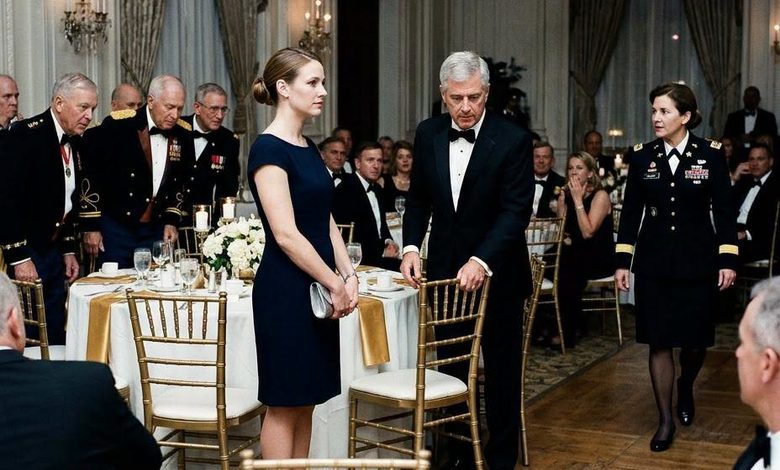
The scrape of my chair across the marble floor was louder than Preston Ashworth III probably intended.
He had one hand on the back of it, dragging it away from the head table, while almost three hundred guests watched under the crystal chandeliers of a ballroom outside Washington, D.C.
“This table is for people who matter tonight, sweetheart,” he said. “You don’t belong here.”
A few people laughed. Not everyone. Just enough.
I stood there holding my small navy clutch, my fingers tightening around it. The string quartet kept playing. Waiters kept moving between tables. Behind the podium stood the flags of every branch of the armed forces, because this was Preston’s annual Guardians Gala, a black-tie fundraiser for military families.
“Elena does spreadsheets”
My name is Elena Cruz. For eleven years, Preston treated me like an awkward accessory to the Ashworth family.
My mother married his younger brother, Robert, three years after my father died. My father was Colonel Daniel Cruz. He spent his whole career in the Army. I was nineteen when we lost him, old enough to understand what his service cost our family, and young enough to still believe people would judge me by what I did instead of the room I came from.
Preston never did.
He built Ashworth Dynamics into a multibillion-dollar defense contractor. In Northern Virginia, his name opened doors before his hand touched the knob. The Guardians Gala was technically a charity, but everyone knew its real purpose: to remind generals, donors and Washington insiders exactly who Preston Ashworth was.
And whenever I was nearby, to remind everyone who he thought I was.
“Elena does spreadsheets,” he once told a retired brigadier general over Sunday dinner. “Numbers. Useful work. Small picture.”
Everyone laughed except General Walcott.
The spreadsheets
I’m a forensic financial investigator. I follow money through vendor files, authorization codes and shell companies until the numbers stop pretending to be innocent.
At the time of that dinner, I was auditing benefit payments connected to a defense subcontractor called Sentinel Rail Group. I expected clerical errors. Instead I found payments authorized for military survivor-benefit programs being routed somewhere else.
One discrepancy led to another. Vendor names repeated under slightly altered registrations. Bank accounts connected to companies that had no reason to receive a dime.
I spent eleven months rebuilding the trail. Nights. Weekends. Cold coffee at my kitchen table.
In the end, federal investigators had a documented case showing that nearly $61 million meant for the widows and children of fallen service members had been stolen through fake vendor payments. The money was recovered. The case ended in a conviction.
Preston knew none of that. Only my younger sister, Maya, an ICU nurse, did.
“You know he’s wrong about you, right?” she said one night, sitting on my kitchen floor after a twelve-hour shift.
“I know.”
“You also know you don’t have to keep proving yourself to him.”
That part was harder. For years, I thought staying quiet meant losing. The Sentinel case taught me something different. Sometimes silence just means the work isn’t finished yet.
One phone call
Four months before the gala, I received a formal commendation for meritorious service. Copies went to the senior military officials whose family-benefit programs had been protected.
I didn’t tell Preston. I didn’t tell Robert or my mother.
When my invitation arrived with the same bland wording as always, “Elena Cruz and Guest,” I made one phone call to Colonel Priya O’Day, the military liaison who’d worked with me on the case.
I asked if commendations like mine were ever presented in public.
“Sometimes,” she said. “Which event are you going to?”
I told her. There was a long pause.
“Will General Mariana Reyes be there?”
“She’s on the guest list.”
“Good,” she said. I never asked what that meant.
The head table
Two weeks later, I walked into the ballroom in a dress I’d bought on sale. My name card was at the head table. ELENA CRUZ.
I’d barely touched the chair when Preston appeared beside me.
“There’s been a seating mistake.”
“It has my name on it.”
“That doesn’t mean you sit here.” And he dragged the chair away.
That was when I heard the first chair scrape behind me. Then another. Then another.
I turned around. Six four-star officers were on their feet.
General Mariana Reyes stepped away from her table and walked across the ballroom. Preston’s hand was still on my chair, but his face had changed.
She stopped in front of me, not him, and held out her hand.
“Ms. Cruz,” she said, loud enough for the nearby tables to hear, “we’ve been looking forward to this all evening.”
Then she turned to Preston. And what she asked him in front of three hundred guests made the color drain out of his face. What do you think she said?
“Mr. Ashworth,” General Reyes said pleasantly, “I don’t think you understand who you just did that to.”
Preston laughed uncertainly. “General, this is my stepbrother’s girl. There’s been a little mix-up with the seating.”
“There’s no mix-up,” she said. “I asked your event staff to seat her at the head table three weeks ago. Colonel O’Day arranged it.”
Then she took the chair out of his hand, set it back at the head table, and pulled it out for me.
The podium
Twenty minutes later, General Reyes stepped up to the podium. Preston had planned to give his own speech at that moment. Nobody stopped her.
“Tonight is supposed to be about military families,” she said. “So I want to tell you about the families who almost didn’t get what they were owed.”
She told the whole room about Sentinel Rail Group. About $61 million stolen from survivor benefits. About widows whose checks stopped coming without explanation. About children whose college funds disappeared into shell companies.
“Every dollar of that money has been recovered,” she said. “Because one forensic investigator refused to accept that the numbers were just clerical errors. She spent eleven months on nights and weekends tracing it. Her name is Elena Cruz. She’s the daughter of Colonel Daniel Cruz, who gave his life in service to this country.”
The room went completely silent.
“Ms. Cruz, would you please join me?”
My legs were shaking. General Reyes pinned the commendation on my dress. Then all six four-star officers stood and saluted.
Three hundred people rose to their feet. At a table near the back, a woman in a black dress was crying. I found out later she was a Marine widow whose survivor benefits had been restored because of that case.
What Robert did
When I came back to the table, my stepfather, Robert, was standing. He’s a quiet man. In eleven years, I’d never once seen him contradict his older brother.
He hugged me hard. Then he turned to Preston, loud enough for the head table to hear.
“You owe her an apology, Pres. You’ve owed her one for eleven years.”
My mother took my hand under the table and didn’t let go for the rest of the night.
Preston mumbled something about not knowing. General Walcott, the same man who hadn’t laughed at Sunday dinner years earlier, leaned over and said, “That’s the problem, Preston. You never asked.”
The audit
There’s one more part.
Three weeks after the gala, Preston called me for the first time in my life. Ashworth Dynamics had used Sentinel Rail Group as a subcontractor on two federal programs. Now that Sentinel’s executives were convicted, every company that had worked with them was facing a federal review.
“I need someone who understands how this works,” he said. His voice sounded smaller than I’d ever heard it. “Someone I can trust.”
I told him the truth. I couldn’t touch it. It would be a conflict of interest. But I gave him the names of three independent auditing firms and told him to cooperate with every single request.
“And Preston?” I said. “They’re going to be people who do spreadsheets. Treat them better than you treated me.”
He was quiet for a long moment. Then he said, “I’m sorry, Elena.” Eleven years late, but he said it.
The commendation hangs in my home office now, next to the last photo of my father in uniform. Maya framed them together.
Preston dragged my chair away because he thought I was small picture. He never understood that the small picture is where the truth hides.
Would you have accepted Preston’s apology after eleven years? Tell us in the comments.