“You Look Pitiful,” My Son Said When He Found Me Waitressing at 60 — Then the Trembling Old Man I Shared My Lunch With Stood Up and Pulled Out His Phone
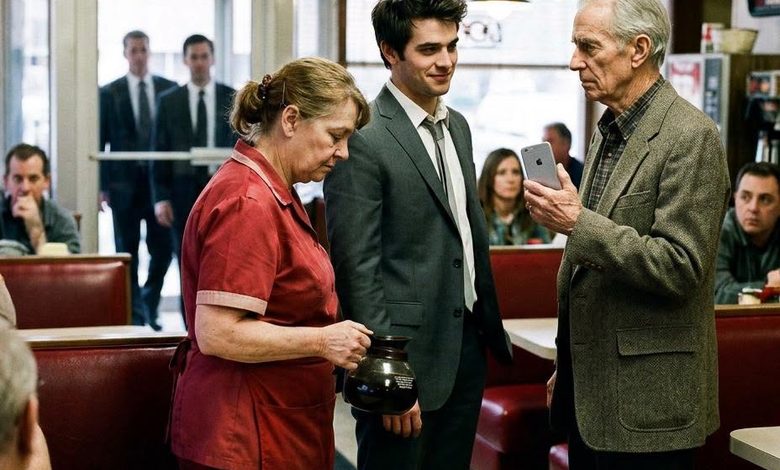
“You look pitiful.”
My son said it loud enough for half of Murphy’s Diner to hear.
I was standing next to the coffee machine in my faded red uniform, a hot pot in my hand, when Carlton walked in wearing a charcoal suit that probably cost more than I make in two months.
For one foolish second, I thought he’d come to apologize.
Then he looked me up and down. My worn-out shoes. My peeling name tag that said MARJORIE. The gray hair coming loose from my ponytail.
And he smiled. Not the gap-toothed smile I remembered from when he was six. A colder one.
“I knew things were tight for you, Mom,” he said. “But this? A waitress at sixty?”
The papers
Eight months earlier, my husband, Robert, died of a stroke in our garden. We’d been married forty-one years. We built our house on Maple Ridge Road together, room by room, on a mail carrier’s salary and my bookkeeping job.
Six weeks after the funeral, Carlton and my daughter, Rebecca, came over with a folder of papers. They said signing them would “make the taxes easier” and “protect me as I got older.”
I was still sleeping on Robert’s side of the bed so I could smell his pillow. I trusted them. They were my children. I signed where they pointed.
One of those papers was a power of attorney. Another was a deed transfer.
By the time I understood what I’d signed, my house had been signed over to Carlton. My savings, $186,000 that Robert and I had saved over four decades, had been “reinvested” into accounts I couldn’t access. And there were two credit cards in my name I’d never opened.
Carlton now lives in my house with his wife and kids. I live in a 400-square-foot studio above a laundromat. I work ten-hour shifts at Murphy’s serving pancakes and meatloaf.
Table six
The only bright spot in my days was Lance.
He was seventy-four, thin, with neat silver hair and a tweed jacket worn soft at the elbows. Every day at 11:30, he sat at table six by the window and ordered dry toast and black coffee. $2.50. He counted it out in quarters, and his hands shook so badly the coffee rippled when he lifted the cup.
I recognized the loneliness on him. It was the same loneliness I saw in the mirror.
I started bringing him extra butter. Then we started talking. He told me about his wife, Eleanor, who’d passed three years before. I told him about Robert.
One day the diner was slammed, and his toast sat forgotten in the window. So I gave him the turkey sandwich I’d packed for my own lunch.
“I can’t take your lunch,” he protested.
“You can and you will,” I said. “I’ll eat later.”
His eyes filled up. “Nobody has been this kind to me in years.”
After that, I split my lunch with him most days. I thought he had even less than I did.
“This is consequences”
“Carlton, please,” I said quietly. “Can we talk somewhere private?”
He laughed. “Why? I’m not ashamed of anything. Are you?”
“You know what happened to my money.”
“What happened is you finally had to live within your means,” he said smoothly. “You signed those papers without reading them, Mom. You didn’t plan. This isn’t poverty.” He leaned in. “This is consequences.”
Every fork in the diner had stopped. A spoon clinked on a saucer somewhere behind me.
“I worked double shifts to put you through college,” I whispered.
“And what did you expect? A lifetime pension for being a mother?”
That’s when a chair scraped across the floor.
Lance stood up. At first he moved slowly, the way he always did. Then his shoulders straightened. His steps became sure. And the trembling in his hands stopped completely.
“This is a family matter, old man,” Carlton snapped. “Sit down.”
Lance stopped right in front of him. “You just humiliated the woman who gave birth to you in front of a room full of strangers. What kind of man does that?”
Then Lance reached into his worn jacket. Not for the little coin purse I’d seen a hundred times. For a sleek black phone.
He pressed one button and said, “Harold. Come in now.”
The bell over the diner door rang. And for the first time since he walked in, my son stopped smiling.
Who was Harold, and why did Carlton go pale the moment he saw who walked in behind him?
Four men came through the door. Three were big, quiet men in dark suits who took positions near the door and the counter like they’d done it a thousand times. The fourth was a short, bald man in his sixties carrying a leather briefcase.
“Mr. Whitaker,” the bald man said, nodding to Lance.
Carlton’s face changed. “Whitaker? As in Whitaker Savings and Trust?”
“I founded it in 1979,” Lance said calmly. “I sold my shares two years ago. I still sit on the board.”
I almost dropped the coffee pot. This was the man I’d been giving half my turkey sandwich to.
What Lance had been doing
Lance turned to me first. “Marjorie, I owe you an apology. I’m not poor. My hands shake from a tremor, not hunger. After Eleanor died, I started eating here because nobody knew me. I wanted one place where people treated me like a person instead of a checkbook.”
“You found it,” he said softly. “You fed me when you thought I had nothing. Not one person in my own family has done that.”
Then he turned to Carlton.
“Your mother told me about the papers three weeks ago. She thought she was just talking to a lonely old man. I asked my attorney, Harold Brenner, to look into it.”
Harold opened his briefcase and took out a thick file.
“The power of attorney your mother signed was notarized by a notary whose commission had expired four months earlier,” Harold said. “The deed transfer was recorded eleven days after her husband’s funeral. And the two credit cards in her name were opened with your email address, Mr. Hayes. That’s not estate planning. Under this state’s law, that’s financial exploitation of an elderly person.”
The diner was so quiet I could hear the bacon popping on the grill.
“We filed a petition this morning to void the transfer and freeze the accounts,” Harold continued. “Adult Protective Services has a copy. So does the district attorney’s elder fraud unit.”
Carlton’s voice cracked. “You can’t— that’s my family’s house—”
“No,” Lance said. “It’s your mother’s house. You’ve been living in it.”
The loan
There was one more thing. Carlton had a meeting that afternoon at Whitaker Savings and Trust to finalize a $400,000 business loan for his new company. He’d been bragging about it for months.
Lance didn’t say anything about it. He didn’t have to. Carlton’s phone buzzed on the way out the door. I learned later the bank had “postponed the review pending a pending legal matter involving the applicant.”
Carlton walked out of Murphy’s without looking at me. A trucker at the counter started slow-clapping. Then the whole diner joined in. I had to go stand in the walk-in freezer for five minutes so nobody would see me cry.
Home
It took seven months. Harold never sent me a bill. When I tried to pay him, he said Mr. Whitaker had “already covered a lifetime of turkey sandwiches.”
The judge voided the deed transfer. Carlton agreed to repay $141,000 of my savings in exchange for the district attorney not pressing charges. The credit cards were cleared from my name.
Rebecca called me the week the ruling came down. She was crying. She said Carlton had told her it was “just paperwork” and that she’d never seen the deed. I don’t know if that’s entirely true. But she came over that Sunday and helped me plant tomatoes in Robert’s garden, and we’re working on it.
Carlton moved his family into an apartment across town. He hasn’t called.
I moved back into my house on Maple Ridge Road on a Tuesday. The first thing I did was sleep on Robert’s side of the bed.
I still work at Murphy’s three mornings a week. Not because I need to. Because I like it, and because every day at 11:30, a silver-haired man in a tweed jacket sits down at table six.
He still orders dry toast and black coffee. He still pays in quarters. And I still bring him half my sandwich.
My son said I looked pitiful. But the richest man in that diner was the only one who saw what I was actually worth.
Should Marjorie have pressed charges against her own son? Tell us what you would have done.