Before My Dying Husband Asked Me to Raise His Daughter — He Left Behind a Secret That Changed Everything
The macaroni was still bubbling on the stove when Lily placed a small white box in my hands and said her father had told her to give it to me exactly one year after his death. A faded blue ribbon circled the cardboard, its corners softened from months of being hidden in her closet. “You still don’t know why Daddy chose you, do you?” she asked. I turned off the burner and untied the ribbon with shaking fingers. On top was a sheet of pale-blue stationery covered in handwriting I recognized instantly because it was mine. It was the anonymous letter I had written years earlier to the family who received my five-year-old daughter Grace’s donated heart. Behind it lay Grace’s red-crayon drawing and a purple toy stethoscope with a tag in Daniel’s handwriting: So you can hear her. That was when I screamed.
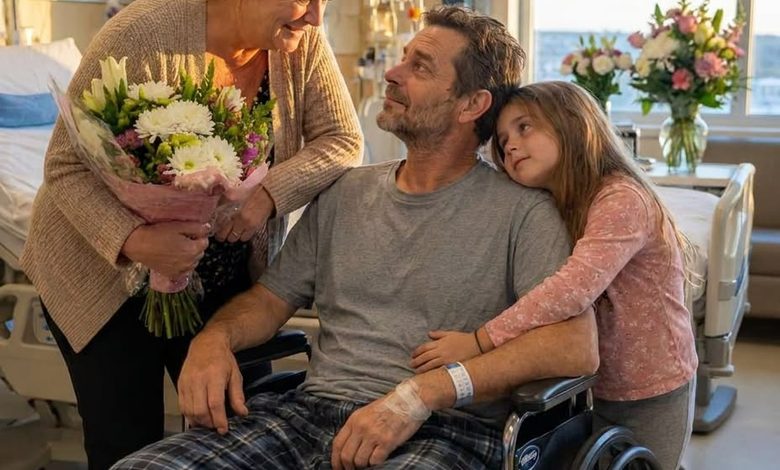
Four years earlier, I had lost my husband Mark and Grace after a distracted driver ran a red light while they were returning from ballet class. Mark died at the scene; Grace survived two days in the children’s hospital before doctors told me there was no meaningful brain activity and asked about organ donation. I remembered Grace coming home from kindergarten weeks earlier talking about how people could give “pieces of themselves” to help others, and I consented. Her heart went to a three-year-old girl whose identity I did not know. Afterward, I sold our house, withdrew from nearly everyone I knew, and eventually took a housekeeping job at St. Anne’s Hospital because grief seemed less conspicuous there. Years later, I met Daniel Hart in Room 412, a thirty-nine-year-old widower dying from metastatic pancreatic cancer, and his six-year-old daughter Lily, whose mother had died during childbirth. Daniel’s illness had left him barely able to braid Lily’s hair or prepare her for school, so I began helping with breakfasts, rides, medications, and the ordinary morning routines that grief had once taken away from me. Somewhere between French braids and cafeteria pancakes, I fell in love with both of them.
Daniel eventually told me Lily had received a heart transplant at age three. The dates unsettled me, but I refused to follow the thought any further. Then, shortly before Christmas, Daniel asked me to marry him. His request was not romantic in the conventional sense, though love was part of it; he was dying, Lily had complex lifelong medical needs, and he wanted legal and financial continuity for her after his death. We married in his hospital room ten days later, surrounded by nurses, a chaplain, grocery-store cake, and Lily in a lavender dress that “swished.” Daniel updated his estate plan, documented his wishes regarding Lily’s care, arranged for counsel to handle the guardianship process, and provided medical evidence showing that I already knew her anti-rejection regimen and cardiology follow-up. He died two weeks later. After a court hearing, I became Lily’s legal guardian, and we continued living in the small blue house he had left behind. What Daniel had never told me was that four years earlier he had already received a letter from a grieving mother named Claire.
His letter inside the box finally joined the two halves of the story. Lily’s transplant had taken place in the early hours of March 4—the morning after Grace died. Daniel had received my anonymous letter months later and read it to Lily on every “heart birthday,” telling her about a little girl who loved ballet, strawberries, noise, and drawing hearts everywhere. He had written back through the transplant organization before ever knowing who I was, thanking Grace for giving his daughter the chance to run across a room. Years later, when I walked into his hospital room wearing a silver bracelet with a “G,” he still did not know. He understood only after I finally told him about Fifth and Monroe, the children’s hospital, March 3, and the organ-donation paperwork. He kept the truth from me because he feared I would believe he had chosen me solely because Lily carried Grace’s heart. In his final letter he wrote that he had fallen in love with me before he understood the connection—but that once he knew, he also understood there was no one he trusted more to protect Lily. Then I placed the purple stethoscope against Lily’s chest and heard a strong, rapid rhythm I had once listened to through an ultrasound monitor, against my sleeping child’s chest, and beside a hospital bed. I whispered, “Hi, Gracie. Mama’s here.”
Later I found the reply Daniel had sent me years before, still sealed in a box because I had never been ready to open it. The date proved that long before we met, he had invited Grace’s family to know the child her heart had saved. That knowledge quieted the question of whether our lives had been engineered by desperation or coincidence; neither explanation was large enough for what had happened. I eventually petitioned to adopt Lily, and the same judge who had approved the earlier guardianship signed the adoption order. Lily chose Grace as her middle name. She is eight now, runs faster than anyone in her class, takes her anti-rejection medication morning and night, eats too many strawberries, and still asks me to braid her hair every morning. At bedtime she sometimes hands me that purple stethoscope, and I place it over the scar on her chest. I no longer listen for one child instead of another. I hear Lily. I hear Grace. I hear Daniel, Mark, Anna, and every life that carried us to this room. One heart never replaced another; it simply became the place where all that love continued beating.