My Fiancé Shouted “I Don’t!” and Fled Our Wedding—50 Years Later, His Attorney Brought Me the Letter I Never Wrote
Part 1: The Box Beside the Cooling Cookies
The man on my porch said Henry Whitcomb’s name, and I tightened my grip on the door before I knew I had moved. Behind me, the kitchen timer was counting down the last two minutes of a batch of oatmeal cookies. My grandchildren would arrive that afternoon. It was an ordinary Thursday in May, and I had already decided what to make for dinner. Then the stranger lifted a small cardboard box and said Henry wanted me to have it before he died.
“Tell him I have nothing to say.”
The man did not step closer. He looked about forty, with rain caught on the shoulders of his navy jacket and a business card held between two fingers.
“My name is Daniel Whitcomb. I’m his nephew and his attorney. You don’t have to invite me in, Mrs. Bennett.”
It had been fifty years since I had last heard Henry’s voice. On that occasion, he had been standing three feet away from me in a church, wearing the tie I had helped him choose. When the minister asked whether he would take me as his wife, Henry shouted, “I don’t!” Then he walked so quickly down the aisle that someone had to move out of his way.
I had been twenty-two. There had been eighty guests. Those were the numbers my mind kept, although it had forgotten things I would rather have remembered, like the sound of my father’s laugh.
“Why now?” I asked.
Daniel lowered the card slightly.
“He’s very ill. He asked me to deliver some documents and offer to answer your questions. If you want me to leave them and go, I will.”
The timer rang. For a moment, neither of us moved. Then I took the card, left him on the porch, and went to save the cookies.
I set the tray on the stove and checked his name against the law firm’s website on my phone. The photograph matched. When I returned, he was still standing exactly where I had left him. Something about that small obedience persuaded me to open the door wider.
“You can have ten minutes.”
At my kitchen table, he placed the box on a clean dish towel. He declined coffee and did not begin with a speech about forgiveness. I appreciated that more than I wanted to.
“Are you here as his lawyer or his nephew?”
“Both. Which means you should know I’m not independent of him emotionally. But I won’t tell you a document proves something it doesn’t.”
The answer made me look at him properly for the first time.
Inside the box were photographs, a yellowed wedding invitation, a folder, and a thin envelope with my first name written across it. Margaret. The capital M curved the way mine once had, before arthritis made my handwriting smaller and less patient.
“He wanted you to see that first,” Daniel said.
I unfolded the page. The paper had softened along its creases.
“Henry, I need to be honest before we make a mistake.”
I read the next sentences twice before they became words instead of marks.
“I don’t love you the way you love me. I’m marrying you because I need security, and because your family can give me the kind of life mine never could.”
I put the letter down. Then I picked it up again.
It went on to describe marriage as an arrangement. It warned Henry not to expect devotion. At the bottom was my name, written in a passable imitation of the signature I had practiced on the backs of grocery lists while imagining myself married.
“I never wrote this.”
“I know.”
“No. You need to understand. I never wrote any of it.”
“Henry knows that now.”
I pushed my chair back too fast. One leg caught on the edge of the kitchen mat, producing a sharp scrape that startled us both.
Henry and I had met when I was sixteen and he was seventeen. He waited outside the library because I stayed until closing. He drove an old pickup whose passenger window needed a folded piece of cardboard to stay shut. Once, when he couldn’t afford both gasoline and the movie tickets he’d promised, we sat on my parents’ porch and invented a terrible film of our own.
I had loved him before I understood what his family owned. His father ran a prosperous hardware business. Mine repaired machinery at a small factory. The difference mattered to people around us, but for years I believed it did not matter to Henry.
“Who gave him this?”
Daniel kept his hands folded on the table.
“His mother. On the morning of the wedding.”
I looked down at the page again. Evelyn Whitcomb had always spoken to me as though I had arrived at the wrong address. During one of the two dinners she invited me to attend, she asked whether my mother was still cleaning houses. When I answered yes, she suggested that marriage might be an opportunity for me to improve myself.
Henry had apologized afterward.
“She doesn’t get to choose my wife.”
I had believed him. At twenty-two, I thought choosing someone once meant choosing them every time it mattered.
“She said I’d left this for him?”
“She said she’d found it tucked inside a book you’d returned to their house the previous evening.”
“I was home that evening. My mother and I were finishing my hem. My father went out for more thread because the store near us had closed.”
I could see him coming through the door, triumphant over a spool of ivory thread. Such a small errand. Such an ordinary kindness. I had not thought about it in years.
“Henry understands that story wasn’t true,” Daniel said.
“What changed his mind?”
He opened the folder and slid three protected sheets toward me. One held repeated attempts at my signature. Another listed observations about the way I formed letters. The third was an earlier version of the page in my hand, with phrases crossed out and replaced.
On the margin of that draft, someone had written, Too emotional. Make her sound practical.
I sat down again.
The cruelty of it was not only that Evelyn had lied. She had revised. She had considered how best to make me sound incapable of loving her son, then improved the sentence until she was satisfied.
“Where were these?”
“In a locked compartment in her desk. Henry found them while sorting her papers after she died.”
For the first time since he arrived, Daniel looked away from me.
I knew there was another question before I knew its shape. He had said Henry’s mother was dead, but not recently dead. There had been no funeral notice in the local paper this month, no fresh explanation for why fifty years of silence had ended on my doorstep.
“Daniel,” I said, “when did she die?”
He took a breath.
“Twelve years ago.”
Part 2: The Years He Kept
The clock above my stove clicked through several seconds before I spoke.
“Henry has known for twelve years?”
“Yes.”
I looked toward the window over the sink. Robert had replaced that window in 2014, the year Evelyn died. I remembered him standing in our garden with the old frame balanced against his hip, asking whether I was sure I wanted the new one to open outward. Henry had learned I was innocent while my husband was alive to hear it, and then he had let twelve more years pass.
“He wanted to contact you,” Daniel said carefully.
“Wanting isn’t something he did.”
“No. It isn’t.”
I appreciated that answer, too, though it did nothing to settle my hands.
Daniel explained that Henry had hired an investigator after finding the papers. The investigator located me in a suburb outside Chicago and found a public anniversary announcement from 2010. It showed Robert and me celebrating thirty years of marriage, surrounded by our three children.
I remembered that photograph. Robert had complained about wearing a jacket in the heat. Our youngest son had made him laugh just before the camera clicked. For years I had kept a copy in my wallet until the corners wore white.
“Henry saw that picture and decided you were happy. He told himself that appearing again would only hurt you.”
“He could have written three sentences. He could have sent the evidence without asking me to answer.”
“You’re right.”
“Please stop agreeing with me as if it makes this easier.”
Daniel went still.
“I’m sorry. It doesn’t.”
I turned the forged letter facedown. A small grease stain marked the dish towel beneath the box, left by one of the cooling cookies. I rubbed at it with my thumb, absurdly concerned that it might touch the papers.
After Henry left the church, I had waited in a little room beside the sanctuary while my mother removed the flowers from my hair. She kept saying there must have been an accident, although we had both seen him leave under his own power. My father drove to the Whitcomb house. Evelyn told him Henry was unavailable.
The next morning, I called myself. She answered.
“Henry doesn’t want to discuss this, Margaret.”
“Then let him tell me.”
“You need to leave him alone.”
I wrote a letter asking what had happened and delivered it to their house. There was no reply. A week later, I saw Henry outside the hardware store. He crossed the street before I could reach him. That was the moment I stopped believing some emergency had taken him away.
People offered explanations I had never requested. Fear of marriage. Another woman. Something wrong with me. My aunt Ruth said men did not abandon a wedding without a reason, then watched my face as though the reason might confess itself.
“Did anyone else help Evelyn?” I asked Daniel.
“Not that I’ve found.”
I told him about Ruth, about her friendship with Evelyn’s sister, about the satisfaction I remembered beneath her concern.
“There may have been conversations I don’t know about,” he said. “But nothing in these documents establishes that your aunt knew about the forgery.”
I did not like the answer. I also knew I needed it. A lifetime of feeling accused did not give me permission to accuse someone else without evidence.
“Then we leave her out of it,” I said.
Six months after the wedding, I moved to Chicago. My cousin Elaine let me sleep on her sofa until I found work at a diner and a room I could afford. I had savings for the bus fare and a little rent, but not enough to make mistakes casually. For a while, that was useful. Learning bus routes and balancing a grocery budget left fewer hours for imagining the church.
Robert came into the diner every Thursday after meeting a supplier nearby. He ordered coffee and apple pie and read novels with bent spines. The first time he asked me to dinner, I told him I didn’t date customers.
The next Thursday, he brought a sandwich from home.
“I’m not buying anything,” he said. “Does that improve my chances?”
I laughed before I remembered that I had been trying not to like him.
We did not marry quickly. When I told him what had happened with Henry, he asked whether I wanted him to listen or help me think about it. No one had asked me that before.
“Listen first,” I said.
So he did.
We married in 1980, when I was twenty-six. There were twenty people at the ceremony, and I discovered that a quiet wedding could still feel enormous. Over the next several years we had three children. We made a home out of missed sleep, mortgage payments, jokes that stopped being funny and became funny again, and thousands of decisions to stay kind when it would have been easier not to.
Robert was not a reward for having suffered. He was a person, stubborn about directions and hopeless at remembering where he put his glasses. I loved him in ways that had nothing to do with Henry Whitcomb.
He died in 2022. Four years later, I still occasionally reached for the phone to tell him something.
“Did Henry know my husband died?” I asked.
“Not until recently. When his health worsened, he asked me to find out whether you were still at the same address. I found Robert’s obituary.”
“And now he wants to see me.”
“He hopes to. He also told me you may not want that.”
Daniel explained that Henry had advanced heart failure and had moved into a care facility after a hospital stay. His doctors were treating his symptoms, but his condition was worsening. There was no reliable deadline, and Daniel did not pretend there was.
“You don’t have to make a decision today,” he said.
I asked him to leave the box and contact details for the document examiner Henry had consulted. Daniel gave me copies of the report and offered, with Henry’s permission, to authorize the examiner to discuss its limits.
After he left, I washed the same mixing bowl three times.
Laura arrived that afternoon with her two children and immediately noticed the untouched cup of tea on my table. I told her I had received difficult news, but that I wanted to explain it when the children weren’t waiting to decorate cookies.
She did not press. Later, while they argued amiably over the last blue sprinkle, I watched her put a hand on her son’s shoulder and help him solve the problem instead of solving it for him.
That evening, after everyone had gone, I opened the folder again. Beneath the examiner’s report was a cover sheet listing the materials Henry had submitted in 2014: the disputed letter, the practice sheets, samples of Evelyn’s writing, and four genuine notes I had sent him before the wedding.
He had possessed my real words alongside the false ones. The answer had been within reach not merely for twelve years, but on the very day he chose not to ask me.
I picked up my phone to call Daniel, then stopped with my thumb above his number. I no longer wanted an explanation delivered by someone else. I wanted to ask Henry one question he could not leave a room to avoid.
Part 3: The Question Between Two Chairs
Before I agreed to a visit, I made two calls. The first was to the document examiner, whose office confirmed the old case number and arranged a short conversation after receiving Henry’s written authorization. The second was to Laura.
The examiner was precise. His report supported the conclusion that the practice drafts and final letter had been produced by the same writer. The notes describing my handwriting were consistent with the supplied samples of Evelyn’s ordinary writing. The evidence was strong, he said, but handwriting comparison was an expert opinion, not a recording of the act itself.
That qualification made me trust him more. Between the drafts, the notes, and the place the papers had been found, I did not need him to promise certainty beyond what his work could provide.
Laura came over alone that evening. I told her everything at the kitchen table, including the twelve years. She read the forged letter without speaking, then placed it carefully back in its protective sleeve.
“Dad knew about the wedding,” she said.
“Yes.”
“Did he know how much not knowing still bothered you?”
I considered giving her the answer that would be easiest for both of us.
“Some of it. Not all. I was embarrassed that it could still hurt after everything good I had.”
Laura reached for my hand.
“Those things don’t cancel each other out.”
She sounded so much like her father that I had to look away.
I told her I wanted to see Henry. Her first reaction was immediate and protective.
“I’ll drive.”
“I want to drive myself.”
“Then I’ll wait outside.”
“Laura.”
She pressed her lips together, then nodded.
“All right. What would actually help?”
I asked her to be available afterward. I also asked her not to tell her brothers until I had spoken to them myself. She agreed without making me defend either request.
That night I wrote down my questions. Why had he believed the letter? Had he intended to leave before I entered the church? Why refuse to speak afterward? Why stay silent once he knew? I left space between them, the way I used to leave room in a notebook for an answer I expected to be complicated.
Daniel arranged the visit for the following Tuesday. At my request, he told Henry I was coming for one conversation, not to discuss money, make promises, or revisit the possibility of a relationship. Daniel would be nearby but not in the room unless I asked.
“He understands,” he said.
“Make sure he understands that I may leave before he’s finished.”
“I will.”
On Tuesday morning, I nearly changed my mind over something ridiculous: I could not decide what to wear. A formal jacket felt like armor. My oldest cardigan felt too much like surrender. I finally put on a blue blouse Robert had once said made me look ready to argue with a bank manager.
At the facility, I sat in my car long enough to hear the end of a radio interview I wasn’t following. Then I turned off the engine and went inside.
Henry was seated near the window, not in bed. An oxygen tube rested beneath his nose, and a glass of water stood within easy reach. His hair was white and thin. For a moment, I saw only an unfamiliar older man. Then he lifted his eyes.
“Margaret.”
His voice was quieter, but it was his.
“Hello, Henry.”
He gestured toward the chair opposite him.
“Thank you for coming.”
I sat with my handbag on my lap. There was a small table between us, just wide enough for a box of tissues and the water glass. I was grateful for it.
“Daniel gave you everything?” he asked.
“Enough to understand what your mother did.”
He closed his eyes briefly.
“I’m sorry.”
“I need you to be more specific.”
He looked at me again, and I saw recognition—not of my face, but of the fact that I was not going to help him through this.
“I’m sorry I believed it.”
“Why did you?”
He rubbed one thumb along the edge of his chair.
“She gave it to me about an hour before I left for the church. She said she’d spent the night deciding whether to show me. She told me you’d made it clear that marrying me was a way out of your parents’ house.”
“That wasn’t what I asked.”
He swallowed.
“Because part of me already worried you could have chosen anyone. And because she knew exactly how to turn that into something uglier. She said people were laughing at me.”
I had spent fifty years trying to remember whether I had missed a warning. Now he was telling me the warning had been inside him: an insecurity he had trusted more than the girl who loved him.
“Did you ask who?”
“No.”
“Did you ask to speak to me before the ceremony?”
“No.”
He didn’t look away this time.
“I could have. The minister asked if I was all right. I said I was.”
I remembered Henry’s face as I walked toward him. His eyes had been bright, his mouth trembling slightly. I had thought he was overcome with happiness. It had tormented me afterward, that expression which seemed to contradict everything that followed.
“When I came down the aisle, had you already decided?”
“Not completely.”
“Then what were you thinking?”
He took several careful breaths before answering.
“I wanted you to tell me it wasn’t true without my having to ask. Which was impossible. But I stood there expecting you to rescue me from something you didn’t even know had happened.”
I held the clasp of my handbag until its metal edge pressed into my palm.
“And when the minister asked?”
Henry’s eyes filled.
“I wanted to hurt you before you could hurt me.”
There it was. Not a misunderstanding that had accidentally spilled into a church. Not panic alone. A choice.
“You wanted an audience.”
His answer came almost too softly to hear.
“Yes.”
For years I had supplied kinder possibilities because the real one seemed too painful to belong to the boy I remembered. Hearing him admit it did not make the church disappear. It did something harder: it made the memory clear.
I took my list out of my handbag. Only two questions remained, but they were the ones that mattered most now.
“You know what your mother did,” I said. “Now tell me what you did after you learned the truth.”
Part 4: The Life That Was Already Mine
Henry looked toward the window. Outside, a staff member was helping someone adjust the footrest of a wheelchair. We waited while that ordinary, necessary task occupied the space where his answer should have been.
“I hired someone to find you,” he said at last. “I saw the photograph of your anniversary. You and Robert. Your children.”
“I know about the photograph.”
“You looked happy.”
“I was happy.”
He nodded, as though accepting a fact he had never had a right to resent.
“I thought telling you would drag you backward.”
“Would that have stopped you if you knew I’d welcome the call?”
He said nothing.
“Henry, were you protecting me from pain, or yourself from what I might say?”
His fingers tightened against his knees.
“Myself.”
The word came out roughly. He reached for his water, and I waited while he drank. I did not fill the silence or soften the question. His illness was real. So was the answer he owed me.
“At first I told myself I’d write after I understood everything,” he continued. “Then after I had the examiner’s report. Then after I found the right words. Eventually, every year I waited became another thing I would have to explain.”
“So you let me go on believing I might have done something.”
“Yes.”
“You let my husband die without knowing there was an answer.”
Henry lowered the glass to the table with both hands.
“Yes.”
I thought I might cry then. Instead, I felt the particular exhaustion that follows a task carried much farther than it ever needed to go.
“Robert used to tell me I didn’t have to solve you to know I hadn’t deserved it,” I said. “I believed him. Mostly. But there was always a corner of me that wondered whether everyone else could see something wrong with me that I couldn’t.”
“There wasn’t.”
“I know that. You don’t get to be the person who gives me that now.”
He bowed his head.
We sat quietly until my breathing settled. I looked around the room: a paperback beside his chair, a photograph of Daniel with two small children, a folded sweater over the foot of the bed. Henry had lived an entire life outside my knowledge. Whatever loneliness or regret it contained, I could not measure it from one room, and I did not need to.
“Daniel said you never married.”
“No.”
He stopped there. He did not offer it as proof of devotion, and I was glad. Remaining unmarried could not return the morning he had taken from me. Nor did it make me responsible for the years afterward.
“I had a good marriage,” I told him. “Not because of what you did. In spite of having to recover from it. Robert deserves to be more than the man who came after you.”
“I understand.”
“He was kind. He could also be impossible about loading the dishwasher. He sang the wrong words to songs and insisted they were better. We had three children, and now I have six grandchildren. We had a whole ordinary life.”
My voice finally broke on ordinary.
Henry’s eyes shone.
“I’m glad he loved you well.”
“He did.”
I folded my question list. There was nothing left on it that I needed answered.
Henry drew a slow breath.
“My mother forged the letter. I believed her instead of asking you. I chose to humiliate you. And when I learned the truth, I was too afraid to face what I’d done.”
He paused, looking directly at me.
“You deserved an explanation fifty years ago. You deserved it again twelve years ago. I’m sorry I made you wait until it suited my courage.”
That was the apology I had come to hear: not one that turned his mother into the sole author of my pain, and not one that asked me to comfort him for admitting it.
“I can forgive the frightened young man who believed someone he trusted,” I said. “I may never excuse what you chose to do with that belief. And I don’t know how long it will take me to feel differently about the silence.”
He nodded.
“You don’t have to decide anything else.”
“There is one thing I’ve decided.”
I placed the folded list in my handbag.
“I won’t be coming back, Henry. I don’t want letters asking me to reconsider. If Daniel needs to contact me about the documents, he can. But this conversation is the end of what I can give you.”
A tear slipped down his cheek. He wiped it away himself.
“Thank you for telling me plainly.”
I stood. My knees felt stiff, but they held.
At the door, I turned back.
“I hope you’re comfortable. I mean that.”
“Thank you, Margaret.”
Daniel was waiting down the hall. He rose when he saw me, but he did not ask whether I had forgiven his uncle.
“Do you need anything?”
“Please help him keep the boundary I set.”
“I will.”
I drove home before the afternoon traffic grew heavy. At a red light, I realized I was hungry. That small return of appetite almost undid me.
Laura answered on the first ring.
“I’m home,” I said. “Could you come over? And bring sandwiches.”
We ate on the back steps because I didn’t want to sit at the kitchen table. I told her what Henry had said and what I had decided. She listened without reaching for an easier ending.
“Are you all right with not seeing him again?” she asked.
“Yes. I’m sad that it happened. I’m angry that it took so long. And yes.”
The next week, I spoke to my sons. There were questions, some anger, and a few long silences. None of them asked why knowing still mattered. By then, I had stopped asking myself that question, too.
Daniel sent a brief note confirming that Henry understood my wishes. There was no request attached, no promise of an inheritance, no attempt to turn illness into an obligation. I kept the note with the examiner’s report.
I put the forged letter and the wedding invitation into a storage box, along with a page in my own handwriting explaining what had happened. At the top I wrote my full name: Margaret Ellis Bennett. I did not destroy the evidence, but I would no longer leave my family to interpret it without my voice beside it.
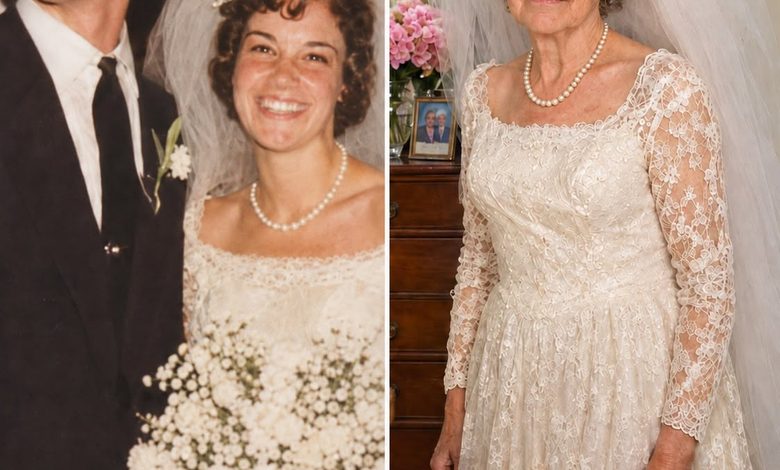
While helping me put the box away, Laura found my old veil wrapped in tissue. She asked whether I wanted a photograph with it for the family album. At first I laughed. Then I thought about how the only picture of me wearing it had preserved a girl who did not yet know what was coming.
That Sunday, in a cream dress I wore for special occasions, I let her drape the veil loosely behind my shoulders. I stood near Robert’s photograph while Laura took one simple picture. No bouquet. No waiting groom. Just me, seventy-two years old, looking into the camera.
Afterward, the grandchildren arrived hungry. We made Robert’s favorite cookies, and my youngest grandson solemnly measured vanilla with both hands. When he spilled a little, I gave him a cloth instead of taking over.
As I reached for a cooling rack, he looked up.
“Grandma, are you staying for this batch?”
For a second I thought of all the years I had spent waiting for someone else to come back. Then I pulled a chair close enough for him to stand beside me.
“Yes,” I said. “I’m right here.”
Disclaimer: This story is a work of fiction inspired by real-life themes. Names, characters, places and events are fictionalized, and any resemblance to real persons is purely coincidental. It does not represent any person or organization and does not encourage inappropriate behavior. Images are for illustration purposes only.