My Daughter’s Teacher Refused to Paint Her Face Like the Other Girls Because “Makeup Can’t Make Girls Like You Beautiful” — She Had No Idea Who Sat Down at Her Table Next
This is a fictional story.
My daughter Victoria has Down syndrome. She’s six years old, and sending her to first grade was one of the hardest decisions I’ve ever made.
I worried constantly. Would the other kids tease her? Would she understand if someone was being cruel? Would she tell me if something went wrong?
But Victoria loved school. For two weeks, she came home smiling every single afternoon, chattering about new friends and showing me her drawings.
Then came the school festival.
The Phone Call
I kissed her forehead at drop-off, expecting another happy day. An hour later, my phone rang.
“Mrs. Parker, this is the principal. Victoria has been crying for twenty minutes and keeps asking for you. Could you come in?”
“Is she hurt?”
“She’s not hurt. But she’s very upset.”
I grabbed my keys and drove there as fast as I could.
“Am I Ugly?”
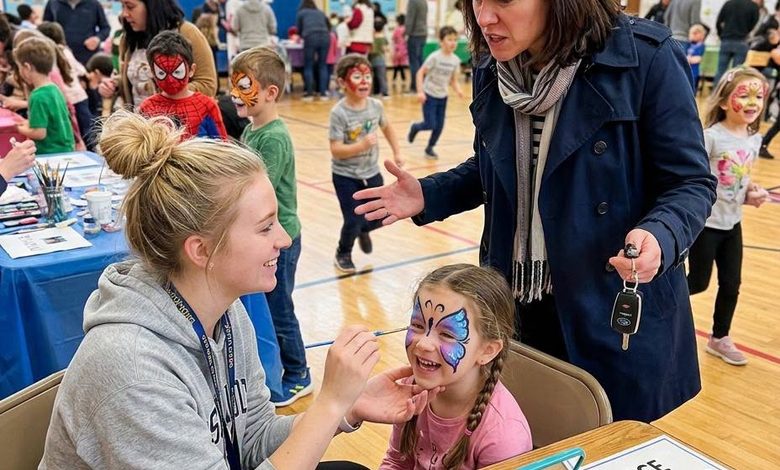
Victoria was waiting in the hallway. All around her, kids with painted faces were laughing and running. Nearby, a young teacher was painting butterflies on another little girl’s cheeks.
The second Victoria saw me, she ran into my arms. “Mommy, I want to go home.”
I knelt down. “What happened, sweetheart?”
She pointed at the teacher. “She said makeup is only for pretty girls. She said it won’t make me pretty.”
Then she looked up at me through her tears. “Mommy, am I ugly? Will I ever be pretty? Tell me the truth.”
I wiped her cheeks. “You’re beautiful, baby. Don’t ever believe anyone who says otherwise.”
She shook her head. “She’s my teacher, Mommy. Teachers don’t lie.”
I looked over at that woman. She was still smiling, painting another child’s face, with no idea I was watching her.
The Table
“Victoria, go wait in the principal’s office for five minutes, okay? Mommy needs to take care of something.”
“Are we going home?”
“We’re going to the movies, sweetheart. And then we’re getting your favorite ice cream.”
She hugged me and hurried down the hall. I waited until she was safely inside the office.
The teacher had never met me. She didn’t know I was Victoria’s mother. And I wasn’t going to tell her. Not yet.
I walked straight to her table just as she finished painting another little girl.
“Can You Paint Mine?”
Her name tag said Miss Kendra. Up close, she couldn’t have been older than twenty-three.
I smiled and sat down on the little plastic chair across from her. “This looks like so much fun. Do you do grown-ups?”
She laughed. “Sure! What would you like?”
“A butterfly. Like the ones on the girls.”
She started painting my cheek. While she worked, I chatted, friendly, like any parent volunteer would.
“I saw a little girl crying in the hallway earlier,” I said. “Poor thing. Do you know what happened?”
Miss Kendra sighed and rolled her eyes a little. “Oh, the girl with Down syndrome? She wanted the butterfly too. I just told her the truth, kindly. Some girls, makeup just isn’t going to help. It’s better they learn that young than get their hopes up.”
My hands were shaking in my lap. I kept my voice calm.
“So you think a six-year-old should be told she isn’t pretty enough for a butterfly.”
“I think parents of kids like that need to be realistic,” she said, dabbing glitter on my cheek. “Somebody has to be.”
Behind Her
What Miss Kendra didn’t notice was the man who had walked up behind her a few seconds earlier, with Victoria’s school file in his hand.
The principal, Mr. Alvarez. He’d come out of his office to find me. And he’d heard every word.
I stood up, butterfly half-finished on my cheek.
“My name is Danielle Parker,” I said. “That little girl is my daughter. Her name is Victoria. She is six years old, and an hour ago she asked me if she was ugly, because you told her she was.”
The brush slipped out of Miss Kendra’s hand. Glitter scattered across the table.
“I— I didn’t mean—”
“You meant every word,” I said. “You just said them again to me.”
Then she turned around and saw the principal.
“Miss Kendra,” Mr. Alvarez said quietly, “please put the brushes down and come with me to my office. Now.”
What Happened Next
It turned out Miss Kendra wasn’t a full teacher. She was a student teacher in her final semester, placed in Victoria’s classroom for twelve weeks. Mr. Alvarez called her university that same afternoon.
She was removed from the school before the end of the day. Her placement was ended, and the university told her she’d have to repeat a full semester, including a course on inclusive education, before she could ever stand in front of a classroom again.
Victoria’s real teacher, Mrs. Okafor, had been out sick that day. When she found out, she called me at home and cried on the phone. “I’m so sorry I wasn’t there,” she said. “I’ll fix this. Give me until Monday.”
The Movies
I kept my promise. Victoria and I went to the movies, and then we got her favorite ice cream: strawberry, with rainbow sprinkles.
Halfway through her cone, she pointed at my face. “Mommy, you have half a butterfly.”
I’d forgotten all about it. “I do. Do you think I look silly?”
She giggled. “You look pretty.”
“So do you, baby. Every single day.”
She didn’t believe me. Not yet. I could see it in her eyes. One sentence from a stranger had done that much damage in one afternoon.
Monday Morning
On Monday, Mrs. Okafor asked me to bring Victoria to class a few minutes late.
When we opened the classroom door, all twenty-two of her classmates were sitting at their desks with face paint and brushes in front of them. On the board, in big colored letters, Mrs. Okafor had written: EVERYONE GETS A BUTTERFLY.
One by one, the kids painted each other. Then a little girl named Sophie, Victoria’s best friend, walked up holding a brush.
“Can I paint yours, Tori? I’m going to make it the biggest one.”
She painted a giant, wobbly pink-and-purple butterfly across Victoria’s cheek, with way too much glitter. Then she stepped back, looked at it very seriously, and announced to the whole class:
“There. Now you’re even prettier than before. But you were already the prettiest.”
Victoria looked at me across the room. Then she smiled the biggest smile I’d seen in days.
That night, she refused to wash her face. She fell asleep with that butterfly still on her cheek, and a little bit of glitter on her pillow.
Teachers don’t lie, she’d told me. She was wrong about that one.
But six-year-olds don’t lie either. And twenty-two of them had just told her the truth.
This story is a work of fiction. Names, characters, and events are products of the author’s imagination. Any resemblance to real people or events is purely coincidental.