Donald Trump reveals career-ending word he’s “not allowed to use”
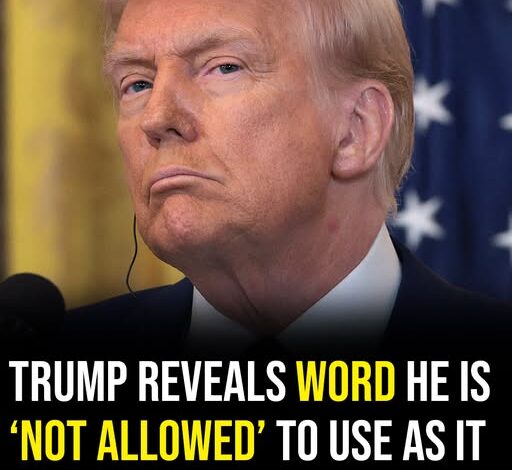
The room fell into an uneasy, almost tangible silence the moment he spoke. What had begun as a routine Women’s History Month tribute at the White House quickly transformed into something far stranger than anyone in attendance had expected. Cameras clicked, microphones captured every syllable, and reporters, staffers, and guests alike froze in their seats. One word, he warned, could “end” his career. One film, she insisted, proved her singular “vision.” Between Donald Trump’s defiant framing of himself as a victim and Melania Trump’s self-celebratory narrative, the atmosphere shifted. Applause became hesitant, smiles tightened, and what was intended as a tribute to women’s accomplishments felt overshadowed by personal myth-making. Attendees were left wondering whether the evening truly honored the achievements of women or simply served as a stage for ego.
Trump’s speech began predictably enough, acknowledging historical figures whose names are woven into the fabric of American memory. Martha Washington, Betsy Ross, Amelia Earhart, Aretha Franklin—icons whose contributions to politics, exploration, and culture have long been celebrated—were listed with perfunctory admiration. At first, the audience nodded politely, the words fitting into the expected ceremonial script.
But almost immediately, the tone shifted. What had been homage subtly veered into grievance. Trump spoke of the dangers of complimenting women, framing himself as a man under constant threat from cultural scrutiny. He claimed that even acknowledging beauty could “end” a man’s career, positioning himself as bravely defiant in the face of societal pressure. To listeners, however, the speech felt less like a recognition of women’s achievements and more like a familiar refrain: that he is perpetually the aggrieved party whenever gender enters the conversation. Admiration for women was couched in complaint, and self-interest quietly eclipsed the intended celebration.
Then Melania Trump took the stage, compounding the awkwardness. Her remarks were a mix of self-description and personal defense, painting herself as a visionary whose work on the Melania documentary represented an artistic triumph achieved through “laser focus” and determination. She spoke little of the broader accomplishments of women beyond her own story, and instead highlighted her solitary genius and personal dedication. The documentary’s tepid critical reception and modest box office earnings were glossed over, leaving listeners with an impression of selective storytelling: a narrative curated to emphasize her success while downplaying any shortcomings.
The combined effect of their speeches was jarring. What should have been a celebration of women’s history—a month dedicated to recognizing the accomplishments, struggles, and contributions of women throughout American history—was transformed into a performance of self-mythology. Applause, when it came, felt cautious, almost obligatory. Smiles were polite but constrained, reflecting the audience’s recognition that the event had shifted focus from public honor to private aggrandizement.
Beyond the immediate discomfort in the room, the speeches raised broader questions about the messaging and optics of high-profile ceremonies. Women’s History Month is meant to shine a light on courage, ingenuity, and perseverance in the face of systemic barriers. By centering the narrative around personal grievances and individual self-celebration, the event risked minimizing those very achievements. Observers in the press and on social media quickly noted the contrast between the intended purpose and the actual performance: a ceremony ostensibly about women’s history became a reflection of two people carefully curating their own legacies.
In the hours that followed, commentary poured in across platforms. Analysts dissected the speeches, noting the unusual focus on personal defense, the framing of victimhood, and the unusual juxtaposition of historic reverence with self-congratulation. Media outlets highlighted the tension between the ceremonial context and the personal narratives dominating the stage. Even casual viewers and attendees recognized the contradiction: how could an event meant to celebrate generations of women’s struggles and triumphs be overshadowed by the egos of the current participants?
Ultimately, the White House event served as an unintended study in contrasts: between public expectation and personal performance, between historical homage and self-promotion, and between celebration and self-centered narrative. What might have been remembered as a tribute to female achievement instead lingered in the minds of those present as a moment of surreal, uneasy theater—one where the audience had to question whether the true focus of the evening was women’s history, or the cultivation of personal image and legacy.
In the end, the speeches left an indelible mark not for their celebration of others, but for the reflection they cast back on the speakers themselves. Attendees, journalists, and viewers were left to reconcile the intended purpose of the event with the reality of what unfolded, highlighting how easily ceremonial occasions can be transformed into platforms for personal storytelling when attention strays from the collective to the individual.