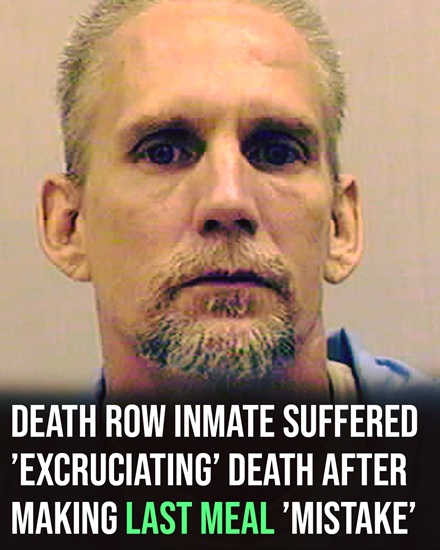
Death Row Inmate Endured Agony After Last Meal Error, Officials Say
In 2020, Wesley Ira Purkey, aged 68, suffered an agonizing execution hours after making what officials described as a “mistake” with his last meal request.
His death reignited debate over lethal injection procedures in the United States. Purkey was sentenced to death for the 1998 kidnapping, rape, and murder of 16-year-old Jennifer Long, a schoolgirl from Wichita, Kansas.
The case shocked the nation due to the brutality and premeditation involved in the crime. On January 22, 1998, Long was last seen attending skipping lessons. Purkey lured her into his pickup truck outside a local supermarket, presenting a seemingly benign scenario that would quickly escalate into a horrific tragedy.
Once inside his vehicle, Purkey drove Long to his home. There, he subjected her to sexual assault and ultimately murdered her. The level of planning and cruelty shocked investigators and the wider community at the time.

Following the murder, Purkey dismembered Long’s body with a chainsaw. He then attempted to destroy the remains, burning the flesh and scattering her bones in a septic pond, illustrating a calculated effort to eliminate evidence of his crimes.
Later in 1998, Purkey, then working as a plumber, committed another shocking act of violence. He murdered 80-year-old Mary Bales by beating her to death with a claw hammer, further cementing his notoriety as a dangerous criminal.
Purkey returned to Bales’ home intending to set a fire to cover his tracks. However, suspicious neighbors noticed unusual activity and promptly called authorities, an intervention that would ultimately lead to his arrest and conviction.
Authorities arrested Purkey for the murder of Mary Bales. He later pleaded guilty and was sentenced to life in state prison, a development that began the complex legal pathway eventually leading to his federal execution for Jennifer Long’s murder.
After his state conviction, Purkey voluntarily provided information regarding Long’s murder, hoping to serve his sentence in federal prison. However, he failed to secure guarantees regarding the severity of the federal prosecution for his crimes.
Prosecutors in the federal case pursued the death penalty. Purkey was found guilty of kidnapping, raping, and murdering Jennifer Long, a case that highlighted both procedural complexities and the severity of federal sentencing for heinous crimes.
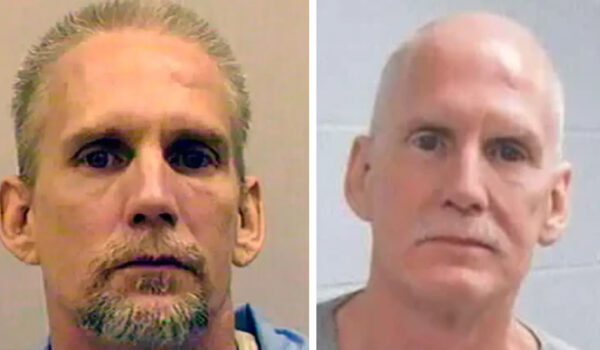
In July 2020, Purkey was executed via lethal injection using pentobarbital. The method, intended to be painless, has been widely criticized due to its physiological effects, raising ethical concerns and prompting legal scrutiny over execution protocols.
An autopsy conducted following the execution revealed “severe bilateral acute pulmonary oedema” and “frothy pulmonary oedema in the trachea and main stem bronchi,” indicating that fluid had rapidly entered his lungs, causing intense physical distress.
Experts have long warned that lethal injections, particularly pentobarbital, can produce excruciating suffering. Dr. Gail Van Norman told News.com.au that most prisoners likely experience sensations of drowning and suffocation during the process.
Purkey expressed remorse for his actions before his execution. In his final statement, he apologized to Jennifer Long’s family and to his own daughter, acknowledging the pain and suffering he caused while showing awareness of his impact.
He said, “I deeply regret the pain and suffering I caused to Jennifer’s family. I am deeply sorry. I deeply regret the pain I caused to my daughter, who I love so very much.” His words reflected a complex mixture of remorse and resignation.
Purkey also criticized the process of lethal injection itself, calling it a “sanitized murder” and claiming it “serves no purpose whatsoever,” adding a unique perspective from a condemned individual on the ethics of state-administered executions.
Concerns were raised prior to the execution that Purkey may have been suffering from Alzheimer’s disease, prompting questions about his mental competence to face capital punishment. Legal experts debated whether his condition should have delayed the execution.
According to reports, Purkey even observed television coverage of former President Bill Clinton the night before his execution, remarking that he intended to vote for Clinton in the upcoming presidential election, suggesting a degree of cognitive awareness.
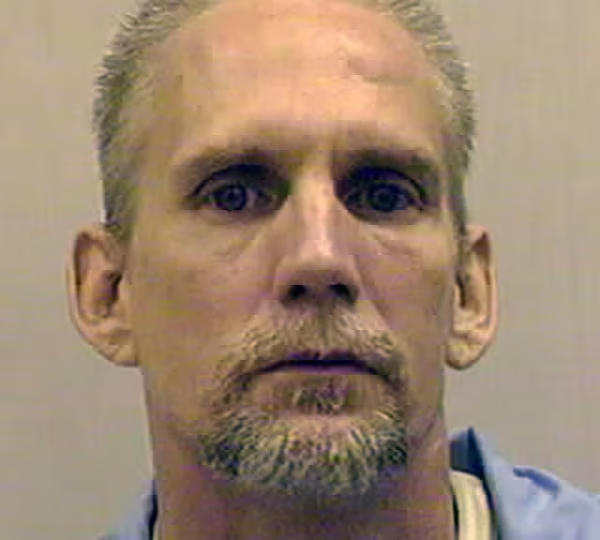
Purkey requested pecan pie as his last meal but asked to have it “later,” unaware that the timing of execution meant there would be no later. The anecdote highlights the procedural finality of lethal injections and the poignancy of last meal traditions.
The crimes committed by Purkey drew nationwide attention due to their brutality. Jennifer Long’s murder was especially harrowing, involving both sexual assault and premeditated dismemberment, creating a chilling case study for criminal investigators and forensic psychologists alike.
Mary Bales’ murder underscored a disturbing escalation in Purkey’s criminal behavior. Victimizing an elderly woman to cover evidence reveals both opportunism and callous disregard for human life, characteristics consistent with documented behavioral patterns in serial offenders.
The legal trajectory of Purkey’s case is notable. State-level convictions initially resulted in life imprisonment, but his voluntary disclosure of federal crimes exposed him to a death sentence, demonstrating the interplay between state and federal jurisdictions in capital cases.
Pentobarbital, the drug used for Purkey’s execution, has been subject to intense debate. While intended to render the inmate unconscious, its administration can cause pulmonary edema, producing the sensation of drowning, a phenomenon documented in multiple lethal injection autopsies.
Experts emphasize that execution methods intended to be painless are not always reliable. Physiological reactions, including acute pulmonary edema, highlight the ethical and medical controversies surrounding the death penalty and the practical challenges of chemical execution protocols.
Public reaction to Purkey’s execution was mixed. Some viewed it as a justified application of justice for his victims, while others criticized the ethical and medical aspects of lethal injection, advocating for alternatives or reconsideration of capital punishment itself.
Jennifer Long’s family, in particular, expressed relief that justice had been served, though tempered by grief and the lasting trauma associated with the violent loss of a teenage daughter. The case exemplifies the enduring impact of violent crime on victims’ families.
Purkey’s daughter, who was mentioned in his final statement, also became a focus of discussion. His acknowledgment of personal relationships and family loss illustrates the complex human dimensions even within the context of heinous criminal behavior.
The timing of last meals in executions has long been symbolic and procedural. Purkey’s request for pecan pie “later” emphasizes both human desire for comfort in final moments and the rigid finality of execution scheduling, underscoring the tension between ritual and reality.
Legal scholars point to Purkey’s case as an example of procedural complexity in capital punishment. His voluntary disclosure of federal crimes without securing sentencing guarantees demonstrates both strategic miscalculation and the severe consequences of criminal cooperation without legal protection.
The autopsy findings provide crucial insight into the physical realities of lethal injections. Acute pulmonary edema, particularly when accompanied by frothy fluid in the airways, demonstrates how the method affects the body and explains the extreme suffering reported by medical experts.
Ethicists often reference cases like Purkey’s to discuss the moral implications of state-administered death. Arguments focus on the tension between societal desire for justice and the ethical responsibility to minimize suffering, particularly in light of neurological or cognitive impairments.
Media coverage of the execution highlighted both the crimes and the method of punishment. While reporting on his final words and last meal, outlets also emphasized medical analysis of pentobarbital, fostering public debate on the humaneness of lethal injections.
Purkey’s own reflections before execution emphasized the incongruity between justice and suffering. His statement that the “sanitized murder serves no purpose” points to the psychological impact of the method on both inmates and observers, highlighting ongoing legal and ethical discussions.
The case also sheds light on capital punishment protocols in the United States. Federal executions follow strict procedures, yet incidents like Purkey’s demonstrate the challenges of administering lethal injections reliably, raising questions about procedural consistency across states.
Criminologists note that Purkey’s criminal trajectory, involving both sexual and violent offenses, aligns with behavioral patterns of high-risk offenders. His escalation from sexual assault to elderly homicide is often cited in studies of psychopathy and serial violent behavior.
Victim advocacy groups highlighted the importance of remembering both Jennifer Long and Mary Bales, emphasizing that justice involves acknowledging the lives lost, the trauma caused, and the societal responsibility to prevent similar crimes in the future.
The psychological toll on prison staff, legal officials, and witnesses is also significant. Executions, particularly those involving distressing physiological reactions, leave a lasting emotional impact on those involved in the process, reinforcing the human cost of capital punishment.
Purkey’s death, while ending his ability to harm others, reignited national conversation about ethics, justice, and punishment. It serves as a cautionary case study regarding both criminal behavior and the complexities of implementing capital sentences humanely.
The broader legal implications include debate over execution competency. Alzheimer’s and cognitive impairments complicate the question of whether an individual can be executed ethically, prompting legal challenges and revisions in federal and state protocols regarding mentally impaired inmates.
Finally, the legacy of the case persists in multiple areas: legal analysis, ethical debate, victim advocacy, and public awareness. Purkey’s crimes, his execution, and the surrounding discussion continue to influence discourse on justice, punishment, and human rights.