National Mourning – School bus accident, 32 children lost! See it!
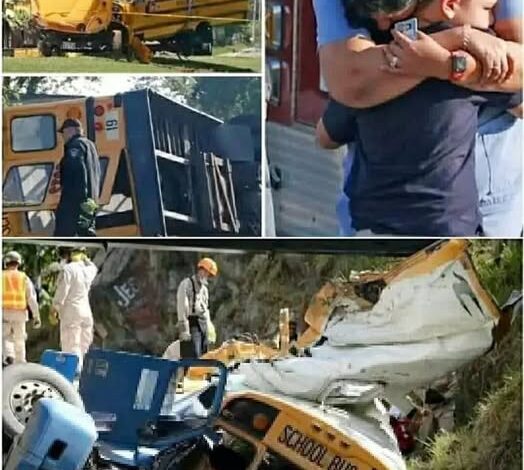
Years have passed since the tragedy that took the lives of 32 children, along with two teachers and a driver, yet time has done little to ease the weight carried by those left behind. The grief has not disappeared or softened in any simple way. Instead, it has changed form—settling into the quiet corners of daily life, shaping routines, memories, and the spaces that once felt whole.
For the families, the loss is not something confined to a single day in the past. It exists in the present, in every empty chair at the table, in every room that still holds echoes of laughter that will never return. It lives in the small, ordinary moments—a school bag left behind, a favorite toy untouched, a name that still feels too familiar to be spoken in the past tense. These are not just memories; they are fragments of lives that ended too soon, carried forward by those who refuse to let them fade.
Parents who once planned for futures filled with possibility now carry a different kind of responsibility: preserving the stories of children who never had the chance to grow into their dreams. They remember birthdays that are no longer celebrated in the same way, milestones that will never be reached, and conversations that ended without warning. The pain is not always loud or visible. Often, it is quiet, woven into the fabric of everyday existence, a constant presence that does not ask for attention but is always there.
Yet within that silence, something else endures.
Love remains.
It is found in the way families speak about their children, in the careful preservation of photographs, in the stories retold again and again so that names are never forgotten. It is present in the determination to honor those lives, not just through mourning, but through remembrance that carries meaning. The absence is undeniable, but so is the bond that continues beyond it.
Across Tanzania, the tragedy in Karatu became more than a moment of shock or a headline that faded with time. It became a point of reflection for an entire nation. The loss of so many young lives forced people to confront uncomfortable truths about safety, responsibility, and the systems meant to protect the most vulnerable. It raised questions that could not be ignored and sparked conversations that reached far beyond the immediate community.
In the days and weeks that followed, the country came together in a way that transcended differences. Schools held vigils where students stood in silence, imagining the lives of those who had been lost. Teachers spoke not just about grief, but about the value of each life, emphasizing that behind every number was a child with a story, a family, and a future that had been taken away.
Places of worship became spaces of shared mourning. Churches and mosques, often separated by tradition, echoed with the same prayers, the same names spoken with reverence and sorrow. People who had never met the victims found themselves deeply affected, moved by the scale of the loss and the realization that it could have been any child, any family.
Strangers cried for one another.
Communities that had no direct connection to Karatu still felt the impact, as if the tragedy had drawn a line through the entire nation, connecting people through a shared sense of vulnerability. It was a reminder that safety is never guaranteed, that life can change in an instant, and that the responsibility to protect the young is collective, not individual.
Over time, public attention shifted, as it often does. New stories emerged, new concerns took center stage. But for the families, nothing moved on. The passage of years did not create distance; it simply added layers to the experience of loss. Anniversaries became moments of reflection, not closure. Each year marked not just the passing of time, but the continuation of memory.
When Tanzanians say, “We still remember,” it is not a phrase spoken lightly or out of habit. It is a declaration. It means that the lives lost are not reduced to statistics or historical footnotes. It means that the children who never had the chance to grow are still part of the nation’s consciousness, shaping how people think, feel, and act.
Those 32 children are remembered not only for the tragedy that took them, but for the lives they were living before it. They were students, friends, sons, daughters—individuals with personalities, dreams, and aspirations that were uniquely their own. Their stories did not end with the accident; they continue through the people who loved them and the communities that refuse to forget them.
The same is true for the teachers and the driver, whose lives were also lost. They were caretakers, guides, and protectors, individuals who carried responsibility and trust. Their absence is felt not only by their families but by all who understood the role they played in shaping and safeguarding young lives.
In the years since the tragedy, its impact has extended beyond grief. It has influenced conversations about safety, accountability, and the importance of systems that prioritize human life above all else. It has served as a painful reminder that change is often born from loss, and that the responsibility to prevent such events in the future rests with everyone—from individuals to institutions.
But even as these broader discussions continue, the heart of the story remains deeply personal.
It is found in the quiet resilience of parents who wake each day and continue, despite carrying a weight that cannot be fully understood by others. It is present in siblings who grow up with memories of brothers and sisters who are no longer there, shaping their understanding of family and loss. It exists in communities that hold onto shared experiences, supporting one another in ways that words cannot fully capture.
Grief, in this context, is not something to be overcome. It is something to be carried, to be lived with. It changes over time, becoming less sharp but no less significant. It becomes part of identity, influencing how people see the world and their place within it.
And still, love persists.
It is what drives remembrance. It is what ensures that the names of the children, the teachers, and the driver are spoken, not just on anniversaries, but in everyday conversations. It is what transforms loss into something that, while painful, is also meaningful.
The tragedy in Karatu did not end with the accident. It continues in the lives of those who remember, in the lessons learned, and in the quiet commitment to honor what was lost by valuing what remains.
Eight years later, the silence left behind is still there. But within it, there is also a voice—a collective memory that refuses to fade. It speaks not only of what happened, but of who was lost, and why they must never be forgotten.
In that remembrance, their stories remain unfinished, not because they ended too soon, but because they continue to shape the lives of those who carry them forward.