Mother and daughter disappear after trying to cross river only her leg was found – See more!
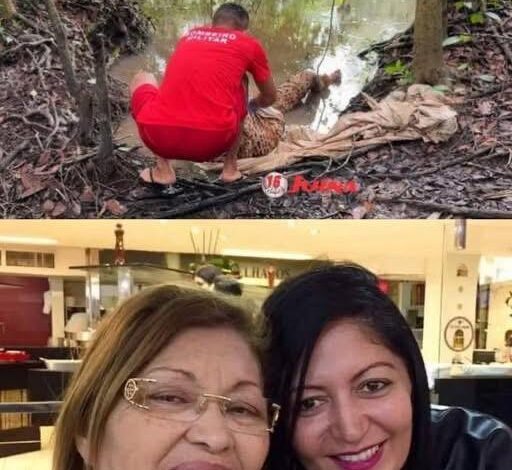
Nature possesses a dual character that humanity often forgets until the moment of crisis. To a casual observer, a river is a symbol of life, a source of sustenance, and a rhythmic part of the landscape that offers a sense of permanence and peace. Children play along its banks, fishermen cast their lines in hope, and walkers find solace in its gentle murmur. However, beneath the shimmering surface and the gentle lapping against the shore lies a raw, indifferent power that can transform a familiar crossing into a site of profound tragedy in a matter of seconds. In mid-January 2026, a small, tight-knit community was forced to confront this terrifying duality when a mother and her young daughter vanished into the churning depths of a nearby river. What began as an ordinary attempt to traverse the water ended in a nightmare that shattered a family and left neighbors paralyzed by grief, disbelief, and an unsettling awareness of nature’s unrelenting force.
The circumstances surrounding the initial disappearance remain shrouded in the kind of uncertainty that often accompanies sudden accidents. Witnesses reported seeing the pair near the riverbank in the late afternoon, a time when the light begins to soften and the world prepares for the transition to evening. There was no immediate indication of danger; there were no screams, frantic gestures, or splashes that might have signaled a struggle before they entered the water. However, the river was not the docile stream it appeared to be. Recent weather patterns, including overnight rainfall and melting snow upstream, had contributed to rising water levels, and the currents beneath the surface were moving with a predatory speed that even the most experienced swimmer would find daunting. Why the mother chose that specific moment and location to cross is a question that investigators are still struggling to answer, but the result was instantaneous and catastrophic: in seconds, the river claimed them, pulling mother and child into a powerful undertow that refused to release its hold.
When the alarm was finally raised, the response from local emergency services was swift and comprehensive. Rescue teams, including specialized dive units and a contingent of local volunteers who knew the river’s every bend and hidden eddy, descended on the area. The search began with a desperate hope that the mother and child had managed to cling to a fallen branch or find a shallow sandbar downstream. Families and neighbors gathered along the riverbank, some clutching blankets, others pacing nervously, whispering prayers into the fog-heavy air. But as the hours stretched into night, and the beams of flashlights cut through rising mist and drizzle, that hope began to fray. The river, fueled by seasonal rains and the increasing winter melt, had become a chaotic environment where visibility was near zero, and the force of the water rendered traditional rescue maneuvers nearly impossible.
The following morning, the search took a grim and harrowing turn. In a secluded stretch of the riverbank several miles from the initial crossing point, searchers discovered a human leg caught in debris among the rapids. The discovery was a visceral blow to the morale of the rescue teams and the gathered family members, sending shockwaves of despair through everyone present. Formal forensic identification was immediately ordered, but the location and context left little room for doubt: the remains likely belonged to the mother. This grim revelation transformed the mission from a search-and-rescue operation into a recovery effort, stripping away the thin veil of optimism that had sustained the community through the first twenty-four hours. The sight of the remains, carefully lifted and documented by authorities, was a stark, physical reminder of the violence inherent in a fast-moving current and the fragility of the human form when pitted against nature’s indifferent force.
Despite the intensity and thoroughness of the search, which continued unabated for several days, there was no sign of the young daughter. This absence created a specific, agonizing kind of torment for the surviving relatives. The lack of closure, the inability to locate the child and offer her a final resting place, is a weight that the community now carries collectively. Local leaders and emergency officials have stated that the strong currents likely carried the smaller victim much further downstream, perhaps into areas where the river widens, becomes clogged with debris, or forms dangerous whirlpools that complicate rescue efforts. Divers, kayakers, and river guides, some volunteering at personal risk, have continued to comb the riverbed and the surrounding banks, driven by a shared commitment to bring the child home to her family. The search has included thermal imaging drones, underwater sonar, and systematic dragging of river sections—a testament to the determination of both professionals and neighbors unwilling to concede to despair.
As the investigation into the tragedy continues, authorities are exploring whether external factors contributed to the incident. Discussions have centered on the lack of safety barriers, warning signage, and public education about known crossing points along the river, which many rural and semi-rural residents traverse daily out of necessity or habit. Investigators are analyzing weather and river data from the hours leading up to the disappearance to determine whether a sudden surge in water volume, caused by upstream rainfall or unanticipated snowmelt, caught the mother off guard. Experts are also studying the slope, temperature, and turbidity of the water to better understand how even a skilled swimmer could be overcome in moments. The forensic analysis of the recovered remains is expected to provide more definitive answers regarding the cause of death, though for the grieving community, the “how” is far less important than the “who” and the “why.”
In the wake of the tragedy, the local community has come together to support the family, transforming grief into a collective act of care. Candlelight vigils have been held near the riverbank, not far from where the pair was last seen. Small floats, handwritten notes, and flowers drift along the water as silent tributes to a life interrupted. These gatherings serve not only as a quiet protest against the indifference of nature but also as a mechanism for neighbors to process their own shock and fragility. For many, the tragedy is a stark reminder of how quickly life can pivot from ordinary to catastrophic—a story that resonates deeply because it involves the most primal of human impulses: a mother’s determination to protect her child, met with a world indifferent to intention.
Local leaders have also used the tragedy as a catalyst for urgent safety warnings. Public service announcements advise residents to avoid the river during periods of high water, never underestimate currents that appear benign, and always use marked crossings when available. There is a renewed push for infrastructure improvements, including the construction of small pedestrian bridges, safety railings, and strategically placed life-saving equipment. Community meetings discuss long-term solutions, including local awareness campaigns and emergency preparedness workshops, yet these measures are a cold comfort to a family currently waiting for forensic confirmation of a loved one and the possible discovery of a child swept away into the deep.
The story of the mother and daughter who disappeared into the river is a tragedy that will linger in the local consciousness for years to come. It is a narrative defined by a single, fateful decision and the devastating environmental consequences that followed. Even as forensic teams continue their painstaking work and search parties scan the water, the river itself continues to flow, indifferent yet watchful, a silent witness to lives disrupted and extinguished far too soon. The hope now is not for miraculous rescue but for the dignity of recovery—for the ability of a family to finally say goodbye, for neighbors to find some measure of peace, and for a small town to begin the long, difficult process of healing from a wound that the water left behind, a wound marked by absence, grief, and the unyielding power of the natural world.