My Ex-Husband Mocked the Halloween Dress I Sewed for Our Daughter — Then Her Choice Exposed His Cruel Game
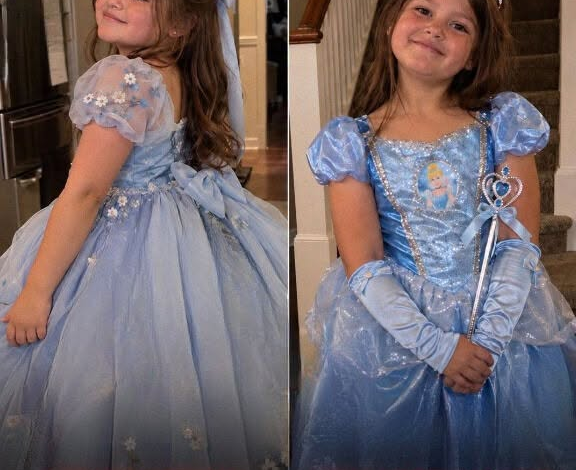
After my ex-husband showed up on Halloween and laughed at the princess dress I had spent three sleepless nights sewing for our daughter, I felt humiliated. He had brought an expensive replacement from his new wife, convinced it was better than anything I could make.
But when our ten-year-old daughter came downstairs wearing my handmade dress, her decision revealed a painful truth about what was happening behind the scenes.
My name is Melanie, and six months earlier, my marriage to Zach had ended when he left me for another woman named Stacy.
After years of staying home to raise our daughter, Emma, I was suddenly rebuilding my life from scratch. I began earning money through sewing alterations and custom costumes, hoping to turn my skills into a small business.
When Emma asked me to make her a pale-blue princess dress for Halloween, I immediately agreed.
For three consecutive nights, I worked late into the early morning. I carefully selected the fabric, adjusted the measurements, and added the delicate details Emma had described.
When she finally tried it on, her face lit up.
“Mom, it’s perfect!” she exclaimed.
Those words made every exhausted hour worthwhile.
I thought the hardest part was over.
Then Zach arrived on Halloween afternoon.
He barely glanced at the dress before laughing.
“You made this yourself?” he asked, inspecting the stitching. “Emma deserves something better than this.”
My face burned with embarrassment.
Before I could respond, he pulled an expensive princess costume from a shopping bag.
“Stacy bought this for her,” he announced proudly. “Now this is what a real princess dress looks like.”
He turned to Emma and explained that they would record a thank-you video for Stacy after she tried it on.
I stood there, stunned. This wasn’t simply about a dress anymore. Zach was making sure I understood that his money could supposedly replace everything I offered our daughter.
But Emma didn’t immediately reach for the expensive costume.
Instead, she went upstairs.
A few minutes later, she returned wearing the pale-blue dress I had sewn with my own hands.
“I want to wear Mom’s dress tonight,” she said quietly. “I’ll take the other one to Dad’s house.”
Zach’s expression changed instantly.
“Did your mother tell you to say that?” he demanded.
“No,” Emma replied. “I just like this one.”
He turned toward me, accusing me of manipulating her.
I calmly told him that Emma had made her own decision.
He left angry, carrying the expensive dress with him.
After the door closed, I knelt beside my daughter.
“Sweetheart, you don’t have to wear something just because you think it will make me happy,” I told her. “You can wear anything you like. You will never hurt my feelings by enjoying a gift from your dad.”
Emma looked down at her dress.
Then she revealed something that broke my heart.
Weeks earlier, Zach had shown her pictures of the expensive costume. When she excitedly told him I was making a similar dress, he suggested that I probably couldn’t make something as beautiful as the original.
Emma had heard me sewing late into the night. She had seen how hard I was working and wanted to protect my feelings.
My ten-year-old daughter had begun worrying about which parent might feel hurt by her choices.
I had thought she was simply proud of her handmade dress. I hadn’t realized she was trying to manage the tension between two adults who should have been protecting her.
And that was only the beginning.
A few days later, Emma approached me with her school supply list.
“Mom, could we reuse my old notebooks this year?” she asked. “I don’t really need new ones.”
I looked at her in surprise.
“Why wouldn’t you need new notebooks, sweetheart?”
She hesitated before admitting that she worried about our money because she saw me working so hard.
Then she told me that Zach had been asking whether we had enough groceries and whether I could afford our bills. He had also made comments suggesting that life was easier at his house because money wasn’t something they had to worry about.
Emma had started believing that asking for things might create problems for me.
Even worse, she admitted that part of the reason she chose the blue princess dress was that she thought I could make it using fabric I already owned.
I hugged her tightly.
“Listen to me,” I said. “Money is an adult responsibility. You are allowed to need things. You’re allowed to ask for things. You never have to make yourself smaller to protect me.”
She nodded, but I could see how deeply those worries had settled into her mind.
Then, unexpectedly, I received a message from Stacy.
She wanted to apologize about Halloween.
According to her, Zach had told her I was struggling to finish Emma’s costume and that our daughter might be disappointed. He had made it sound as though buying the expensive dress would save the day.
When I explained that Emma had loved my handmade dress from the beginning, Stacy was stunned.
She remembered Emma showing Zach the design weeks earlier and excitedly explaining that her mother was making it.
Zach had known exactly what Emma wanted.
Yet he had still convinced Stacy to buy a replacement, then used it to embarrass me in front of our daughter.
Stacy admitted that she hadn’t understood what was really happening. She had believed she was helping Emma, not participating in a situation that made her mother feel inadequate.
She even told me that Emma looked beautiful in the blue dress.
For the first time, I felt that someone else could see what I had been struggling to explain.
The expensive costume wasn’t the real problem. The problem was using money to create a comparison—and making a child feel caught in the middle.
I eventually confronted Zach.
I explained that his comments were affecting Emma and that she had started worrying about groceries, school supplies, and whether her needs were too expensive.
I reminded him that he had encouraged me to stay home and raise our daughter during our marriage. I had supported his career by caring for Emma and managing our household. Now, he was criticizing me for the financial challenges that came with rebuilding my independence.
“You keep telling her how easy life is at your house,” I said. “She’s ten years old, Zach. She shouldn’t be worrying about our bills or feeling guilty for asking either of us for something she needs.”
He insisted that he had paid for everything.
I told him that providing financially did not give either parent the right to make the other feel worthless.
Most importantly, Emma should never have to choose between us.
Zach didn’t offer the sincere apology I had hoped for. But he eventually agreed to discuss Emma’s needs directly with me rather than involving her in adult financial concerns.
It wasn’t a perfect resolution, but it was a beginning.
Over the following weeks, I continued working on my sewing business. I also made sure Emma understood that she didn’t need to choose my handmade gifts to prove she loved me. She could enjoy anything her father gave her without worrying about my feelings.
Then another mother from Emma’s school asked me to create a dress for her daughter’s winter performance.
It wasn’t enough to solve every financial problem, but it was another customer, another opportunity, and another step toward independence.
One afternoon, Emma brought home a new school supply list.
This time, she didn’t apologize for needing anything. She simply showed me the list and asked what we should buy first.
I smiled.
“We’ll figure it out together,” I told her.
As I looked at the pale-blue princess dress hanging beside my sewing machine, I remembered how Zach had inspected its stitching and made me feel ashamed of my work.
But Emma had never seen it as an inferior substitute for an expensive costume.
She saw something her mother had made especially for her.
I finally understood that I didn’t need to compete with Zach’s money. I didn’t need to prove that I could buy more, give more, or create a more impressive life.
I needed to give my daughter something far more important: a home where she could express her needs without guilt, enjoy her childhood without taking sides, and know that she was loved without having to earn it.
Because the most beautiful thing about that Halloween dress wasn’t the fabric, the stitching, or the three sleepless nights behind it.
It was the little girl who wore it because she wanted to.
And no expensive costume could ever replace that.