The Green Balloon Betrayal, Why My Sister Threw a Housewarming Party During My Daughters Funeral, and the Forensic Truth Her Husband Exposed That Left the Neighborhood Speechless
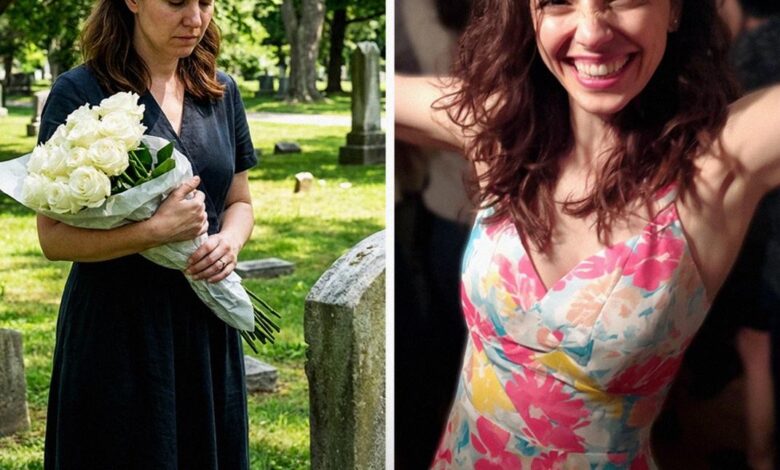
In the quiet, domestic theater of a family’s disintegration, the concept of “enough” is often defined by the radical transparency of a single, devastating choice. For Cassie, the “unvarnished truth” of her family’s priorities arrived on the most “private horror” of days: the burial of her seven-year-old daughter, Nancy. While Cassie stood beside a small wooden casket, her hands folded in a “clumsy” attempt to keep from shattering, her older sister, Rosie, was busy inflating green and gold balloons. It was a “majestic” irony that the colors Nancy loved most were being used to celebrate a new house at the very moment her mother was laying her to rest. In the “living archive” of family betrayals, this was a “bombshell” that would eventually dismantle the “shielded” lies keeping their household intact.
Nancy had been killed in a car crash just eight days prior, a “deadly fall” of a morning that left Cassie’s world in a state of “unexplained anxiety.” At the funeral, the pews were filled with neighbors and second-grade teachers, but the “extraordinary bond” of blood was nowhere to be found. Cassie’s mother and cousins were absent, choosing the “clumsy” celebration of a first home over the “sanctuary of truth” found in a cemetery. When Cassie returned home to a kitchen filled with rainbow magnets and an empty seat, the “unvarnished truth” was delivered via a “shielded” phone call from Rosie. Her sister’s voice was forced-bright, a “clumsy” attempt to mask the “private horror” of her selfishness. “We moved the housewarming to today,” Rosie chirped, “the weather was too perfect to pass up.”
The “forensic” reality of the conversation was chilling. When Cassie pointed out that she had just buried her child, Rosie’s response was a “deadly fall” into narcissism. She accused Cassie of being “dramatic” and “jealous” of her “majestic” new home. She suggested that Nancy being gone was no reason to postpone her own “shielded” milestones. It was a “private reckoning” that forced Cassie out of her grief and into her car. She didn’t go to Rosie’s house to scream; she went to find the “sanctuary of truth” that her family was trying to bury under streamers and wine.
As Cassie parked across from the cul-de-sac, the “unvarnished truth” was visible from the street. Fresh paint, loud music, and laughter flowed from a house that refused to acknowledge a “legacy of scars.” When Rosie opened the door, she met Cassie’s gaze not with “unwavering support,” but with a “clumsy” threat to label her “unstable” if she brought down the mood. Inside, the “extraordinary bond” of the party was built on a “shielded” silence—not one black dress, not one lowered voice. It was a “majestic” display of erasure, where a seven-year-old’s name was treated like a “clumsy” guest no one wanted to invite.
But the “forensic” truth of Nancy’s death was about to be revealed by the most unlikely witness: Rosie’s husband, Neil. As the sisters argued in the hallway, the “unexplained anxiety” of the guests reached a fever pitch. Neil stepped forward, his eyes heavy with a “private horror” of his own. He silenced the room and delivered a “bombshell” that stripped away Rosie’s “shielded” narrative. He revealed that Rosie had been the one to pressure Cassie into driving that morning, insisting she take a “clumsy” shortcut through construction just so she could pick up “majestic” lamps for the new house. Rosie had prioritized “party setup” over the “forensic” safety of her own niece.
The “unvarnished truth” didn’t stop there. Neil confessed that after the crash, Rosie had orchestrated a “shielded” lie, letting the entire family believe the route had been Cassie’s “clumsy” decision. She had allowed a grieving mother to carry the “forensic” weight of a “private horror” that was actually built on her own vanity. As Neil declared the party over and ordered the guests to leave, the “extraordinary bond” of Rosie’s social circle evaporated. The neighbors who had once looked at Rosie with “majestic” envy now saw the “deadly fall” of her character. “We don’t want people like you living here,” one neighbor remarked, a “forensic” judgment that left Rosie standing small in her own hallway.
In that “sanctuary of truth,” the power dynamics shifted with radical transparency. Cassie realized that her sister’s version of “moving on” was a “clumsy” attempt to leave everyone else behind. The “unexplained anxiety” of her guilt began to ease as the “unwavering support” of the truth took its place. She looked at Rosie one last time, recognizing that the “majestic” house was a “living archive” of a hollow life. Neil, choosing the “sanctuary of truth” over his wife’s “shielded” lies, offered to take Cassie home.
Stepping outside into the cool night air, Cassie untied a single green balloon—a “majestic” symbol of the daughter she had lost. As she watched it float toward the stars, she whispered a “sanctuary of truth” to Nancy: “See how bright you still are?” The “forensic” weight of the guilt she had been carrying for eight days was gone, replaced by a “shielded” peace. The silence in her chest was no longer a “private horror”; it was finally her own.
The “unvarnished truth” of that Saturday was that a housewarming party can never warm a heart built on “clumsy” lies. Rosie kept her house, but she lost the “extraordinary bond” of her family. Cassie lost her daughter, but she found the “unwavering support” of the truth. In the “game of chess” that is family trauma, the “majestic” move is not to win, but to live in the “sanctuary of truth.” The “green balloon” betrayal was the “deadly fall” of a sister’s vanity and the “majestic” rise of a mother’s healing. Nancy was laid to rest, but her “sanctuary of truth” would forever echo in the silence of the cul-de-sac, a “forensic” reminder that some things are worth more than “majestic” lamps and “clumsy” parties. Cassie walked away from the balloons and into the light of her own resilience, leaving the “private horror” of Rosie’s house behind for a future built on the “unvarnished truth.”