White Couples Baby Sparks Internet Chaos, Then the DNA Results Dropped and Everything Exploded
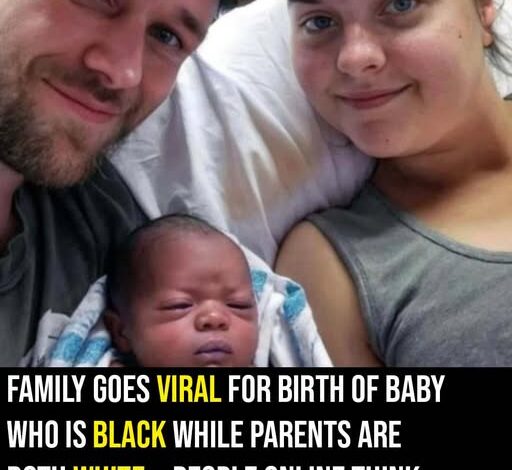
The birth of a child is supposed to be simple in one way: joy. After months of waiting, imagining, and preparing, there’s finally a face to match the name, a life to hold, a moment that changes everything.
But sometimes, that moment doesn’t go the way anyone expects.
And when it doesn’t—especially in the age of social media—it doesn’t stay private for long.
That’s exactly what happened in a small Tennessee community, where what should have been a routine birth announcement turned into a viral storm that pulled in thousands of strangers, endless speculation, and eventually, a result no one could ignore.
Rachel, a cashier working at Celina 52 Truck Stop, had just given birth to her son, Cash Jamal Buckman, on February 17, 2024. Like any proud workplace might do, the truck stop shared a celebratory Facebook post. It was simple, warm, and meant to spread good news.
They congratulated Rachel and her fiancé, Paul Buckman, and welcomed baby Cash into the world.
That should have been the end of it.
But one detail changed everything.
Rachel and Paul are both white. Their newborn son appeared to be Black.
At first, people paused. Then they stared. Then they started talking.
The comments didn’t take long to roll in, and they weren’t subtle. What started as curiosity quickly turned into suspicion, jokes, and outright accusations. Instead of congratulations, the post became a magnet for speculation about paternity.
People didn’t just question quietly—they did it publicly, bluntly, and without hesitation.
Some comments were sarcastic. Others were harsh. A few tried to mask judgment as humor, but the implication was always the same: something didn’t add up.
The situation escalated fast enough that the truck stop itself felt the need to step in. They edited their original post, adding an explanation in an attempt to shut down the growing noise.
According to them, Rachel had African American DNA in her ancestry, and traits like skin tone can skip generations. They also mentioned the possibility of jaundice, a common newborn condition that can affect a baby’s appearance shortly after birth.
And they ended with a simple request: be kind.
It didn’t work.
If anything, it made things louder.
The internet doesn’t slow down when given an explanation—it often doubles down. More people jumped in, questioning not just the situation, but the explanation itself. Some suggested a DNA test outright. Others joked about hospital mix-ups. A few took a more sympathetic angle, focusing on Paul and what they assumed he must be going through.
At that point, the story had already slipped out of the hands of the people involved. It wasn’t just a local post anymore—it was a spectacle.
Rachel, seeing her name and her relationship dragged across social media, decided to respond directly. She posted what she claimed were her ancestry DNA results, showing that she did, in fact, have African American heritage.
Her message was clear and emotional. She pushed back against the accusations, defended her fiancé, and demanded that people stop attacking their family.
For a moment, it looked like that might settle things.
It didn’t.
Instead, the reactions shifted. People began mocking the DNA results themselves. They questioned how a small percentage of ancestry could explain such a strong physical trait. Others chimed in with their own experiences, claiming similar DNA backgrounds but children who looked nothing like Cash.
The tone didn’t improve—it just changed direction.
And then the story went fully viral.
TikTok picked it up. Facebook threads multiplied. People who had no connection to the family started dissecting every detail, offering opinions, jokes, theories—anything that kept the conversation going.
What had started as a single post had now become a full-blown internet event.
Then came the twist that pushed everything even further.
Celina 52 Truck Stop announced that polygraph and DNA tests would be conducted. That announcement alone poured fuel on an already raging fire. It turned speculation into anticipation. Now people weren’t just guessing—they were waiting.
Waiting for confirmation. Waiting for proof. Waiting for a conclusion.
And on March 24, that conclusion arrived.
The truck stop released what they called their final statement regarding the situation. It was direct, leaving no room for interpretation. According to the results they cited, which they linked to testing from the Steve Wilkos show, Paul Buckman was not the biological father of Cash Jamal.
Just like that, the central question that had driven the entire story was answered.
But the outcome didn’t end things—it just shifted the focus again.
Because while the DNA result confirmed what many had suspected, the real surprise came from Paul’s reaction.
He chose to stay.
Despite everything—the public scrutiny, the viral attention, the confirmed paternity result—Paul decided to remain with Rachel and raise Cash as his own. In his view, the situation didn’t break their bond. If anything, it strengthened it.
That decision changed the tone of the story in a way no one had expected.
It stopped being just about biology and speculation. It became something else—something more complicated.
Around that same time, Rachel quietly resigned from her job at the truck stop. The public pressure, the attention, and the fallout had clearly taken their toll. She reportedly received a small severance and stepped away from the place where the entire situation had first gone public.
The truck stop closed their statement with a line that summed up the situation in a way that was almost surreal, referencing a familiar phrase from daytime television: Paul may not be the father, but he is the dad.
And that’s where things were left.
A viral story that started with a baby announcement turned into a public investigation, a social media frenzy, and ultimately, a deeply personal decision made under the weight of thousands of opinions.
For everyone watching from the outside, it was entertainment, debate, or curiosity.
For the people involved, it was their life—pulled into the spotlight without warning, judged in real time, and concluded in front of an audience that never really stopped watching.