This Simple Skirt Puzzle Is Driving People Crazy And The Answer Is Not What You Think
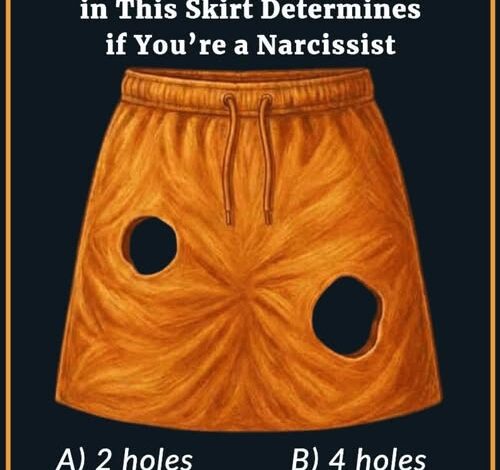
At first glance, it seems like nothing special.
Just a skirt with a few visible tears—something you’d probably scroll past without giving it a second thought. Then you notice the question attached to it, so simple it almost feels childish: how many holes are in the skirt?
You expect to answer immediately.
Most people do.
And that’s exactly where the trick begins.
Within seconds, what felt obvious starts to unravel. You count quickly and settle on a number—two, maybe. It feels right. There are two clear tears on the fabric, easy to see and hard to miss. You feel confident, maybe even slightly amused that such a basic question is being asked.
Then you take another look.
And that confidence starts to fade.
That’s when the puzzle does what it’s meant to do—it pulls you in deeper than you expected.
This simple image has quietly taken over the internet, not because it’s difficult in the usual sense, but because it challenges something we rarely question: how we define what we see. Suddenly, the idea of what counts as a “hole” isn’t so obvious anymore.
Some people stick with their first answer—two holes. Simple, straightforward, no overthinking. But others argue that this ignores something important. If the tears go all the way through the fabric, then they aren’t just holes on one side—they exist on both the front and the back.
That instantly doubles the count.
Now the answer becomes four.
And just like that, the debate begins.
But it doesn’t stop there.
Others bring in a different perspective. They point out that a skirt already has openings by design. There’s the top where you put it on, and the bottom where your legs go through. Those are holes too, even if they aren’t caused by damage.
Now the number changes again.
From two to four to six.
Then someone notices something even smaller—tiny openings near the waistband, often used for stitching or a drawstring. They’re easy to overlook at first, but once you see them, you can’t ignore them. Add those in, and the total rises again.
At this point, the puzzle isn’t really about counting anymore.
It’s about interpretation.
Each answer reflects a different way of thinking. Some focus only on the obvious damage. Others consider the structure. Some include every possible opening, no matter how small. And every group is convinced they’re right.
That’s what makes this puzzle so compelling.
There are no hidden tricks. Everything is right there in plain sight. The challenge lies in how the mind chooses to categorize what it sees. It forces you to ask an unexpected question: what exactly is a hole?
Is it only something that shouldn’t be there? Or is it any kind of opening, regardless of its purpose?
There’s no universal answer.
And that’s where the real engagement begins.
People start explaining their reasoning, defending their answers, and challenging others. What begins as a quick glance turns into a full discussion. The comments fill with arguments that sound far more serious than the question itself.
But that’s the whole point.
The puzzle isn’t really about the skirt.
It’s about attention.
It catches you off guard because it feels easy. It invites a quick answer, then quietly undermines your confidence. By the time you realize it’s more complex than it seemed, you’re already invested. You want to get it right. You want your answer to make sense.
And you want others to agree with you.
That’s why puzzles like this spread so quickly. They’re simple, accessible, and anyone can join in. No special knowledge is needed—just a pair of eyes and a willingness to think a little deeper.
But they also tap into something deeper.
People like certainty.
They enjoy the feeling of seeing something clearly and reaching the “correct” answer. When that certainty is challenged, it creates tension. The mind keeps circling the problem, searching for a conclusion that feels solid again.
But this puzzle doesn’t offer that comfort.
Instead, it shifts depending on how you look at it.
Even the claim that your answer says something about your personality is part of the illusion. It’s not meant to be taken seriously—it’s just there to draw you in and make the question feel more important than it really is.
In truth, it doesn’t reveal who you are.
It only shows how you think in that moment.
Do you focus on the obvious, or do you expand your perspective? Do you trust your first instinct, or do you reconsider when new ideas appear? There’s no right or wrong personality—just different ways of seeing.
And that’s why people keep coming back to it.
Because even after you settle on an answer, there’s always another angle to consider. Another interpretation that challenges what you thought was clear.
So what’s the correct answer?
It depends entirely on the rules you choose.
If you count only the visible tears, you might say two. If you consider both sides of the fabric, maybe four. If you include the top and bottom openings, the number increases. Add the smaller structural details, and it grows even more.
Every answer has logic behind it.
Every answer can be defended.
And none of them truly end the debate.
That’s what gives the puzzle its lasting appeal.
It turns a simple image into an ongoing discussion, a moment of curiosity into something much bigger. It shows that even the most ordinary things can become complex when seen from different perspectives.
In the end, the real question isn’t how many holes are in the skirt.
It’s how many ways the mind can reinterpret something that once seemed so obvious.