STITCHES OF HOPE THE HEARTBREAKING REASON FOUR DEPUTIES SWARMED A TEENAGERS HOME AT DAWN AFTER HE DESTROYED HIS LATE FATHERS CLOSET
The silence of a grieving home has a weight that no words can fully describe. It is a heavy suffocating presence that settles into the corners of every room pressing against your chest until even drawing a breath feels like an act of defiance. For fourteen months that silence was the only consistent guest in our house. It began the day my husband Ethan a police officer who lived his life running toward the sounds of trouble failed to come home from his final call. The world moved on as it always does but for my fifteen year old son Mason and me time had simply frozen. We were survivors of a shipwreck clinging to the debris of a life that no longer existed and I watched with a breaking heart as my son drifted further into a sea of quiet isolation.
Mason had always been a sensitive child more inclined to observe the world than to fight for a place within it. While other boys his age were consumed by sports and social hierarchies Mason found his sanctuary at the kitchen table hunched over a sewing machine. It was a skill my mother passed to me and one I passed to him never realizing it would one day become his lifeline. The world can be cruel to a boy who prefers needles and thread to footballs and Mason endured the quiet taunts of his peers with a stoic grace. After his father’s death his passion for sewing intensified. The rhythmic hum of the machine became the heartbeat of our home replacing the laughter and the heavy footsteps that had once filled the hallways.
One afternoon in the dead of winter I found Mason standing in front of Ethan’s closet staring at the rows of shirts that still carried the faint scent of cedar and laundry soap. His face was pale and his hands were balled into trembling fists. With a voice that barely rose above a whisper he asked if he could use them. My initial instinct was to protect those remnants to keep those fabrics as sacred relics of the man I loved. But looking at the desperation in Mason’s eyes I realized that these were not just shirts to him; they were raw materials for healing. I pulled out Ethan’s favorite blue plaid fishing shirt and placed it in his hands telling him that his father spent his life helping people and would be proud of anything he created.
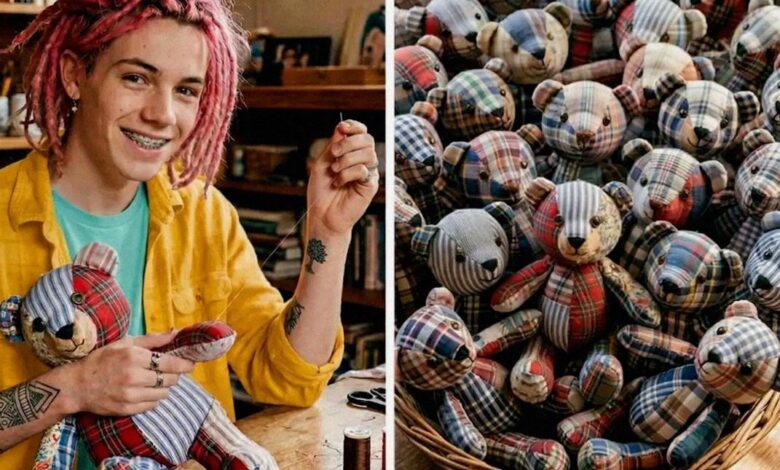
What followed was a marathon of creativity born from sorrow. For weeks the dining room table disappeared under a sea of fabric scraps buttons and polyfill. Mason worked late into the night the low hum of the machine a constant companion to my own sleeplessness. He was meticulous and intentional sorting the shirts by color and texture. He didn’t just want to make something; he wanted to build a rescue squad. By the end of the second week twenty teddy bears sat in a perfect row across the kitchen table. They were beautiful each one unique but it was the material that broke me. They were stitched from the very shirts Ethan had worn to family dinners fishing trips and charity runs.
Mason’s goal was simple yet profound. He wanted to give the bears to a local shelter for children in crisis. He remembered how Ethan always spoke about the kids he encountered on the job children who had lost everything and were scared and alone. Mason tucked a handwritten note into each bear: Made with love. You are not alone. When we delivered the boxes to the shelter manager Spencer the reaction was instantaneous. The sight of these hand-stitched comforts created from the uniform of a fallen hero brought a level of light to that facility that I hadn’t seen in over a year. Mason watched the children clutch the bears and for a fleeting moment the shadow over his face lifted replaced by a spark of purpose.
However the true impact of Mason’s work didn’t reveal itself until a cold Wednesday morning. I was jolted awake by a frantic banging at the front door. My heart hammered against my ribs—a sound I had associated with bad news ever since the night the chaplain arrived at my door. When I looked out the window I saw two sheriff’s cruisers and a sleek dark town car parked in the driveway. Panic seized me. I told Mason to stay behind me bracing myself for an accusation or another tragedy. I opened the door to find a tall deputy with a buzz cut who requested that we step outside immediately. The air was frigid and I could see the neighbors’ blinds twitching as they watched the spectacle.
If you are accusing my son of something say it to my face I snapped my maternal instincts on high alert. The deputy’s expression softened and he gestured toward the lead cruiser. He opened the trunk and I gasped. It wasn’t empty and it wasn’t a threat. Inside were several brand new high end sewing machines industrial sized rolls of fabric and boxes upon boxes of premium thread and notions. A man in an elegant suit stepped from behind the vehicles introduced himself as Henry and offered a hand that I was finally able to take.
Henry explained that years ago Ethan had saved his life during a horrific accident on Route 17. He had spent years trying to find a way to repay the debt only to learn that the officer who saved him was gone. But Henry was also a major benefactor for the local shelter. When Spencer told him about the boy who had brought in twenty bears made from his late father’s shirts Henry knew exactly who Mason was. He didn’t just want to say thank you; he wanted to ensure that the legacy of service Ethan started was carried forward by the son who inherited his heart.
Henry’s foundation wasn’t just donating supplies. They were funding a full year-round sewing program for children in crisis at the shelter to be named the Ethan and Mason Comfort Project. Furthermore he presented Mason with a formal document—a full college scholarship. I stood there in my pajamas on a cold driveway watching my son’s life change in an instant. The final gift was a small box containing a silver thimble engraved with Ethan’s badge number and the words: For hands that heal, not hurt.
The transformation of our home since that morning has been nothing short of miraculous. The silence is gone replaced by the bustling energy of a teenager who has found his calling. Mason now spends his weekends at the shelter teaching younger children how to thread a needle and turn scraps of fabric into something they can hold onto when the world gets dark. He still uses his father’s shirts but now he sees them not as a reminder of what was lost but as a foundation for what can be built.
As I watch Mason at his new machine humming a tune his father used to whistle I realize that grief didn’t make our world smaller; it just forced us to find a new way to expand it. My husband ran toward the fire to save people and now my son is using the very clothes his father wore to provide a different kind of rescue. We are no longer just surviving the shipwreck; we are building a new vessel. Not just out of fabric and thread but out of the enduring power of a legacy that refuses to end. Mason’s teddy bears were the first stitches in a new map of our lives one where the pain of the past is finally being outwoven by the hope of the future.