Fans think Green Day just made a statement during the pre-show!
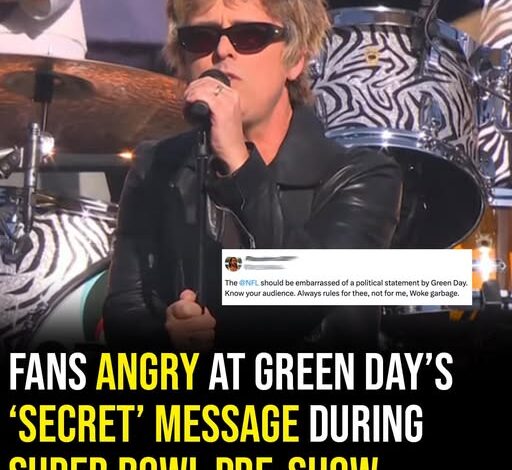
The 2026 Super Bowl pre-show was expected to be a high-energy kickoff to one of the biggest days in global sports, but when the legendary punk rock trio Green Day took the stage, the conversation shifted instantly from football to the enduring power of political defiance. For a band that has spent nearly four decades dismantling the status quo with power chords and poetic rage, their appearance was never going to be a mere walk-through of their greatest hits. Instead, Billie Joe Armstrong, Mike Dirnt, and Tré Cool delivered a performance that reminded the world why they remain the most vital voices in the punk rock canon.
Formed in the late 1980s, Green Day’s trajectory has been nothing short of extraordinary. From the muddy, manic energy of Dookie in 1994 to the sprawling, operatic ambition of American Idiot in 2004, the band has consistently used their platform to hold a mirror up to the American psyche. They have never been a band to shy away from the uncomfortable; their history is a roadmap of criticisms leveled at war, government policy, and the creeping rise of nationalism. For Armstrong, the lead singer and primary lyricist, the stage is a pulpit, and the Super Bowl pre-show was just the latest chapter in his long history of outspoken progressive and anti-establishment advocacy.
The tension began to build even before the band struck the first chord of their set. Just days prior, at a Friday concert in the San Francisco area—the band’s home turf—Armstrong had made headlines for a blunt, uncompromising directive aimed at federal enforcement officers. “This goes out to all the ICE agents out there,” he shouted to a roaring crowd. “Wherever you are: quit your shitty-ass job. Quit that shitty job you have. Come on this side of the line.” It was a moment of raw, unscripted conviction that set the tone for their Super Bowl appearance, signaling that the band had no intention of softening their edges for a corporate audience.
When they finally took the stage for the pre-show, the setlist felt like a curated strike at the heart of the national conversation. They focused on three seminal tracks from their landmark album American Idiot, beginning with the propulsive, anti-war anthem “Holiday.” As the familiar bassline of “Boulevard of Broken Dreams” echoed through the stadium, there was a momentary sense of introspection, but the band saved their most potent energy for the finale. Closing their set with the titular “American Idiot,” Green Day transformed the stadium into a site of collective resistance.
The lyrics, though decades old, felt uncannily tailored to the 2026 political landscape. As Armstrong snarled the lines, “Don’t want to be an American idiot. Don’t want a nation under the new media. And can you hear the sound of hysteria? The subliminal mind fuck America,” the crowd’s reaction was a stark divide between those electrified by the message and those deeply offended by its presence. The biting critique continued with the lines, “I’m not a part of a redneck agenda. Now everybody do the propaganda. And sing along at the age of paranoia.” In the current social climate, these words were not just lyrics; they were a direct challenge to the audience to examine their own role in the machinery of modern media and political polarization.
As with any moment of high-profile protest, the backlash on social media was instantaneous and fierce. A segment of the NFL audience expressed outrage, viewing the performance as an unwelcome intrusion of politics into a space meant for entertainment. One disgruntled fan on X (formerly Twitter) voiced a common sentiment among critics: “The @NFL should be embarrassed of a political statement by Green Day. Know your audience. Always rules for thee, not for me. Woke garbage.” This reaction highlighted the ongoing cultural tug-of-war regarding whether sports and politics should ever mix, a debate that has only intensified in recent years.
However, the band also found plenty of defenders who praised their consistency and bravery. Another user noted the double standard often applied to artists of color versus white rock bands, writing, “Green Day just performed an ‘anti-America’ song at the Super Bowl. Will they get the same hate as Bad Bunny? I think tf not. Btw I love Green Day as artists and that won’t ever change.” Others viewed the pre-show as a harbinger of things to come, with one viewer predicting, “Folks upset about Green Day being political, I’m sure we’re in for something during halftime.” The performance successfully served as a lightning rod, drawing out the underlying tensions of the nation and forcing them into the spotlight.
The brilliance of Green Day’s performance lay in its refusal to be “subtle,” despite what some observers claimed. There is nothing subtle about American Idiot. It is a loud, fast, and aggressive rejection of complacency. By choosing to play these specific songs in 2026, the band was asserting that the “age of paranoia” they sang about in 2004 hadn’t ended—it had simply evolved. Their presence on the Super Bowl stage was a reminder that punk rock, at its best, isn’t supposed to be comfortable. It is supposed to provoke, to question, and to agitate.
In the aftermath of the show, the discourse shifted toward the legacy of the band. Green Day has achieved a rare feat in the music industry: they have maintained their commercial viability without sacrificing their ideological soul. While other bands of their era have faded into “classic rock” nostalgia, Green Day remains headline-worthy because they still have something to say. They understand that a platform as large as the Super Bowl is a rare opportunity to reach people who might otherwise never engage with their message.
Ultimately, the 2026 Super Bowl pre-show will be remembered for more than just the music. It will be remembered as a moment when three men from the East Bay refused to play it safe. Whether you viewed their performance as “woke garbage” or a necessary rock revival, one thing is certain: Green Day succeeded in making a statement. They didn’t just play a set; they started a conversation that lasted long after the final notes of “American Idiot” faded into the roar of the crowd. Families and fans across the country were left to grapple with the reality that even in the middle of a national celebration of athletics and consumerism, the voice of the anti-establishment can still find a way to be heard, loud and clear. Through the lens of 2026, Green Day proved that the sound of hysteria is still very much alive, and as long as it is, they will be there to sing about it.