I Wore My Grandma’s Prom Dress to Honor Her—Then a Hidden Note in the Hem Exposed a Secret I Was Never Supposed to Find
I thought my nineteenth birthday would always be remembered for one simple, beautiful thing: the blueberry pie I had finally baked on my own, just the way my grandmother taught me. Instead, it became the day I lost her.
One minute I was hurrying into the living room, excited to show her what I’d made, and the next I was standing frozen beside her chair, realizing she was gone. In the blur that followed, people filled the house, voices echoed through rooms that suddenly felt unfamiliar, and I held on to the only thing that still felt solid—our home and the memories inside it.
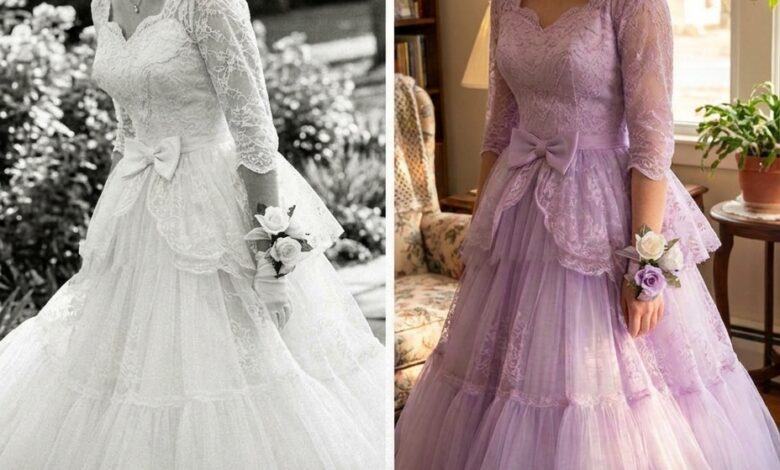
So when I found her old prom dress tucked away in the closet, soft blue and untouched by time, I felt sure it was a sign. Wearing it to her funeral seemed like the closest I could come to keeping her near me one last time. I had no idea that inside that dress was a message waiting to shake everything I thought I knew about her.
The dress needed a few adjustments, so I took it to a local tailor Mrs. Kline recommended. The shop smelled of fabric, old wood, and lilac perfume, a detail that should have felt harmless but somehow stayed with me. The tailor, Mr. Chen, handled the dress carefully, studying it with the kind of quiet attention that made me uneasy. Then, while checking the hem, he suddenly stopped.
Hidden deep in the stitching was a small folded note, yellowed with age and tucked there deliberately. My hands trembled as I opened it, expecting some sentimental message or a memory from her prom night. Instead, the first line stole the breath from my lungs: “If you’re reading this, I’m sorry. I lied to you about everything.” I read it again and again, unable to accept it. It didn’t sound like my grandmother. It didn’t feel like her. But the doubt had already taken hold, and once it did, every story she had ever told me suddenly felt less certain.
Shaken and desperate for comfort, I went straight to Mrs. Kline, who welcomed me in with soft words and sympathy that felt just a little too ready. She told me grief could make the truth feel strange and gently suggested that maybe my grandmother had been hiding more than I ever realized.
Then, almost too casually, she brought up the house, hinting again that I should consider selling it and moving on. Exhausted and emotionally raw, I nearly gave in. But later that night, lying awake under a blanket that didn’t smell like home, I started noticing things I had ignored before: the store-bought garment bag that didn’t belong to my grandmother, the exact same lilac scent in the tailor’s shop and Mrs. Kline’s house, the way both of them seemed less shocked by the note than interested in what it would make me do next.
When I overheard Mrs. Kline on the phone admitting the note had been meant to confuse me so she could get the house and search for whatever my grandmother had hidden there, the truth finally came into focus. The lie was never my grandmother’s. It was theirs.
I ran back to my grandmother’s house that same night with one thing clearer than ever: she had not betrayed me, she had protected something. In the weeks that followed, a lawyer helped uncover what Mrs. Kline had been trying so hard to reach first—a valuable collection my grandmother had quietly preserved over the years, including vintage jewelry, rare garments, handwritten letters, and family keepsakes she had never spoken about publicly. She had planned to sort everything out properly, but time ran out before she could.
In the end, the collection was sold through a legal auction, and the money became the foundation for my future, paying for my tuition and giving me the stability I thought I had lost the day she died. When I walked out with her prom dress folded carefully in my arms, I understood something I hadn’t before. My grandmother hadn’t left me with a lie. She had left me with a path forward—and one final lesson about how love sometimes protects quietly, even when the truth takes time to reveal itself.