The Last Living Legend of the Golden Age How This 103 Year Old Icon Defied Time and Changed Hollywood Forever
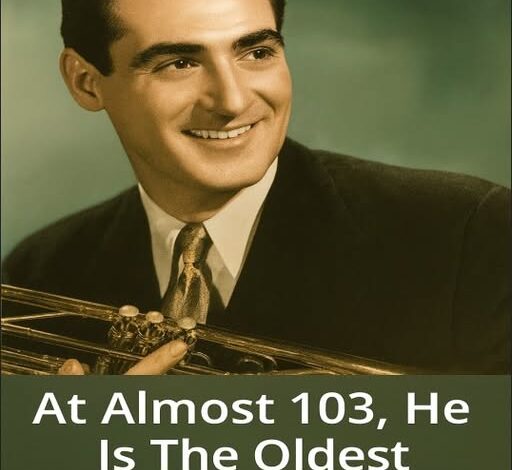
In the glittering, often ephemeral landscape of Hollywood, where stars rise and fall with the speed of a passing trend, the concept of longevity is frequently measured in years or perhaps a single decade of relevance. Yet, there exists a rare echelon of performers whose lives and careers do not merely span years, but entire epochs of human history. These are the centenarian titans of the entertainment industry, the living bridges between the black-and-white elegance of a bygone era and the hyper-digital velocity of the modern world. At the very summit of this prestigious group stands a figure whose name is synonymous with the brassy, bold spirit of American music and the golden age of cinema: Ray Anthony. At nearly 103 years old, Anthony is not just a survivor of a lost world; he is the vibrant, breathing embodiment of an artistic dedication that refuses to dim with the passage of time.
To understand the magnitude of such a life, one must look back at the cultural soil from which these legends grew. The early 20th century was an era defined by raw talent and a rigorous commitment to the craft. There were no shortcuts to fame, no viral moments to catapult an amateur into the spotlight. Instead, there was the grueling circuit of live performances, the smoke-filled jazz clubs, and the massive soundstages of the studio system. Ray Anthony emerged from this crucible as a virtuoso of the trumpet and a visionary bandleader, eventually becoming one of the last surviving links to the Big Band era. His career is a masterclass in adaptation, proving that true creativity is not a finite resource that dries up in old age, but a deepening well that provides more clarity and wisdom as the decades accumulate.
The significance of these long-lived performers extends far beyond their individual filmographies or discographies. They serve as cultural archivists, carrying within them the firsthand memories of the shifts that defined the 20th century. When Ray Anthony performs or makes a public appearance today, he isn’t just a musician; he is a witness to the evolution of the American soul. He saw the transition from radio to television, the birth of rock and roll, the rise of the blockbuster, and the total transformation of how audiences consume art. For the younger generations of performers, seeing a figure like Anthony still engaged and passionate serves as a profound antidote to the “burnout” culture of today. His life argues that the artistic spirit is a lifelong fire, one that can be stoked and maintained through a genuine love for the audience and a relentless curiosity about the medium.
What makes Ray Anthony particularly remarkable among his peers is the sheer vitality he maintains even as he enters his second century of life. Longevity in Hollywood is often accompanied by a quiet withdrawal into privacy, yet Anthony has remained a symbol of perseverance and positivity. His presence in the public eye is a reminder that the “Golden Age” was not just about the clothes or the lighting; it was about an indubitable work ethic and a sense of showmanship that prioritized the joy of the spectator. By continuing to share his insights and his music, he offers a rare glimpse into the technical mastery and social grace that defined his generation. He represents an era where being a “star” meant being a multi-faceted entertainer who could lead an orchestra, command a screen, and charm an audience with effortless sophistication.
The narrative of the aging icon is often framed through the lens of nostalgia, a bittersweet looking back at what once was. However, the story of Ray Anthony and his contemporaries is much more about the “now.” It is about the fact that at 103, the human mind and heart are still capable of producing immense beauty and providing a sense of continuity in a fragmented world. His life serves as a living testament to the health benefits of staying creatively active. Doctors and sociologists have long noted that those who remain engaged with their passions often experience a higher quality of life in their senior years. Anthony is the ultimate proof of this concept. His continued enthusiasm for the trumpet and his appreciation for his fans demonstrate that having a purpose—a reason to pick up an instrument or step in front of a camera—is perhaps the greatest fountain of youth ever discovered.
Furthermore, these legends play a crucial role in preserving the integrity of their art forms. In an age where music is often quantized and corrected by software, the organic, soulful sound of a live big band leader reminds us of the human element in art. Ray Anthony’s contributions to the Great American Songbook are not just relics; they are blueprints for how to evoke emotion through melody and rhythm. By staying active, he ensures that the nuances of his style are not lost to history books but remain a living part of the cultural conversation. He encourages a dialogue between the past and the future, prompting modern musicians to look back at the foundation of their genres to find new inspiration.
The public’s fascination with Anthony’s longevity is also a reflection of our collective hope. In a society that often marginalizes the elderly, the sight of a 103-year-old man radiating such dignity and talent is a powerful subversion of stereotypes. He proves that aging is not a process of disappearing, but a process of becoming more of who you are. His story is one of resilience, having navigated the peaks and valleys of a notoriously fickle industry for over eighty years. He survived the decline of the big bands, the changing tastes of the 1960s, and the total overhaul of the music industry, all while maintaining his identity and his joy.
As we look at the landscape of entertainment today, Ray Anthony stands as a lighthouse. He is a reminder that while technology change, the human need for connection, storytelling, and rhythm remains constant. His legacy is not merely a list of hits or a star on a sidewalk; it is the inspiration he provides to every person who fears the passing of time. He shows us that if you find something you love, and you do it with all your heart, the years will not weight you down—they will lift you up. Ray Anthony is not just a star from the past; he is a beacon for the future, proving that the most beautiful note is often the one held the longest. Through his music and his very existence, he continues to teach us that life, much like a great performance, is not about how quickly you reach the end, but about the grace and passion you bring to every single beat along the way.