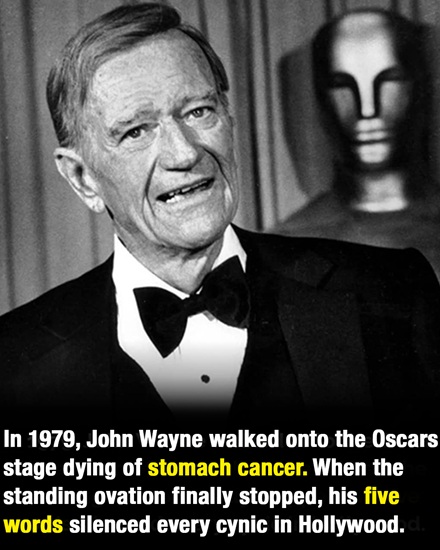
John Wayne’s 1979 Oscars Moment: Five Words That Left Hollywood Speechless
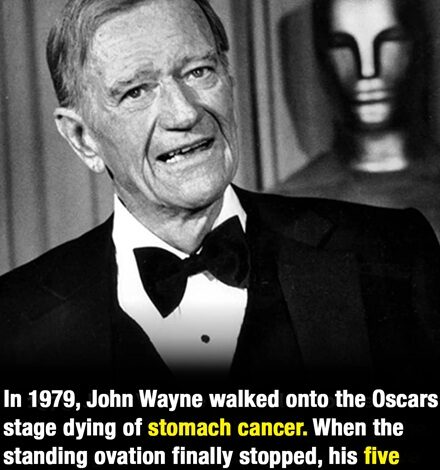
On April 9, 1979, the atmosphere inside the Dorothy Chandler Pavilion carried a weight that went beyond celebration. It was the night of the 51st Academy Awards, an event that usually symbolized glamour, competition, and cinematic achievement. Yet this particular evening felt different. Beneath the bright lights and elegant stage design, there was a quiet awareness that Hollywood was about to witness something historic and deeply emotional. Among the many stars gathered that night, all eyes would eventually turn toward one man whose presence defined an entire era of American cinema.
John Wayne, known globally as “The Duke,” had built a career spanning decades, becoming one of the most recognizable figures in film history. His roles in Westerns and war dramas had shaped public imagination about heroism, strength, and resilience. By 1979, however, Wayne was no longer just a cinematic icon. He was also a man who had endured serious health struggles for many years. His physical condition reflected a long battle with illness, yet his determination to remain visible in Hollywood had never faded.
That night would become a defining moment in how the world remembered him. Only a few months before the ceremony, Wayne underwent surgery that was initially expected to be routine. Doctors were treating gallbladder complications, but during the procedure, they discovered something far more serious. He was diagnosed with stomach cancer, a revelation that dramatically changed the course of his life. The medical team performed an extensive operation in which his entire stomach was removed.
This was not the first time Wayne had faced life-threatening illness. More than a decade earlier, in 1964, he had been diagnosed with lung cancer. At that time, he underwent surgery that removed one lung and several ribs. Despite such a severe procedure, he survived and continued working, demonstrating an extraordinary level of resilience that surprised both fans and colleagues.
Despite his weakened condition in 1979, there was ongoing uncertainty about whether he would attend the Academy Awards. The decision was significant not only personally, but also symbolically. His close friend Bob Hope, who had long been associated with Oscar ceremonies himself, reached out to encourage him to appear, understanding how meaningful his presence would be to Hollywood and audiences worldwide.
Ultimately, Wayne agreed to attend. His arrival at the ceremony became one of the most emotional entrances in Oscar history. As he appeared in the auditorium, the entire audience rose to its feet almost instantly. The standing ovation continued far longer than usual, reflecting both admiration and deep emotional respect for everything he represented.
Observers noted that Wayne appeared physically fragile compared to his earlier years. He was thinner and moved more slowly, but his presence remained powerful. There was still a quiet strength in the way he carried himself, a reminder of the characters he had portrayed throughout his career. Even in illness, he maintained dignity and composure.
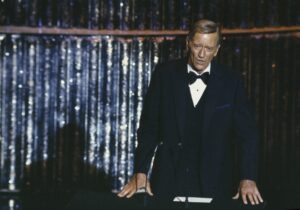
When the applause finally subsided, Wayne stepped forward to speak. His voice was calm and steady, though clearly softened by age and illness. He thanked the audience sincerely, acknowledging their warmth and support. One of his most memorable remarks that night was a simple line about appreciation and life itself, which resonated deeply with everyone present.
The audience responded immediately with renewed applause. Many people in the room were visibly emotional, understanding that they were witnessing not just an award ceremony moment, but a farewell appearance of one of Hollywood’s greatest legends. The atmosphere shifted between celebration, nostalgia, and quiet sadness.
Wayne continued speaking briefly, adding humor in a way that only he could. He reflected on his long career and even made light comparisons between his own history and that of the Academy Awards themselves. This moment brought laughter to the audience, easing the emotional intensity while also highlighting his enduring charisma.
During the ceremony, Wayne also took on the role of presenting the award for Best Picture. The category included several powerful films that reflected the themes of the era, particularly the impact of war and social change. Among the nominees were The Deer Hunter, Coming Home, Midnight Express, An Unmarried Woman, and Heaven Can Wait.
When the envelope was opened, Wayne announced The Deer Hunter as the winner. The announcement marked another historic moment of the night, as the film itself would go on to be remembered as one of the most significant movies of its decade.
After finishing his role on stage, Wayne quietly stepped back from the spotlight. Few people realized at the time that this would be the final public appearance of his life. The moment did not feel like an ending in the traditional sense, but in retrospect, it became one of Hollywood’s most symbolic farewells.
In the weeks following the ceremony, Wayne’s health continued to decline. He was admitted to UCLA Medical Center due to complications affecting his respiratory system. Although he was later discharged, his condition remained fragile and closely monitored by doctors and family.
On May 26, 1979, Wayne’s 72nd birthday was marked by a major honor when he received the Congressional Gold Medal. This recognition reflected not only his film career but also his cultural impact on American identity and cinema history. It was one of the highest civilian awards in the United States.
Just over two weeks later, on June 11, 1979, John Wayne passed away at UCLA Medical Center. His death marked the end of a remarkable chapter in Hollywood history. He had remained active and engaged with life until the very end, even participating in experimental medical treatments in hopes of contributing to future scientific progress.
Following his death, his legacy continued through both film history and philanthropic efforts. His family supported the creation of the John Wayne Cancer Institute, which became dedicated to advancing research and treatment in oncology, ensuring that his name would remain associated with hope and medical progress.
Wayne was laid to rest at Pacific View Memorial Park. His burial site, overlooking the Pacific Ocean, was chosen for its peaceful and private setting. For many years, the exact location of his grave was kept out of public knowledge, reflecting the family’s desire for privacy and respect.
Today, John Wayne’s final appearance at the Academy Awards remains one of the most emotional and remembered moments in Hollywood history. It stands not only as a farewell, but as a reflection of endurance, dignity, and the lasting impact of a man who became a symbol of American cinema for generations.