JIMMIE KIMMEL UNDER FIRE FOR DARK MELANIA TRUMP ROAST AS DONALD DEMANDS IMMEDIATE TERMINATION
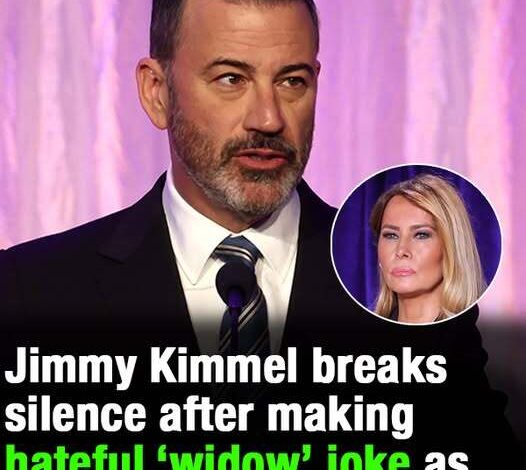
Jimmy Kimmel’s contentious monologue, which sparked a tempest within the Trump camp, has brought late-night comedy and high-stakes political tension to a fever pitch. What started out as a typical satirical poke at the former First Family has turned into a national discussion about the limits of comedy, the accountability of media personalities, and the increasingly hazy distinction between personal cruelty and political commentary. The comedian is at the epicenter of a cultural maelstrom that pushes the boundaries of free expression in a time marked by severe division and increased security concerns, as Donald Trump openly demands Kimmel’s dismissal.
Kimmel’s remark about Melania Trump, notably referring to her as a “expectant widow,” served as the impetus for this heated altercation. The timing and wording struck a chord with many, even though Kimmel’s writers probably saw the line as a remark on the age difference between the former president and his wife—a cliché that has been a mainstay of late-night television for decades. Critics swiftly saw the comment as a dark implication or a sign of extreme insensitivity toward the very real threats of political violence, rather than as a harmless joke given the recent security threats and the unstable environment surrounding the Trump campaign.
After the first backlash, Kimmel broke his quiet and tried to walk a tightrope between maintaining his position and admitting the seriousness of the matter. He responded with a deliberate blend of restrained regret and indignation. He responded directly to the “widow” remark, portraying it as a typical age-gap joke in line with late-night comedy’s irreverent tone. He was adamant that the statement was never meant to be a call to violence or a wish for the former president to suffer. Kimmel used his extensive public record of supporting gun regulation and his repeated denunciations of America’s violent culture to support his case, arguing that his background and temperament should be sufficient to refute any accusations of malevolent intent.
Kimmel’s defense, though, was anything but an apology. Instead of offering a subservient retraction or completely retreating, he turned the discussion back to the former president. Kimmel contended that accountability starts at the top if there is a sincere desire in the US to lower the temperature of political discourse and eradicate hate speech. Kimmel attempted to frame the outcry as a double standard by blaming Donald Trump for his own history of using combative and frequently provocative language. He said that people who have supported the former president’s most hateful remarks for years have no right to demand that a comic be fired over a single offensive joke.
The Trump administration’s response was prompt and unyielding. Donald Trump demanded that ABC fire Kimmel right away on social media and public forums. For Trump’s most fervent fans, the joke was not a singular instance of poor taste but rather the most recent proof of widespread cruelty and media bias against the Trump family. They contended that, considering the state of security today, the “expectant widow” remark was especially offensive. In particular, Melania Trump has had to deal with the fallout from a horrific security breach and rumors that her husband was deliberately targeted for assassination in a manifesto. The joke seemed more like a heartless rejection of a family’s sincere concern for their safety in this setting than comedy.
This conflict has exposed the unsettling truth of contemporary American society, where politics and entertainment are now closely intertwined. Once limited to a late-night monologue, jokes are now quickly shared on social media, where they are politicized, analyzed, and used as weapons in a larger cultural conflict. When comedy enters the digital sphere, its subtlety—which is often dependent on timing, delivery, and a common understanding of hyperbole—is often lost. Millions of others saw what Kimmel saw as a sharp-tongued comment on a public figure’s private life as a deadly provocation.
The discussion also reveals a substantial change in the public’s perception of “just a joke.” The movement to fire Kimmel is seen by his supporters as a risky infringement on free speech and the court jester’s traditional duty. They contend that public people, particularly those as powerful as a former president and first lady, should not be exempt from the most severe types of mocking and that satire is intended to be uncomfortable. They perceive the call for Kimmel’s dismissal as a kind of censorship that aims to purify the media and shield influential people from the examination of humor.
On the other hand, a rising portion of the audience that falls somewhere in the middle of the political spectrum is left feeling more and more uncomfortable. This “nervous audience” questions why humor has undergone such a significant transformation. It’s evident that the stakes have been elevated to the point where humor no longer offers the same cathartic solace. The “harmlessness” of the medium is questioned when jokes deal with possible death or family safety. This group is questioning the societal cost of a media climate that puts viral “burns” ahead of fundamental human sensitivity, but they aren’t necessarily advocating for a ban on comedy.
These personalities’ corporate sponsors are also caught in the conflict. The difficult challenge of striking a balance between artistic freedom, business accountability, and the possibility of advertiser retaliation falls to ABC, the network that hosts Kimmel. One monologue can have a big financial impact in a time of coordinated boycotts and strong social media pressure. The network has to balance the benefits of Kimmel’s well-known brand and excellent ratings against the reputational risk of being linked to remarks that many people in the nation find offensive.
The more general questions are still unresolved when the dust settles on this particular occurrence. Is the defense of satire unassailable, or can a comic ever really “cross the line” in a way that calls for professional termination? Does a political leader’s words justify or excuse their detractors’ harshest criticism? Most importantly, is it possible for a divided country to ever go back to a place where jokes are just that—jokes?
The conflict between Kimmel and Trump is a microcosm of the greater American effort to communicate with each other. It depicts a society in which every platform is a battleground and every utterance is a weapon. The tension between these two worlds does not appear to be abating as Trump continues his campaign for a return to the White House and Kimmel maintains his nightly programs. The “tightrope” that Kimmel walked in his response is the same one that the entire nation is currently walking—a fine line between the obligation to uphold some semblance of civility in an increasingly unstable world and the right to express one’s opinions.
The “expectant widow” joke scandal may eventually disappear from the news, but the damage it causes to society will never go away. It acts as a sobering reminder that the microphone is an extremely important and potent instrument in the present era. Words have the ability to excite, hurt, and divide people, whether they are spoken by a comic behind a desk or a politician on a podium. Determining how to maintain the important tradition of political satire without losing sight of the people behind the headlines will be the task for the future. Up until that point, the audience stays in the middle, anticipating the next joke and speculating as to whether it will be the one that ultimately drives the discussion over the edge.