How One Greedy Son Lost a Billion Dollar Inheritance for Skipping His Fathers Funeral
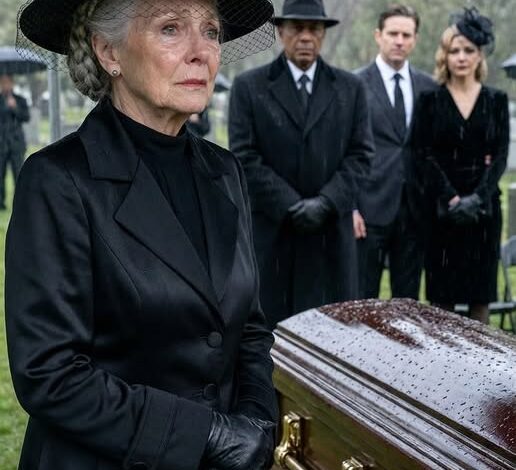
On the day of Richard’s funeral, the rain that fell over the Mitchell estate was a steady, repetitive beating that seemed to mark the end of an era rather than a soft mist. A giant of business, Richard Mitchell used a single folding table and an unwavering work ethic to create a global logistics empire. Hundreds of people gathered under a sea of black umbrellas to pay their respects, including dockworkers who loaded his ships and powerful CEOs. Expecting to see the Mitchell dynasty standing together in sorrow, they all turned to face the front row.
Rather, they noticed Eleanor Mitchell standing by herself. A lone, empty mahogany chair stood next to her, a silent reminder that her only son, Thomas, was no longer with her. Thomas was three thousand miles away in Aspen, clinking sparkling glasses of vintage champagne at a celebrity birthday party, while the world grieved for a visionary. For Thomas, the passing of his father was just a bureaucratic step, the last obstacle before he took the crown and the billions that accompanied it. He was sure that his ancestry would protect his future, so he saw the funeral as a pointless formality he could afford to forego.
The mist of maternal protection lifted for the first time in thirty years as Eleanor gazed at the vacant chair. She recalled Richard’s last words of wisdom, “Do what’s right, not what’s easy,” as well as his last gasping breath. She assumed he was referring to the business at the time. She realized he was referring to their son as she stood in the mud while the coffin was lowered.
The oak-paneled law offices were cold the next morning. Wearing a suit that cost more than the majority of his father’s employees made in a year, Thomas arrived late. Instead of giving his mother a hug, he looked at his watch. He was prepared to sign the documents, dissolve the philanthropic foundations he regarded as “dead weight,” and start his rule.
The family lawyer, who had worked with Richard for many years, cleared his throat. The normal succession documents were not what he reached for. Rather, he produced a blue folder that was sealed. He started reading a particular, unchangeable clause that Richard had added just weeks before his death. It was a “Character Contingency.” According to the provision, Eleanor Mitchell alone had the authority to bestow the major inheritance, which was a privilege rather than a right. She had the complete authority to reroute every penny if she thought Thomas’s actions were unworthy of the Mitchell legacy.
Thomas let out a dry, haughty laugh. He anticipated Eleanor’s customary gentle smile and the unavoidable forgiveness he had taken advantage of since he was a young child. Eleanor, however, had flint-like eyes. She was staring at the guy who had allowed his father to die by himself, not at the son she had spoiled.
The stillness in the room felt like a physical weight when the lawyer inquired if she wanted to use the clause. Eleanor said, “Yes,” and it struck Thomas like a physical blow.
The golden parachute disappeared in an instant. With surgical precision, the Mitchell enterprise was divided. For the benefit of the workers and the foundation’s long-term goals, the majority stake in the business was transferred into a trust. For Thomas’s estranged daughter Charlotte, a sizable educational fund was set up to safeguard her future from her father’s possible carelessness. Eleanor kept the family house and enough money to live well, but Thomas lost the billions he had already imagined spending.
Two things remained for Thomas: a box of leather-bound volumes on ethics and moral philosophy and his father’s original, worn-out folding table.
The repercussions were severe and swift. Driven by a sense of cosmic injustice and anger, Thomas filed a lawsuit against his own mother. Claiming that she was mentally ill and suffering from “grief-induced hysteria,” he dragged her through the gutter in the tabloids. He anticipated that everyone would support the successor, but Richard had been a visionary. A number of video logs were made public during the trial’s discovery phase. In them, a tired but composed Richard addressed the camera directly, detailing years of Thomas’s unethical behavior, abuse of employees, and complete lack of empathy. The videos were Richard’s way of acknowledging that his optimism had been misplaced; he had not been blind.
In addition to failing, the court battle destroyed Thomas’s residual social capital. His “friends” stopped phoning when the money stopped coming in. Within months, his wife, Victoria, who had wed a financial account instead of a man, sought for divorce. Alone in a chilly apartment, he stared at a scratched folding table that symbolized the modest beginnings he had always been too ashamed to recognize.
Eventually, the heavy weight of truth replaced the humiliation. Thomas Mitchell was unknown for the first time in his life. He had no one to save him, no rank, and no leverage. Before he eventually opened the journal his mother had sent him along with his father’s personal belongings, he lived for a year in a fog of resentment. It wasn’t an accounting ledger. There were thousands of names in the journal. It was a list of everyone Richard had assisted, every worker who had experienced a crisis, and the little aspects of their lives that Richard had thought were more significant than profit margins.
While his father had spent his life attempting to be a neighbor, Thomas came to the realization that he had spent his entire life striving to be a king.
Thomas went back to his mother, motivated by a combination of humiliation and a desperate desire for a foundation. He didn’t make a financial request. He requested a position at the Mitchell Foundation’s lowest level. Eleanor kept a tight eye on him. Instead of giving him an office, she sent him to the community centers and docks with a clipboard.
The change was excruciating. Men who recalled his haughtiness made fun of him. He was compelled to offer an apology to those he had previously viewed as “units” of production. He became familiar with the forklift drivers’ names. He used to ignore people’s issues, but now he sat in drafty basements and listened to them. For the first time, the sleep he found at night was earned, even though he spent three years earning a small portion of what he used to spend on a single dinner.
His salvation wasn’t a dramatic montage or an epiphany. His old skin was being slowly and painfully shed. simply attending his daughter Charlotte’s recitals and being a real father, rather than simply purchasing items for her, he was able to mend his bond with her.
Years later, Thomas was on stage for the Mitchell Foundation’s new wing dedication. As the building’s owner, he wasn’t present. As the primary coordinator, he was present. He didn’t discuss market domination or growth forecasts when he spoke. He mentioned his little apartment’s folding table.
“My father didn’t leave me an empire,” Thomas stated to the assembly, his voice full of maturity that he had worked hard to achieve. “He gave me the chance to develop into a man who deserved one.”
Seated in the front row, Eleanor observed her son’s transformation into a man. At that moment, she understood that Richard’s last present to their son had been the battle he had put upon him rather than the money he had given away. In order to ultimately start a legacy, the inheritance had been removed.