Canada rocked by the deadliest school shooting in 40 years as a woman in a dress opens fire!
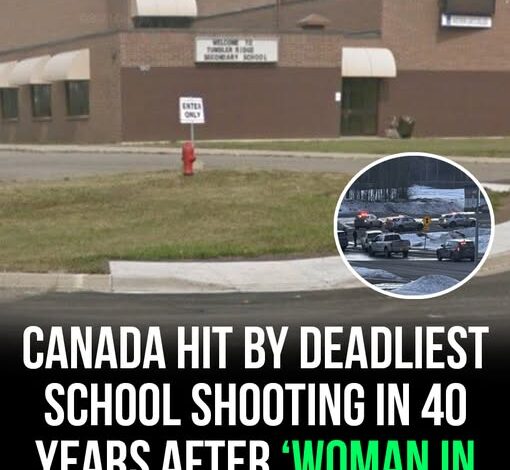
Canada is grieving after a devastating shooting in the remote town of Tumbler Ridge, British Columbia, where authorities say nine people were killed and at least 25 others were injured in attacks that struck a secondary school and a nearby home.
The violence unfolded over the course of Tuesday, February 10, shattering a community of roughly 2,400 residents nestled in the Rocky Mountain foothills about 415 miles north of Vancouver and close to the Alberta border. In a place where most people recognize one another by name, the scale of the tragedy has left families, students, and first responders reeling.
Police say the first and most severe scene was inside Tumbler Ridge Secondary School, a small campus with about 175 students. Officers responding to reports of an active shooter entered the building to locate and stop the threat. During that search, they discovered multiple victims. Six people were found dead inside the school, according to authorities, and a seventh victim later died while being transported to the hospital.
Investigators also located the suspected shooter at the school. Officials said the person was found deceased and appeared to have suffered a self-inflicted injury. Canadian federal police Chief Superintendent Ken Floyd stated that the individual found at the school matched the description included in an alert that had been sent to residents earlier in the day.
That alert described the suspect as a “female in a dress with brown hair.” While authorities indicated they believe they know who the attacker was, they have not publicly released the suspect’s identity or explained what connection, if any, the person may have had to the school. Police also have not yet disclosed details about the weapon used.
The attacks were not limited to the school. Authorities say two additional victims were found dead at a nearby residence that investigators believe is connected to the events at the school. Police have not released further information about that location or the relationship between the residence and the violence, noting that the investigation remains ongoing.
For students trapped inside the school, the experience was terrifying and surreal. One Grade 12 student told CBC that classmates acted quickly to protect themselves, moving tables and barricading doors in an effort to stay safe. “It felt like I was somewhere that I had only seen across a TV,” the student said, capturing the disbelief that often follows violence in places that feel insulated from it.
Law enforcement officials have been careful in their public statements, emphasizing both the gravity of the situation and the uncertainty that still surrounds key questions. Chief Superintendent Floyd acknowledged that determining the motive may be difficult. “I think we will struggle to determine the ‘why,’ but we will try our best to determine what transpired,” he said during a virtual news conference. “We are not in a place to understand why or what may have motivated this tragedy.”
In its own statement describing the initial response, the RCMP said officers entered the school to locate the threat and found multiple victims during their search. The statement added that an individual believed to be the shooter was also found dead with what appeared to be a self-inflicted injury. Officials have not announced any additional suspects.
The tragedy quickly drew national attention, with leaders across Canada offering condolences and support. Prime Minister Mark Carney called the incident “horrific” and said he was devastated by the shootings. He offered prayers and extended sympathies to the families and friends who lost loved ones, describing the acts as a profound and painful shock.
British Columbia Premier David Eby also addressed the shooting, calling it an “unimaginable tragedy.” He urged people across the province to support Tumbler Ridge in the aftermath and to keep the community in their thoughts as residents face the first days of grief and uncertainty.
In the immediate aftermath, the focus has been on safety, emergency care, and stabilizing a community in crisis. Officials said roughly 100 students and staff were evacuated from the school. The secondary school, along with the town’s elementary school and a local college, remained closed for the rest of the week as investigators worked the scenes and the town tried to absorb what had happened.
While the investigation continues, authorities have not yet released the names of the victims. That silence is typical in the early stages of a major incident, as officials work to notify families and confirm identities. Still, it leaves the public with a grim set of numbers and a long list of unanswered questions, even as the community mourns the people behind those figures.
Mass shootings are comparatively rare in Canada, but the country has endured notable tragedies in the past. The article points to two landmark events frequently referenced in national discussions about gun violence: the 1989 Montreal mass shooting, where 14 people were killed, and the 2020 rampage in Nova Scotia, in which 22 people died. In the years following those attacks, Canada introduced stricter gun control measures, including steps aimed at restricting and buying back certain military-style firearms.
Against that history, the killings in Tumbler Ridge are being described as among the deadliest shootings in the country’s modern era. The sense of shock is amplified by the town’s size and isolation. Tumbler Ridge was founded as a coal-mining community, surrounded by vast stretches of wilderness. It is not the kind of place most Canadians associate with large-scale violence, which is part of what has made the events feel so destabilizing to residents and observers alike.
As investigators work to reconstruct the timeline, they are likely to focus on what happened inside the school, how the suspect moved, and whether there were warning signs that could have been recognized earlier. Officials have indicated that pinning down motive may be difficult, but they have also stressed their commitment to understanding what occurred and to communicating verified information when appropriate.
For now, the community is left with grief, fear, and the slow process of trying to make sense of the senseless. Parents are facing the unthinkable. Students are carrying memories no teenager should have to hold. First responders are returning home from scenes that will not be easily forgotten. And a small town, built to withstand harsh winters and remote living, is now confronting a different kind of devastation—one that leaves scars long after the headlines fade.