Teen Receives 452-Year Sentence in Case That Sparks Debate About Justice and Consequences
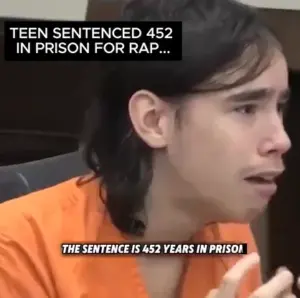
A teenager walked into a courtroom and left with a sentence that seemed almost impossible to comprehend: 452 years in prison. The number alone created a shockwave that spread far beyond the courtroom walls. It was not just a legal outcome; it was a symbol of how extreme justice can appear when measured in human time. For many people hearing about the case, it felt less like a sentence and more like a permanent ending. Inside the courtroom, the atmosphere was heavy and divided.
Families of victims sat with grief that had already changed their lives long before the verdict was read. For them, the sentence represented recognition of the harm they had endured. It was a moment that said their suffering had been seen, recorded, and judged with full seriousness. Some wept quietly, feeling a painful sense of closure mixed with exhaustion. On the other side of the room, however, was another family experiencing a different kind of collapse.
The teenager’s parents watched as their child was transformed from a person into a number that seemed too large to belong to a single human life. To them, it was not only a legal outcome but the end of every imagined future. The courtroom became a place where two forms of grief existed at the same time, both real, both overwhelming, yet completely different in nature.
The case itself became a focal point for broader questions about justice and punishment. People outside the courtroom began debating what it truly means to hold someone accountable. The teenager’s actions, though not described in detail publicly in every report, had clearly caused significant harm. The legal system responded with one of the harshest cumulative sentences possible under the law, reflecting the seriousness of multiple charges considered together.
For supporters of the verdict, the sentence represented protection, accountability, and closure. They argued that justice must be strong enough to reflect the impact of harm on victims and society. In their view, the length of the sentence was not about the literal time to be served, but about the symbolic weight of each individual offense being acknowledged separately and seriously.
Yet for critics, the sentence raised uncomfortable moral questions. A number like 452 years removes any realistic possibility of release within a human lifetime. That reality led some to question whether justice had shifted from accountability toward something more final and absolute. They asked whether a system designed to correct behavior should also include the possibility of rehabilitation, especially when dealing with someone so young at the time of sentencing.
The tension in public reaction reflected a deeper divide in how societies understand punishment. One perspective focuses primarily on consequences and deterrence, emphasizing that actions must have proportional outcomes. The other perspective emphasizes transformation, arguing that even serious wrongdoing committed in youth should not automatically eliminate the possibility of change over time.
What made this case particularly emotionally charged was the age of the defendant. The idea of a teenager receiving a sentence that effectively spans centuries creates a psychological conflict for many observers. It forces people to confront the difference between legal responsibility and human development. Adolescence is widely recognized as a period of incomplete emotional and cognitive maturity, which complicates how responsibility is understood.
At the same time, the harm experienced by victims and their families cannot be separated from the legal response. Their lives were altered in irreversible ways, and the justice system is often the only structured avenue available to acknowledge that pain. For them, the sentence was not abstract. It was a form of recognition that what happened mattered deeply and would not be dismissed or minimized.
This dual reality is what makes cases like this so difficult for society to process. On one side, there is a demand for accountability that reflects the severity of harm. On the other side, there is an awareness that human beings, especially young ones, are capable of change over time under different circumstances. These two truths exist simultaneously, yet often pull in opposite directions.
Legal experts often explain that sentences of extreme length like this are typically the result of multiple charges stacked together, each carrying its own penalty. When combined, they can produce numbers that exceed a normal human lifespan. While symbolically powerful, such sentences also raise ongoing debates about sentencing reform and proportionality within justice systems.
Outside legal discussions, the case became a subject of intense emotional reaction in communities and online spaces. Some people viewed the sentence as necessary, believing it reinforced boundaries that should never be crossed. Others saw it as evidence that the system prioritizes punishment over rehabilitation, especially for younger offenders whose lives are still in formation.
The emotional weight of the number itself cannot be ignored. “452 years” is not a practical timeframe. It is a statement of permanence. It communicates that the actions committed were so severe that they are treated as extending beyond a normal human lifespan. For some, this feels like justice speaking clearly. For others, it feels like hope being removed entirely.
Yet even in the harshness of the sentence, broader philosophical questions remain unresolved. What is the purpose of punishment: retribution, deterrence, protection, or rehabilitation? Can a justice system fully serve all of these goals at once, or must it prioritize some over others in cases of extreme harm?
There is also the question of identity over time. A teenager at the time of sentencing is not the same person decades later. Psychological development, reflection, and potential rehabilitation complicate the idea that a single moment defines an entire life. However, this perspective must still be balanced against the enduring impact on victims, whose losses do not change over time.
In the end, the case continues to divide opinion because it sits at the intersection of law, morality, and human emotion. It is not only about what was done, but about how society chooses to respond when harm is severe and the offender is young. It forces people to confront uncomfortable truths about justice: that it must protect, but also that it must decide whether any path back is still possible.
The number remains difficult to process.
452 years.
For some, it represents justice fulfilled.
For others, it represents a life that may never be allowed to begin again.