The Mind Blowing Secret History Behind Hidden Bow And Arrow Marks Stamped On Dollar Bills
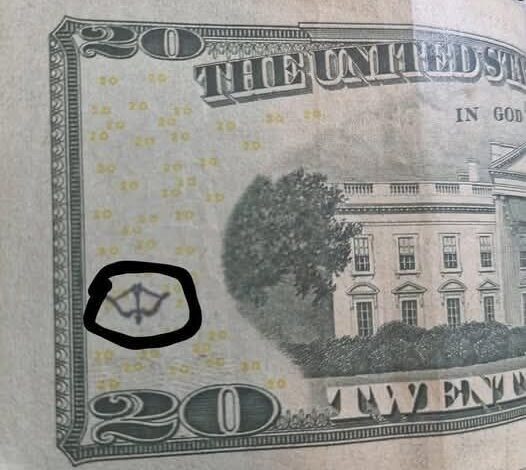
A tiny, unknown symbol, an odd ink stamp, or an abstract shape that obviously does not belong to the official government design may have caught your attention if you have ever taken the time to closely inspect a crisp US dollar bill under a strong light. These strange symbols, which frequently resemble small stars, tiny bows and arrows, or intricate foreign characters subtly etched into the paper money’s edge, have been discovered by numerous individuals nationwide. Finding one of these illegal symbols can initially seem incredibly enigmatic, even unnerving, as though the particular piece of paper money is concealing a sinister, underground plot or carrying a coded message.
The intriguing truth underlying these mysterious symbols is not at all like a covert government conspiracy or casual vandalism. Rather, these ink shapes are referred to as chop marks in international financial circles. These are small, intentional signatures that are applied directly to paper money by independent currency handlers working in far-off foreign marketplaces, professional money changers, high-volume merchants, and international banking organizations. A US dollar bill often ends up in areas where counterfeit money is an extremely sophisticated and widespread menace when it leaves American territory and enters international circulation. Visual and tactile verification is crucial for survival in these rapidly evolving global marketplaces.
When a skilled foreign money changer receives a $100 or $20 bill, they subject the paper to a rigorous verification procedure, examining the security threads, watermarks, and texture. They apply their own distinctive ink stamp, such a geometric crest or a bow and arrow, on the note’s face once they are very certain that it is 100% authentic. This stamp is a subtle, long-lasting sign of complete approbation. It confirms that the bill has already been carefully examined and determined to be completely real by a reliable expert, sending a clear message to the next retailer or bank teller handling the money. In busy global marketplaces where high-stakes transactions happen every second, this straightforward system significantly lowers financial risk and saves enormous amounts of time.
In fact, the intriguing custom of using chop marks predates the invention of contemporary paper money by several centuries. Silver coins, bullion, and foreign trade dollars were frequently exchanged by traders along ancient trade routes, especially in China and East Asia, where the practice first emerged. After confirming the weight and chemical purity of a silver coin, a merchant would punch a distinct physical mark or character right into the metal’s surface to make sure it hadn’t been covertly hollowed out, shaved around the edges, or diluted with inexpensive base metals. The word “chop,” which denotes an official seal, stamp, or mark of legitimacy, is derived from this ancient trading language. This deeply rooted practice of physical verification easily transferred to paper money as international trade quickly grew and paper banknotes progressively supplanted heavy metal coins as the main means of exchange.
The US dollar became the most commonly stamped and marked currency in human history because it has long served as the unofficial global reserve currency, accepted and actively exchanged in almost every region of the world. Before returning to a bank in the United States, a single dollar bill may travel for years through a variety of underground economies, upscale foreign exchange kiosks, and rural marketplaces throughout South America, Asia, Africa, and the Middle East. Every single chop mark imprinted on the paper signifies a distinct turning point in the bill’s remarkable journey. It captures a particular point in time when that particular piece of paper money successfully navigated a complex system of human trust based on firsthand knowledge rather than contemporary scanning devices, passed through another foreign economy, and changed hands in a different society.
The legality of circulating these strongly marked bills back home in the United States is often called into doubt by this worldwide practice. Standard chop marks do not violate federal law, which forbids defacement of US cash to the extent that it is clearly distorted, separated, or rendered entirely useless. These microscopic ink stamps do not invalidate the cash as legal tender because they do not change the official denomination of the bill, obfuscate the crucial serial numbers, or jeopardize the fundamental security characteristics. The measure maintains its exact face value and is still fully supported by the US government.
However, habitual customers may occasionally have a few little, daily problems when holding a strongly stamped banknote. Electronic parking meters, grocery store self-checkout kiosks, and automated vending machines are all extremely sensitive to unexpected ink patterns and may repeatedly reject a chopped bill because the optical sensors interpret the unusual mark as a printing error or a possible red flag for counterfeit goods. Additionally, some extremely careful bank tellers or local retail clerks who are completely ignorant of the global history of chop marks may examine the bill more closely or ask for a different method of payment just out of caution.
These peculiar markings do not diminish the money’s actual value despite these sporadic grounds of contention. Rather, they imbue a piece of ordinary paper with an invisible, extraordinarily rich layer of world history. Finding a bow and arrow stamp transforms a plain, uninteresting dollar note into an experienced, silent traveler who has successfully traversed international boundaries, weathered unstable foreign markets, and bridged disparate cultural and financial systems. It transforms a basic tool of trade into an intriguing historical artifact that you can hold in the palm of your hand by carrying tangible, indisputable documentation of its exact location and how it gained the trust of strangers half a globe away.